Best Digital Marketing Strategies 2026
Digital marketing in 2026 feels crowded, automated, and expensive. Everyone has AI tools, ad platforms are pushing automation, search results are changing, and buyers compare you across Google, YouTube, TikTok, Instagram, Reddit, email, and AI answer engines before they ever speak to your team.
That is why this guide breaks down the best digital marketing strategies 2026 for businesses that want measurable growth, not random activity. You will learn how to build a practical system for search visibility, AI-assisted content, paid ads, email, social search, chatbots, conversion tracking, and long-term brand trust.
Featured Snippet: What Are the Best Digital Marketing Strategies for 2026?
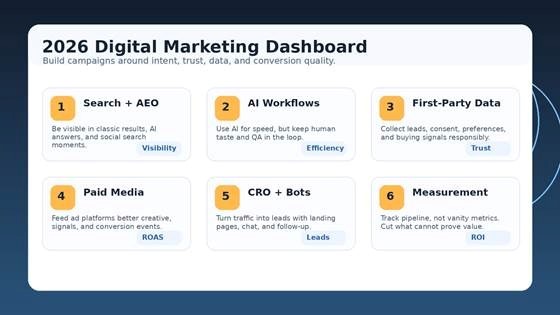
The best digital marketing strategies 2026 combine AI-assisted workflows, people-first SEO, answer engine optimization, short-form video, first-party data, paid media testing, email automation, chatbot lead capture, conversion rate optimization, and privacy-first measurement. The winning formula is simple: attract qualified intent, build trust quickly, and track revenue quality.
Digital marketing analytics dashboard for 2026 strategy
Essential Tools & Materials Breakdown
A strong digital marketing system needs tools, but tools do not create strategy by themselves. Start with the minimum stack that lets you publish, track, test, and follow up without wasting budget.
| Tool or Material | Best Use | Estimated Monthly Cost | Skill Level | What to Check Before Buying |
| Google Analytics 4 | Website behavior, events, funnel tracking | Free | Intermediate | Confirm key events, forms, calls, and purchases are tracked correctly. |
| Google Search Console | Search queries, indexing, technical SEO checks | Free | Beginner | Review clicks, impressions, pages, and indexing warnings weekly. |
| CRM System | Lead storage, pipeline stages, source reporting | Free-$100+ | Intermediate | Choose one your sales team will actually update. |
| Email Marketing Platform | Welcome flows, nurture campaigns, newsletters | $0-$150+ | Beginner | Check automation, segmentation, deliverability, and forms. |
| Consent Management Platform | Cookie consent and privacy controls | $0-$50+ | Intermediate | Make sure it integrates with tags and consent settings. |
| Google Ads / Meta Ads | Paid acquisition and retargeting | Flexible spend | Intermediate | Track qualified conversions, not only clicks and form fills. |
| SEO / Keyword Tool | Research demand, competitors, and content gaps | $0-$150+ | Intermediate | Use it for decisions, not vanity volume screenshots. |
| AI Writing and Research Tools | Drafting, summarizing, content briefs, repurposing | $0-$30+ | Beginner | Build human review into every workflow. |
| Design / Video Tool | Social posts, reels, thumbnails, ad creatives | $0-$30+ | Beginner | Choose templates that speed production without making you generic. |
| Chatbot / Live Chat | Lead capture, FAQs, appointment routing | $0-$100+ | Intermediate | Connect it to CRM and human handoff. |
| Dashboard Tool | Reporting for owners and managers | $0-$100+ | Advanced | Report revenue, lead quality, and campaign decisions. |
MyFlexBots Rule: do not buy a tool until you define the decision it will help you make. A dashboard that does not change budget, content, targeting, or sales follow-up is decoration.
Build the Strategy Around Buyer Intent, Not Platforms
Most businesses start with the wrong question: “Should we post on TikTok, run Google Ads, or write blogs?” The better question is, “Where does my buyer show intent, and what proof do they need before they trust me?”
A 2026 strategy should map the full path from curiosity to purchase. That path often includes search, social proof, video, reviews, email, website comparison, and direct conversation.
Create a Buyer Intent Map
Break your market into four intent levels:
- Problem-aware: The buyer knows the pain but not the solution. Example: “Why are my leads low?”
- Solution-aware: The buyer is comparing approaches. Example: “SEO vs Google Ads for small business.”
- Provider-aware: The buyer is comparing vendors. Example: “best digital marketing agency near me.”
- Decision-ready: The buyer wants price, demo, consultation, quote, or implementation.
Your content and campaigns should cover all four stages. If you only target bottom-funnel traffic, clicks are expensive. If you only publish educational content, you may get traffic that never buys.
💡 Quick Hack: Open your CRM or WhatsApp chats and copy the last 30 real questions prospects asked. Turn those into blog sections, video hooks, FAQ answers, ad copy, and chatbot prompts. Real buyer language usually beats keyword tools.
Choose Channels by Job, Not Trend
Every channel should have a clear role:
- SEO: capture ongoing demand and build authority.
- Answer engine optimization: help AI systems cite or summarize your brand accurately.
- Google Ads: capture high-intent demand quickly.
- Meta/TikTok/YouTube: create awareness, proof, retargeting pools, and social search discovery.
- Email: convert attention into repeat contact.
- Chatbot/live chat: reduce friction when visitors have questions.
- CRM: turn marketing data into sales decisions.
The best digital marketing strategies 2026 do not chase every platform. They assign a job to each channel, then remove anything that cannot support the buyer journey.
Win Search in Google, Social Platforms, and AI Answers
Search is no longer only ten blue links. In 2026, people search on Google, YouTube, TikTok, Instagram, Pinterest, Reddit, marketplaces, maps, and AI tools. Your brand needs structured answers, real experience, and proof signals across the places buyers check.
Google’s own Search Central guidance emphasizes helpful, reliable, people-first content instead of content built only to manipulate rankings. Use the Google Search Central people-first content guide as the quality filter for every serious article.
Build Content Around Problems, Comparisons, and Decisions
For SEO and AEO, prioritize content formats that answer real commercial questions:
- “Best tools for…” guides
- Comparison pages
- Pricing explainers
- Step-by-step tutorials
- Mistakes and troubleshooting guides
- Alternatives pages
- Case studies
- FAQs with concise answers
- Glossary pages for complex terms
Each page should have one primary intent. Do not stuff five unrelated topics into one post just to make it longer. Long content works when depth helps the buyer make a decision.
Optimize for Answer Engines
Answer engines pull from pages that are easy to parse. That means your article should include direct answers, tables, bullets, definitions, and original evidence.
Use this on-page structure:
- A clear H1 that matches the topic.
- A 40-50 word direct answer near the top.
- Descriptive H2s written like search questions.
- Short paragraphs with one idea each.
- Comparison tables where buyers need choices.
- First-hand examples, screenshots, results, and limitations.
- Author or brand experience where relevant.
Pro-Tip: Add a “Decision Guide” table to every commercial article. AI systems and human readers both prefer clean comparisons over vague paragraphs.
Refresh Existing Pages Before Publishing More
Most websites already have content that could perform better with updates. Before writing 20 new posts, audit your top pages.
Check:
- Is the title current for 2026?
- Does the intro answer the search intent quickly?
- Are old screenshots, prices, tools, or platform names outdated?
- Does the page include original experience?
- Does it link to relevant internal content?
- Does it have a clear CTA?
- Does it rank but fail to convert?
Updating old pages is often cheaper than creating new ones. It also sends freshness signals when the update is meaningful.
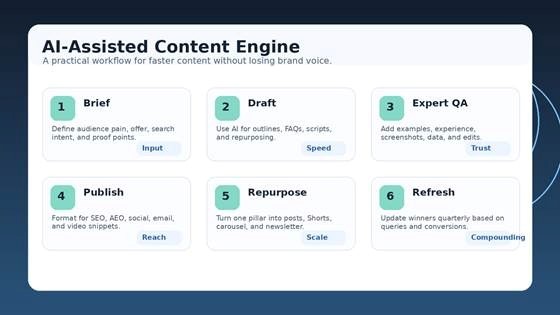
Build an AI-Assisted Content Engine Without Losing Trust
AI is no longer a novelty in marketing. HubSpot’s 2026 State of Marketing page frames AI as a baseline, not the differentiator, and highlights the importance of brand point of view and human-led marketing in crowded markets.
That is the important lesson: AI can speed production, but it cannot replace judgment, taste, customer insight, or proof.
AI-assisted content marketing workflow for marketers
Use AI for the Right Tasks
AI is excellent for:
- Turning customer questions into outlines.
- Summarizing long research.
- Creating first-draft email flows.
- Generating variations of ad copy.
- Repurposing a blog into social captions.
- Finding missing FAQ angles.
- Creating content briefs for writers.
- Drafting chatbot responses.
- Classifying leads by intent.
AI is weaker when you ask it to invent expertise. It can sound confident while producing generic advice. That is why every AI-assisted workflow needs expert review.
Use the 70/20/10 Content System
A practical content calendar for 2026 should not be random. Use this split:
- 70% evergreen education: tutorials, comparisons, FAQs, pillar guides.
- 20% proof and trust: case studies, testimonials, behind-the-scenes, demos.
- 10% trend response: current platform changes, news, experiments, hot takes.
This balance helps you build long-term search value while still staying relevant.
💡 Quick Hack: Create one pillar guide per month, then turn it into 8 social posts, 3 short videos, 1 email newsletter, 1 LinkedIn post, 1 Pinterest pin, and 5 FAQ snippets. One strong idea should become a content asset system, not one lonely blog post.
Add a Brand Point of View
In 2026, generic content is invisible. A brand point of view makes your content memorable.
Examples:
- “We believe small businesses should track lead quality before increasing ad spend.”
- “We do not recommend publishing AI content without expert editing.”
- “We believe a simple CRM beats a complex funnel nobody uses.”
- “We prefer fewer channels with stronger execution.”
The best digital marketing strategies 2026 include a clear opinion because buyers are tired of recycled information. They want a guide who can tell them what to do, what to avoid, and why.
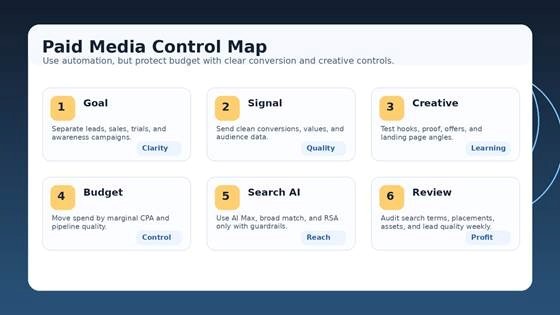
Use Paid Media as a Testing Engine, Not a Money Burner
Paid ads are powerful, but automation can hide waste if your tracking and offers are weak. In 2026, the winning paid media team feeds platforms better inputs and reviews output with discipline.
Google’s 2026 marketing updates highlight AI-powered Search, YouTube, measurement, commerce, creative, and agentic tools. The practical takeaway is simple: platforms want more automation, but advertisers still need clear conversion goals, budget guardrails, and creative testing.
For Search specifically, Google explains in its Google Ads Help article on AI Max that AI Max uses search term matching and asset optimization to expand reach and tailor creative. That can help performance, but it also makes landing page quality, conversion tracking, brand controls, and search-term review more important.
Paid media strategy map for AI search ads and creative testing
Set the Correct Conversion Goal
Do not optimize every campaign for cheap leads. Cheap leads can become expensive when sales time, poor fit, fake submissions, and low close rates are included.
Track deeper actions when possible:
- Qualified lead
- Booked call
- Sales accepted lead
- Proposal sent
- Closed sale
- Repeat purchase
- Customer lifetime value
If the ad platform only sees form submissions, it may optimize toward people who submit forms easily, not people who buy.
Build a Creative Testing Matrix
Every ad test should isolate one major variable:
| Test Area | Example Variation | What You Learn |
| Hook | “Stop wasting ad spend” vs “Get more qualified leads” | Which pain creates attention. |
| Proof | Case study vs testimonial vs data point | What builds trust fastest. |
| Offer | Free audit vs demo vs checklist | What lowers friction. |
| Audience | Retargeting vs lookalike vs keyword intent | Where qualified demand comes from. |
| Landing Page | Short form vs long form vs comparison page | Which page converts quality traffic. |
💡 Quick Hack: Before increasing ad budget, rewrite the landing page headline to match the highest-intent ad group. A message-match improvement can lift conversion without spending another rupee or dollar.
Budget Rules That Protect Profit
Use these rules to avoid emotional spending:
- Give each test enough budget to learn, but cap it before it damages cash flow.
- Review lead quality, not only cost per lead.
- Pause ads that attract the wrong audience even if clicks are cheap.
- Move budget toward campaigns that create pipeline.
- Keep a small testing budget active every month.
- Refresh creative before frequency fatigue kills performance.
The best digital marketing strategies 2026 treat paid media as a controlled experiment. You are not buying clicks. You are buying learning, demand capture, and profitable customer acquisition.
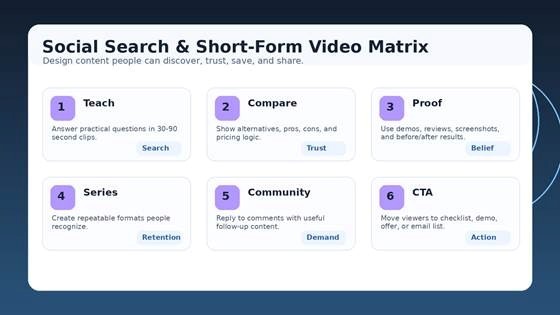
Treat Social Media as Search, Trust, and Community
Social media is not only entertainment. In 2026, it is a discovery engine, review engine, customer service channel, and brand trust signal.
Sprout Social’s 2026 social data reports that traditional search remains important, but social search is especially strong for topics where people want personal experiences and honest reviews. It also highlights that consumers expect brands to respond quickly during crises and that video continues to dominate social behavior.
Social search and short-form video content matrix
Build Content for Searchable Social Moments
Instead of posting random graphics, build posts around searchable questions:
- “How to choose…”
- “Best tools for…”
- “Mistakes to avoid…”
- “X vs Y…”
- “Before you buy…”
- “How much does it cost…”
- “What nobody tells you about…”
Use the phrase a real person would type or speak. Put the topic in the first line, caption, on-screen text, and file name where possible.
Use Serialized Content
Series make your brand easier to remember. A one-off post disappears. A repeated format trains people to come back.
Examples:
- “1-Minute Marketing Fix”
- “Ad Spend Audit Friday”
- “AI Tool Test of the Week”
- “Landing Page Tear-Down”
- “SEO Mistake Monday”
- “Small Business Growth Hack”
Pro-Tip: A simple recurring series is easier to produce than a completely new idea every day. It also gives your team a format they can improve over time.
Combine Human Face With Useful Proof
The rise of AI-generated content makes human proof more valuable. Use founder videos, team walkthroughs, customer clips, screen recordings, behind-the-scenes processes, and honest lessons from campaigns.
Do not only say, “We help businesses grow.” Show the dashboard, explain the problem, reveal the fix, and tell viewers what changed.
Build First-Party Data, Email, and CRM Follow-Up
Traffic without follow-up is waste. The buyer who is not ready today may be ready in 30 days, but only if you have a way to continue the conversation.
First-party data includes information people share directly with you: email, phone number, form details, preferences, purchase history, quiz responses, chatbot conversations, and CRM notes. This data is more valuable when privacy rules, cookie limits, and AI-driven browsing reduce visibility. In practical terms, this is where the best digital marketing strategies 2026 become operational instead of theoretical.
Google’s consent mode setup guide explains how consent settings can control data collection for advertising and analytics purposes. Even if your business is small, you need a respectful approach to consent, tracking, and customer data.
Create Lead Magnets With Commercial Intent
Do not create generic freebies just to collect emails. Create resources that reveal buying intent.
Good examples:
- Digital marketing budget calculator
- SEO audit checklist
- Website conversion checklist
- Google Ads waste calculator
- AI tools comparison sheet
- Content calendar template
- Email nurture swipe file
- Local SEO checklist
A person who downloads a pricing calculator or audit checklist is often closer to buying than a person who downloads a broad inspiration guide.
Build a 7-Day Nurture Flow
A basic email flow can outperform random newsletters.
Use this structure:
- Email 1: Deliver the resource and set expectations.
- Email 2: Explain the common mistake your audience makes.
- Email 3: Share a practical checklist or framework.
- Email 4: Show proof, case study, or example.
- Email 5: Handle objections.
- Email 6: Offer a call, demo, audit, or consultation.
- Email 7: Give a final helpful tip and soft CTA.
💡 Quick Hack: Add one question to your lead form: “What is your biggest marketing challenge right now?” Use the answer to segment leads and personalize the first follow-up email.
Connect CRM With Marketing Source
Your CRM should show where leads came from. At minimum, capture:
- First source
- Last source
- Campaign
- Landing page
- Form name
- Lead quality
- Sales status
- Deal value
- Close reason
Without CRM feedback, marketing teams optimize for volume. With CRM feedback, they optimize for revenue quality.
The best digital marketing strategies 2026 depend on this connection because algorithms are only as good as the signals you feed them.
Improve Conversion Rate Before Scaling Traffic
Many businesses spend more on traffic when the real problem is the landing page. Conversion rate optimization is the cheapest growth lever when a page already gets visitors.
Start with the page that has the most commercial intent. For most businesses, that is a service page, pricing page, product page, demo page, or consultation page.
Use the 5-Second Test
Ask someone outside your company to look at the page for five seconds. Then ask:
- What does this company offer?
- Who is it for?
- What problem does it solve?
- Why should I trust it?
- What should I do next?
If they cannot answer clearly, your page is confusing.
Fix the Above-the-Fold Section
The top of the page should include:
- Clear headline
- Specific subheadline
- Primary CTA
- Trust signal
- Visual proof
- Audience or use-case clarity
Weak headline: “Grow Your Business With Us.”
Better headline: “Get More Qualified B2B Leads With SEO, Paid Ads, and AI Automation.”
Add Trust Builders Near Every CTA
Trust builders include:
- Reviews
- Client logos
- Case study numbers
- Guarantees or risk reducers
- Security badges
- Before-and-after results
- Team credentials
- Process screenshots
- Clear pricing ranges
- FAQs that remove objections
💡 Quick Hack: Place a short FAQ directly below your main CTA. Answer price, timeline, process, and risk questions before the visitor leaves to compare competitors.
Use Chatbots for Friction, Not Spam
A chatbot should not attack every visitor with a fake “Hi dear” message. It should help visitors take the next step.
Good chatbot flows:
- Qualify leads by budget, timeline, and need.
- Answer pricing range questions.
- Book appointments.
- Route support questions.
- Recommend resources based on topic.
- Capture emails when visitors are not ready.
For MyFlexBots-style websites, chatbot-led navigation can be a serious conversion advantage because readers often need help choosing tools, comparing options, or finding the right guide.
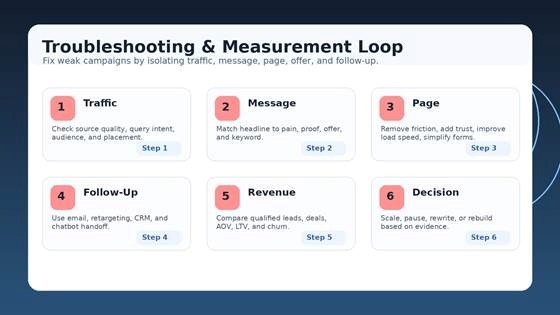
Build a Measurement System That Owners Understand
A report is only useful if it leads to a decision. Avoid reports filled with impressions, clicks, and follower counts unless they connect to business outcomes.
A strong 2026 marketing dashboard should answer:
- Which channels create qualified leads?
- Which campaigns create pipeline?
- Which pages assist conversions?
- Which content brings returning visitors?
- Which ads waste spend?
- Which lead sources close at the highest rate?
- Which offers generate the best customers?
- What should we stop, start, and scale?
Marketing troubleshooting and measurement loop
Build a Weekly Scorecard
Track these every week:
| Metric | Why It Matters | Bad Sign | Action |
| Qualified leads | Shows whether demand is relevant | Leads rise but sales reject them | Tighten targeting and form questions. |
| Conversion rate | Shows page and offer strength | Traffic rises, leads stay flat | Test headline, CTA, proof, and form length. |
| Cost per qualified lead | Shows true paid efficiency | CPL looks low, qualified CPL is high | Feed better conversion signals. |
| Sales accepted leads | Connects marketing to sales | Sales ignores leads | Improve routing and lead notes. |
| Close rate by source | Shows traffic quality | One channel drives bad-fit leads | Reallocate budget. |
| Content-assisted conversions | Shows content value | Blog traffic has no assisted value | Improve internal CTAs and topic selection. |
| Email revenue or booked calls | Shows nurture value | Opens but no action | Rewrite emails around stronger intent. |
Make Monthly Decisions
At the end of each month, classify every campaign into one of four actions:
- Scale: profitable and repeatable.
- Optimize: promising but blocked by message, page, or follow-up.
- Pause: not enough evidence or poor quality.
- Kill: consistently unprofitable and strategically weak.
The best digital marketing strategies 2026 are not complicated because they use more tools. They are effective because they force better decisions every week.
Common Mistakes to Avoid
Mistake 1: Using AI to Create More Average Content
More content is not the goal. Better content is the goal.
If your AI workflow produces the same advice already ranking everywhere, it will not build authority. Add examples, testing notes, screenshots, unique opinions, expert edits, and specific recommendations.
Mistake 2: Optimizing for Traffic Instead of Business Value
A viral post can bring attention without buyers. A low-volume keyword can bring leads. Judge marketing by qualified demand, not applause.
Ask: “Would this visitor realistically become a customer, subscriber, user, or partner?”
Mistake 3: Letting Ad Platforms Choose Everything
Automation needs guardrails. If conversion tracking is weak, automated bidding can optimize toward junk leads.
Review search terms, placements, creative assets, landing pages, form quality, and CRM outcomes. Automation should support strategy, not replace it.
Mistake 4: Ignoring Email and Retargeting
Most visitors do not convert on the first visit. Without email, retargeting, and CRM follow-up, you keep paying to reacquire the same attention.
Build a simple follow-up system before scaling traffic.
Mistake 5: Reporting Vanity Metrics to Decision-Makers
Owners do not need 30 slides of impressions. They need to know what worked, what failed, why it happened, and what you will do next.
Use plain language and connect every metric to money, pipeline, cost, risk, or learning.
Advanced Tips and Next-Level Hacks
Create a “Source of Truth” Content Library
Build one internal document that contains:
- Brand positioning
- Approved claims
- Customer pain points
- FAQs
- Case study numbers
- Testimonials
- Offer details
- Pricing rules
- Competitor differences
- Tone of voice examples
Use it to train writers, AI prompts, chatbots, sales scripts, and ad copy. This reduces inconsistency and protects your brand from generic output.
Use Topic Clusters With Conversion Paths
A topic cluster should not only link pages together. It should guide a reader toward action.
Example cluster:
- Pillar guide: Digital marketing strategy for small business
- Supporting post: SEO vs PPC
- Supporting post: How to track marketing ROI
- Supporting post: Best AI tools for marketing teams
- Supporting post: Email nurture workflow
- Conversion page: Book a marketing audit
Every educational page should point to the next logical step.
Build a Search-to-Social Feedback Loop
Search data tells you what people ask. Social content tells you what people react to. Combine both.
Workflow:
- Pull Google Search Console queries.
- Turn common questions into short videos.
- Read comments for objections.
- Add those objections to the blog FAQ.
- Use the strongest social hooks in ads.
- Add converting questions to chatbot flows.
💡 Quick Hack: When a short video gets comments, turn the best comment into the next video. This creates a low-cost content series powered by audience language.
Use Micro-Conversions
Not every visitor will submit a lead form. Track smaller actions that show intent:
- Pricing page visit
- Calculator use
- Video watch
- FAQ expansion
- Chatbot start
- Email signup
- Download
- Call button click
- Repeat visit
- Scroll depth on service pages
Micro-conversions help you understand buyer readiness before the final conversion happens.
Create a Competitor Proof File
Collect screenshots of competitor ads, landing pages, offers, reviews, content angles, pricing claims, and social comments. Review it monthly.
You are not copying competitors. You are spotting gaps. Maybe they never explain pricing. Maybe they have weak reviews. Maybe their content is broad and generic. Your strategy can win by being clearer and more useful.
Refresh Offers Quarterly
A tired offer weakens every channel. Refresh lead magnets, consultation angles, bundles, pricing pages, and seasonal hooks every quarter.
For example:
- January: “2026 Marketing Audit”
- April: “Q2 Lead Generation Fix”
- July: “Mid-Year Funnel Review”
- October: “Holiday Campaign Readiness Check”
The best digital marketing strategies 2026 keep the core positioning consistent while refreshing hooks, proof, and offers.
Troubleshooting and Maintenance Guide
Problem: Traffic Is Up, But Leads Are Flat
Check these in order:
- Is the traffic relevant?
- Are visitors landing on pages with CTAs?
- Does the page match search intent?
- Is the offer strong enough?
- Is the form too long?
- Are tracking events firing correctly?
- Are mobile users bouncing because the page is slow?
Fix: improve message match, add stronger CTAs, create commercial internal links, and test a lower-friction offer.
Problem: Leads Are Cheap, But Sales Says They Are Bad
This usually means the campaign is optimizing for the wrong event or attracting the wrong promise.
Fix:
- Add qualifying questions.
- Exclude irrelevant audiences or locations.
- Change ad copy to filter bad-fit leads.
- Track qualified lead as the primary conversion.
- Review search terms and placements.
- Send offline conversion data back to ad platforms when possible.
Problem: Content Ranks, But Does Not Convert
A ranking page may answer the topic but fail to guide readers.
Fix:
- Add a clear CTA after the intro.
- Add comparison tables.
- Include service/product links in helpful places.
- Add proof examples.
- Insert FAQs that handle buying objections.
- Add a relevant lead magnet.
- Create a related email sequence.
Problem: Social Posts Get Likes, But No Leads
Likes are not a funnel. You need bridge content.
Fix:
- Add CTAs to useful resources.
- Create problem-solution videos.
- Use profile links strategically.
- Retarget engaged viewers.
- Pin conversion-focused posts.
- Convert top-performing posts into landing pages.
Problem: Email Open Rates Are Good, But Clicks Are Low
Your subject lines may be working while your email body lacks urgency or relevance.
Fix:
- Put the main value in the first two lines.
- Use one CTA per email.
- Segment by interest.
- Shorten paragraphs.
- Add examples or proof.
- Remove generic promotional language.
Problem: Reporting Is Confusing
Too many metrics create delay. Simplify.
Fix the report into four blocks:
- What happened?
- Why did it happen?
- What did we learn?
- What are we doing next?
This format keeps the team focused on decisions, not dashboards.
Frequently Asked Questions
1. What is the most important digital marketing strategy in 2026?
The most important strategy is building a connected system: search visibility, helpful content, first-party data, paid testing, email follow-up, conversion optimization, and revenue-based measurement. One channel alone rarely wins. The advantage comes from making every channel support the same buyer journey.
2. Is SEO still worth it with AI search and zero-click results?
Yes, but SEO must evolve. Classic rankings still matter, but content should also be structured for AI answers, social discovery, and conversions. Focus on original experience, clear answers, strong internal links, and proof. SEO should drive visibility, trust, and assisted conversions, not just raw clicks.
3. How should small businesses use AI in marketing?
Small businesses should use AI to save time on research, outlines, drafts, repurposing, reporting, email flows, and chatbot scripts. They should not publish unedited AI content or let AI invent claims. The best use of AI is speeding up execution while humans provide strategy, expertise, and quality control.
4. How much should a business spend on digital marketing in 2026?
There is no universal number. A small business can begin with a lean budget for content, email, and retargeting, while competitive industries may need heavier paid media. The smarter approach is to define a test budget, measure cost per qualified lead, then scale the channels that create profitable pipeline.
5. Which platforms should businesses prioritize first?
Start with the channels closest to buyer intent. For many businesses, that means Google Search, SEO, website conversion pages, email, and retargeting. Add social platforms based on audience behavior, content capability, and proof needs. Do not choose a platform just because it is trending.
6. How often should a digital marketing strategy be updated?
Review performance weekly, make tactical changes monthly, and refresh the full strategy quarterly. Platform rules, buyer behavior, AI search, ad costs, and competitor offers change quickly. Quarterly strategy reviews help you update content, creative, offers, tracking, and budget without constantly starting over.
Conclusion: Build a Marketing System, Not a Random Calendar
The best digital marketing strategies 2026 are practical, connected, and measurable. They use AI for speed, SEO for durable visibility, paid media for controlled testing, social content for trust, email for follow-up, chatbots for friction removal, and analytics for better decisions.
The businesses that win will not be the ones posting the most or buying the most tools. They will be the ones that understand their buyers, prove their value clearly, and improve the system every week.
What is the biggest digital marketing challenge you want MyFlexBots to break down next: SEO, paid ads, AI tools, social media, email automation, or conversion tracking?
editor's pick
latest video
news via inbox
Nulla turp dis cursus. Integer liberos euismod pretium faucibua