15 Best Online Business Ideas for Beginners in 2026
Starting an online business should not require buying an expensive course, stocking a garage, or gambling months of savings on an untested idea. This guide to Best online business ideas for beginners 2026 compares realistic models, startup costs, and beginner skills, then shows how to turn one offer into a first paying customer without confusing sales revenue with profit.
What are the best online businesses for beginners?
The best beginner-friendly online businesses are skill-based freelancing, virtual assistance, online tutoring, digital downloads, niche writing, and simple business services. They can be tested with limited upfront spending. Ecommerce, affiliate sites, and content channels can also work, but typically require more time, marketing, or capital before producing dependable income.
Start with the business model, not the trend
Anyone researching Best online business ideas for beginners 2026 should realize that a promising online business is not necessarily a passive one. Every model requires some mix of customer acquisition, creation, delivery, support, bookkeeping, and iteration. Before selecting an idea, decide how much cash can be lost without harming essentials, how many hours are available each week, and what a customer will actually pay to receive.
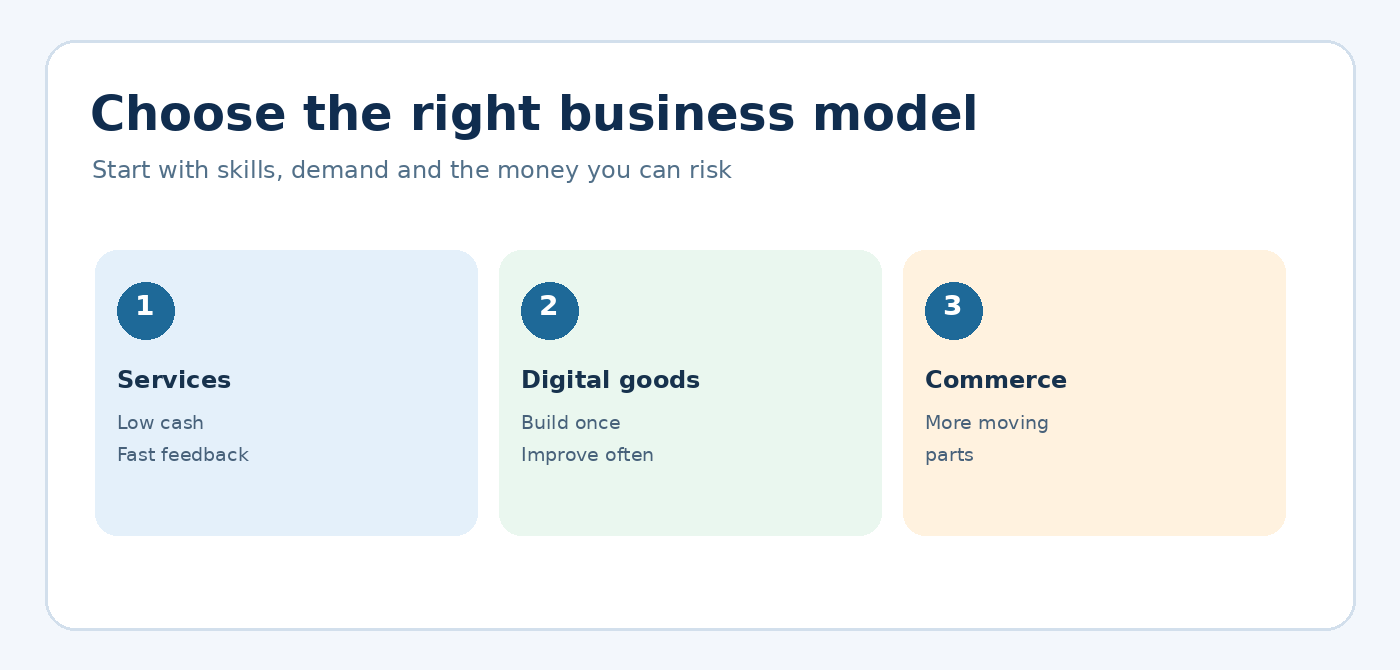
The Best online business ideas for beginners 2026 conversation is most useful when it separates three paths: selling expertise, selling repeatable digital goods, and selling physical goods. Services tend to validate quickly, digital products require distribution, and physical commerce adds supplier, refund, and logistics risk.
Figure 1. Choose a business model based on available skill, cash, and customer access.
Essential tools, startup materials, and realistic budgets
For Best online business ideas for beginners 2026 decisions, these estimates are planning ranges in USD, not vendor quotations or guaranteed first-month spending. Free tiers, geography, transaction fees, and taxes change the total; a business can often be piloted before paying for a domain or subscription.
| Need | Low-cost option | Planning cost | Skill |
| Research | Search, interviews, spreadsheets | 0–20 | Beginner |
| Website/portfolio | Free portfolio or basic hosting | 0–25/month | Beginner |
| Design | Free editor or templates | 0–15/month | Beginner |
| Calls/meetings | Video calls and scheduling | 0–15/month | Beginner |
| Payments | Payment processor | Variable transaction fees | Beginner |
| Email/list | Entry-level email platform | 0–30/month | Intermediate |
| Store setup | Marketplaces or storefront | 0–40+/month | Intermediate |
| Accounting | Spreadsheet or bookkeeping app | 0–30/month | Beginner |
Compare total costs with customer lifetime value. A $10 monthly tool is inexpensive if it enables profitable client work; it is wasteful if the business has no validated offer. Most beginners should start with a spreadsheet, video call tool, basic sample portfolio, and payment method supported in their country.
15 best online business ideas: costs, first offers, and pitfalls
- Freelance writing and editing
Illustrative launch budget: 0–100. Write useful website pages, product descriptions, or customer emails for one industry.
First customer playbook: Choose a sector you understand, produce two before-and-after samples, and offer a paid 600-word landing-page refresh.
Critical risk: Avoid selling generic AI-generated articles without fact-checking or rights review.
- Virtual assistant services
Illustrative launch budget: 0–75. Handle inbox triage, scheduling, research, CRM updates, and customer follow-ups.
First customer playbook: Make a list of three administrative problems; pitch a five-hour trial with a defined turnaround time.
Critical risk: Put access rights, confidentiality, response hours, and data handling in writing.
- Social media content management
Illustrative launch budget: 0–100. Plan captions, repurpose posts, schedule content, and report outcomes for local brands.
First customer playbook: Create a one-week content calendar for one niche and sell a fixed monthly package.
Critical risk: Do not promise follower counts or viral results; report useful leads and actions.
- Online tutoring
Illustrative launch budget: 0–80. Teach school subjects, languages, coding fundamentals, or job-specific skills.
First customer playbook: Run one diagnostic call and sell a four-session learning plan with measurable objectives.
Critical risk: Screen learners safely and follow platform or child-protection rules where relevant.
- Resume and LinkedIn profile editing
Illustrative launch budget: 0–50. Turn unclear experience into accurate, targeted career documents.
First customer playbook: Build sample rewrites using fictional examples and offer one review round.
Critical risk: Never invent degrees, roles, employment dates, or achievements.
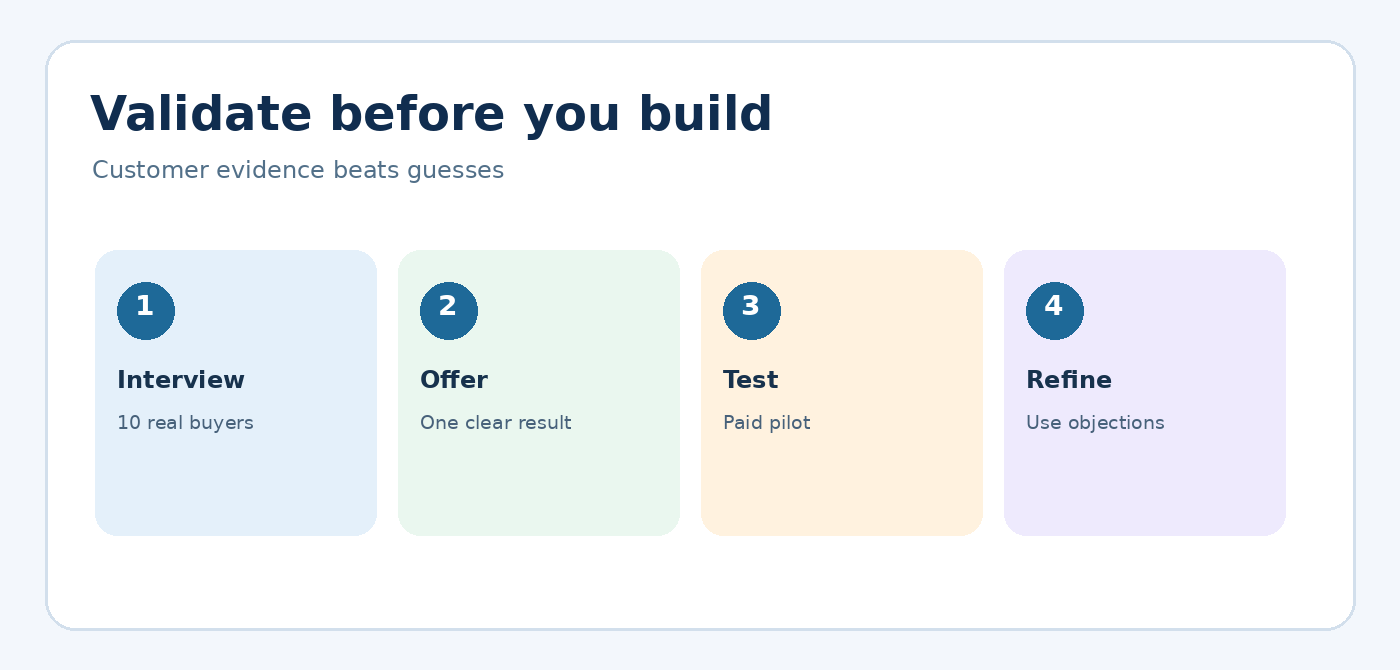
Figure 2. Validate with a small paid pilot before building a full website.
- Sell digital templates
Illustrative launch budget: 0–150. Create spreadsheets, planners, project trackers, or checklists with repeat demand.
First customer playbook: Interview five target users, build one template, and demonstrate it with a short video.
Critical risk: Test formulas and usability; provide instructions, version history, and refund terms.
- Print-on-demand products
Illustrative launch budget: 50–250. Offer original designs on products produced after purchase.
First customer playbook: Pick a narrow audience, order a sample, photograph quality, and test five listings.
Critical risk: Calculate shipping, samples, platform fees, refunds, and trademark risks.
- Niche blogging and affiliate publishing
Illustrative launch budget: 40–250. Publish problem-solving guides, reviews, and useful comparison content.
First customer playbook: Pick twenty questions from one audience; publish helpful first-hand content and disclose affiliate links.
Critical risk: Expect a longer ramp; never imply you tested products you did not test.
- Video editing and short-form repurposing
Illustrative launch budget: 0–150. Turn long recordings into captioned, accessible short videos.
First customer playbook: Produce a twenty-second sample from footage you have rights to use and package four clips.
Critical risk: Specify revision limits, asset ownership, captions, and export formats.
- Local SEO and business profile help
Illustrative launch budget: 0–150. Improve service pages, local listings, images, and measurement for real businesses.
First customer playbook: Audit one business for publicly visible issues and offer a bounded cleanup project.
Critical risk: Avoid fake reviews, spam listings, and ranking guarantees.
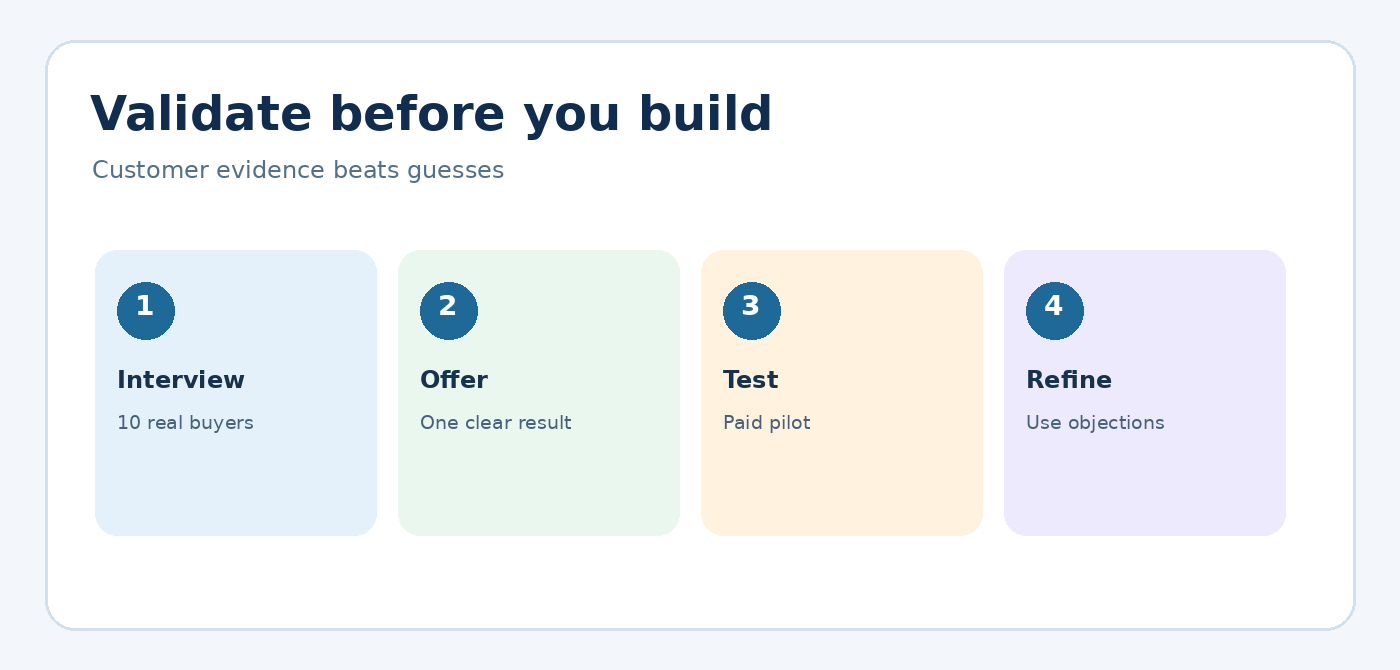
Figure 3. A simple funnel keeps customer acquisition measurable.
- No-code website setup
Illustrative launch budget: 0–200. Build simple brochure sites, booking pages, and contact forms.
First customer playbook: Create a demo for one niche and package a mobile-friendly five-page website.
Critical risk: Set maintenance scope, accessibility checks, backups, and client ownership.
- Ecommerce resale of a focused product
Illustrative launch budget: 150–800+. Buy and resell a small inventory with clear demand and acceptable margins.
First customer playbook: Start with a tiny test batch and calculate delivered cost per unit before restocking.
Critical risk: Inventory can tie up cash; account for returns, damage, and local tax requirements.
- Podcast production assistance
Illustrative launch budget: 0–150. Edit audio, write show notes, create chapters, and schedule episodes.
First customer playbook: Make a clean sound sample and pitch a per-episode package.
Critical risk: Agree on licensing, raw file storage, deadlines, and music rights.
- Online workshops and mini-courses
Illustrative launch budget: 0–200. Teach a narrow result live, then turn repeated questions into materials.
First customer playbook: Pre-sell a small live workshop with a clear syllabus and refund policy.
Critical risk: Do not spend months recording before confirming that people will buy.
- Research and spreadsheet dashboards
Illustrative launch budget: 0–125. Build lightweight reporting, lead organization, and analysis systems.
First customer playbook: Show a sample dashboard using synthetic data and sell one defined reporting workflow.
Critical risk: Protect sensitive data and verify any claims generated from automation.
How to choose an idea that fits your actual situation
Use the Best online business ideas for beginners 2026 shortlist as a filter, not a popularity contest. Rate each candidate on existing skill, urgency of the buyer problem, ability to reach buyers, startup exposure, and repeat purchase potential. Score each category from one to five, then discard ideas that require cash you cannot afford to lose.
For example, someone with bookkeeping experience and ten contacts who run shops may validate dashboard services faster than launching a general-interest dropshipping store. Someone who enjoys teaching and has a reliable internet connection may prefer scheduled tutoring over unpredictable search-engine traffic.
💡 Quick Hack: Write one offer sentence: “I help [specific customer] achieve [specific result] in [timeframe] with [deliverable].” If that sentence cannot be written without vague words, the business is not positioned clearly enough.
Step-by-step: go from idea to first customer
Choose one audience and painful problem
When applying Best online business ideas for beginners 2026 advice, list the ten people or businesses you could reasonably contact this week. Note their shared occupation, repeated bottlenecks, and current workarounds. A target such as “independent salon owners who need appointment reminder templates” is testable; “everyone who uses the internet” is not.
Read customer reviews, support questions, niche communities, and competing offers. Look for evidence of spending or costly inconvenience rather than merely enthusiastic comments. Avoid collecting private group posts or personally identifying information without authorization.
Talk to buyers before building
Book five to ten short conversations. Ask what they currently do, what breaks, how often it happens, what it costs, and what they tried. Do not ask only “Would you buy this?”; people tend to agree politely when the purchase is hypothetical.
Ask for a recent example of the problem.
Find the existing budget, alternative, or workaround.
Describe a narrow deliverable in plain language.
Offer a paid pilot with a start date and clear refund terms.
Record exact objections and revise the offer.
💡 Quick Hack: Save early research in a spreadsheet with columns for problem, workaround, budget signal, objection, and next step. Ten precise observations beat a hundred vague survey responses.
Build a minimum credible offer
Write a one-page sales sheet covering who it is for, what the customer receives, timeline, price, requirements, revisions, and support. Make a portfolio sample with realistic details and label demonstration work clearly. For services, the offer might be one fixed-scope paid project rather than a monthly contract.
For product businesses, document sample quality, production capacity, return rules, delivery timing, and customer support. For digital downloads, test that the file opens, instructions make sense, and any promised formulas or automations actually work.
Price around margin and delivery time
To evaluate Best online business ideas for beginners 2026 profitability, estimate time, tools, payment fees, platform fees, customer service, revisions, and taxes. If a $150 service takes ten hours plus two hours of admin, the effective gross hourly revenue is $12.50 before expenses and tax—not $150 of profit. Increase scope efficiency or pricing rather than chasing more volume at a loss.
For physical goods, write down landed cost, packaging, seller fees, shipping, expected returns, promotions, and ad costs. Use contribution margin to decide whether each additional sale helps the business.
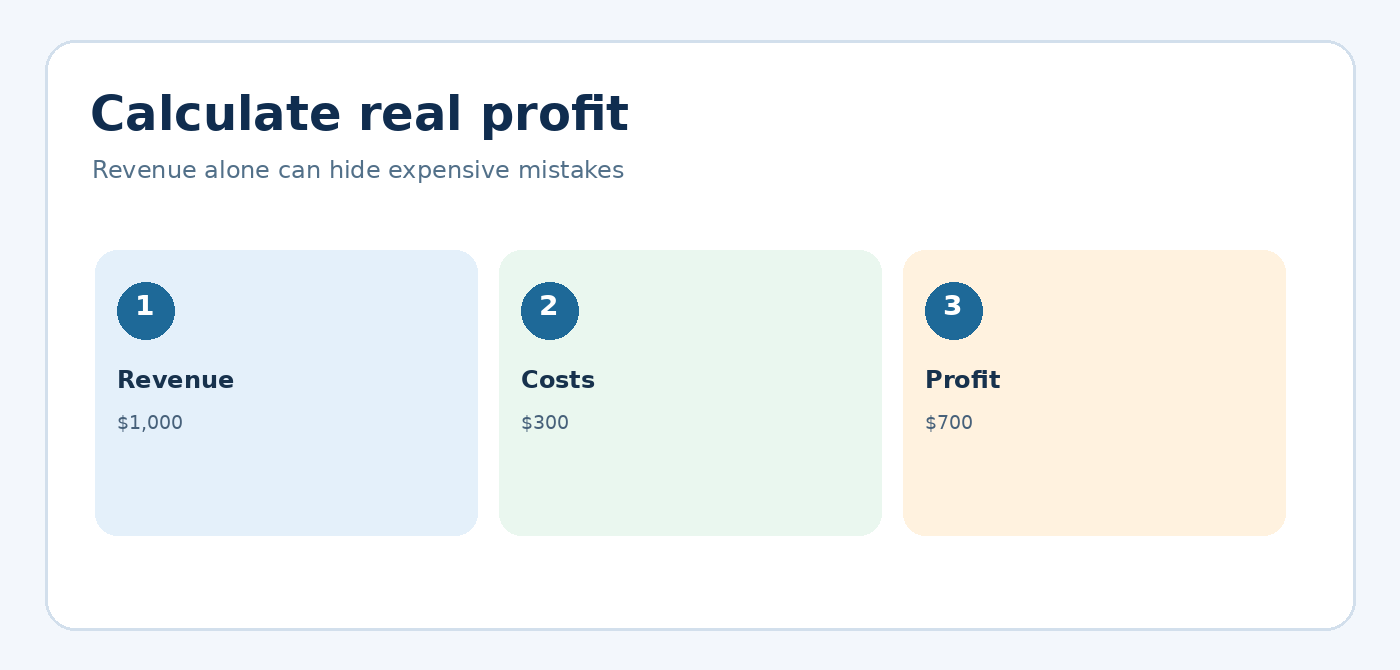
Figure 4. Track net results, not screenshots of top-line sales.
Set up the basics legally and safely
Before acting on Best online business ideas for beginners 2026 recommendations, choose a brand name that is not confusingly similar to an existing business, check available domains, and use a professional contact email. Select a payment provider supported in your jurisdiction; note that services, tax registration, licenses, VAT or sales tax, privacy rules, and consumer rights depend on where the owner and customers are located.
Separate personal and business records, issue clear invoices, maintain receipts, and do not collect customer data you do not need. US-based sole proprietors can consult the IRS self-employment guidance linked in the roadmap; entrepreneurs elsewhere should use their local official authority.
Build an acquisition system you can repeat
Pick one main channel for the first month: tailored outreach, a niche community where promotion is permitted, practical search content, short demonstrations, or warm introductions. Spend far more time on real buyer conversations than on logos, brand colors, or elaborate automation.
Send short individual messages explaining a visible problem and one sensible fix. Do not scrape private contacts, buy dubious email lists, or send spam. If content is the acquisition channel, publish examples that answer exactly what buyers ask before purchasing.
💡 Quick Hack: Reuse one detailed customer question as a helpful article, two short posts, a simple checklist, and a demonstration video. Adapt the format; do not paste identical captions everywhere.
Deliver exceptionally, document the process
For Best online business ideas for beginners 2026 service experiments, use a kickoff checklist to confirm requirements, file access, deadlines, contacts, and what counts as “done.” Send progress notes at agreed milestones and request an explicit approval on final delivery. Ask satisfied clients for honest, optional feedback; never purchase fabricated reviews.
Document repeatable steps and common questions. A service becomes more scalable when delivery is predictable and a customer can understand the outcome, not when every task is automated indiscriminately.
Review numbers weekly
When testing Best online business ideas for beginners 2026 approaches, track qualified conversations, proposals, paid orders, revenue, direct expenses, delivery hours, refunds, and repeat purchases. Conversion rate equals customers divided by qualified prospects, calculated over a consistent period. A low conversion rate may mean the offer or audience is wrong, not merely that the sales page needs brighter colors.
The point of comparing Best online business ideas for beginners 2026 opportunities is to find a business with workable economics, not the one posting the most impressive revenue screenshots.
A practical 30-day launch plan
| Week | Priority | Concrete milestone |
| 1 | Interview and select | 10 conversations; one audience; one testable offer |
| 2 | Build and package | Sample, price, one-page pitch, payment workflow |
| 3 | Acquire first buyers | 30 relevant, personalized contacts or equivalent qualified traffic |
| 4 | Deliver and improve | Finish pilots, record margin, revise offer |
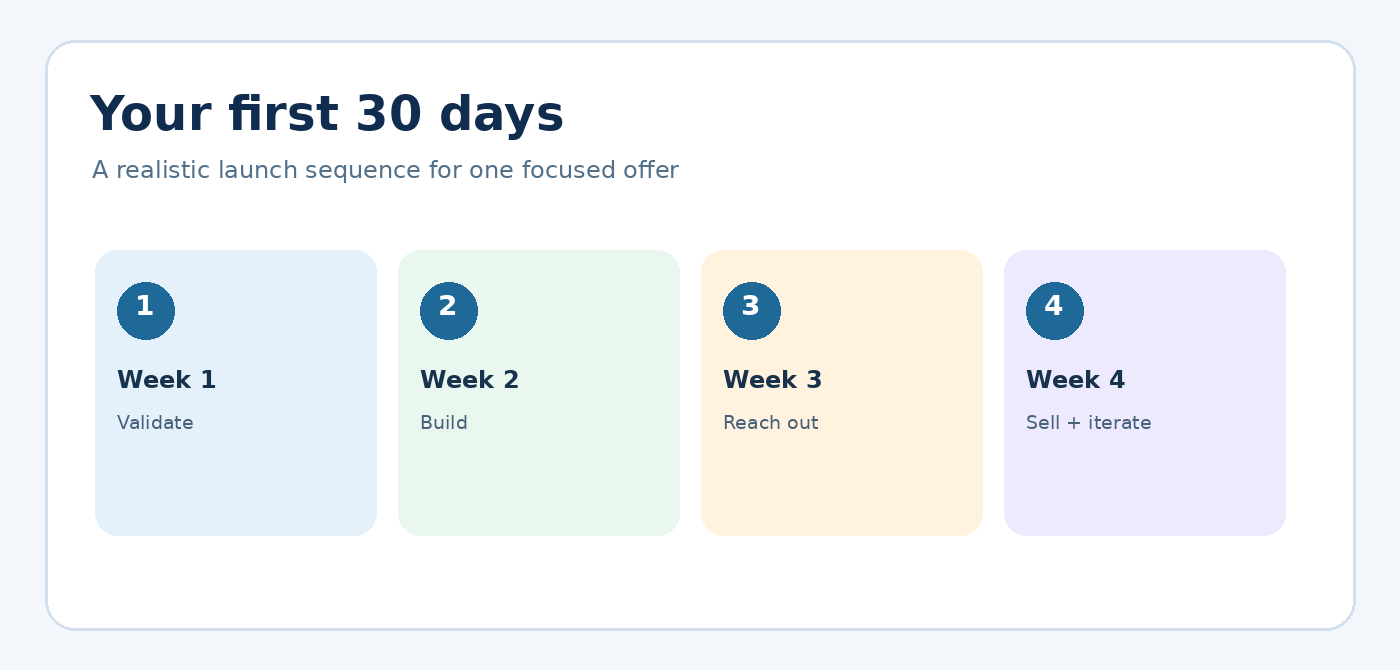
Figure 5. Prioritize real demand before scaling tools and spend.
💡 Quick Hack: Put a maximum cash-loss cap in writing before launch. An inexpensive idea can become costly when subscriptions, ads, inventory, and courses are purchased without sales evidence.
Five expensive beginner mistakes and how to avoid them
Mistake 1: Trying three businesses at once
Every model has different audiences, channels, and delivery habits. Choose one primary offer for thirty days, track results, and only diversify when a repeatable sale exists.
Mistake 2: Mistaking revenue for profit
Revenue is money received; profit remains after expenses. Set a simple monthly profit-and-loss sheet from day one, include a reserve for taxes, and calculate hourly earnings for service work.
Mistake 3: Paying for customers before validating the offer
Paid ads can magnify an offer that is already working, but they also magnify weak economics. Find buyers through direct relationships or small content tests before committing serious ad budgets.
Mistake 4: Copying content or designs without rights
Stock images, music, templates, and software libraries have specific license terms. Use authorized material, keep evidence of permissions, and review AI-produced work for factual errors and intellectual-property issues.
Mistake 5: Believing guaranteed-income promises
Scams frequently claim easy money and pressure buyers into expensive training or managed stores. Research the company and the seller, be skeptical of testimonials, and reject any claim that returns are guaranteed. The FTC provides practical warning signs in the external source section.
Advanced growth tips after the first few sales
**Productize a proven service.** When three clients buy broadly similar work, define fixed tiers and clear inputs. This reduces quotation time and makes delivery more consistent without requiring immediate hiring.
**Create a second purchase.** A tutoring client may need monthly review sessions; a website client may need upkeep; a digital template buyer may benefit from an advanced version. Upselling should solve a real next problem, not create artificial dependencies.
**Build a permission-based email list.** Offer a useful checklist or tutorial, describe what subscribers will receive, and honor unsubscribes. Relevant email communication can improve repeat customer value but should never substitute for a product worth purchasing.
**Automate bottlenecks carefully.** Use templates for onboarding and repetitive reports only after manually understanding the workflow. Keep a human review step for legal, financial, or customer-facing claims.
**Borrow distribution through partnerships.** Collaborate with a complementary business that serves the same customer without competing directly. Agree on the offer, referral disclosures, customer permission, and tracking before sharing leads.
💡 Quick Hack: Every Friday, write down the one question prospects repeatedly asked. Turn the answer into a sales-page improvement and a helpful piece of content next week.
Not every idea in the Best online business ideas for beginners 2026 category can become passive income. A stronger goal is a sustainable business with manageable acquisition costs, trustworthy delivery, and improving customer retention.
Troubleshooting: fix problems without wasting the budget
No one responds to outreach
Check whether the audience actually experiences the problem and whether messages are personalized. Test a narrower subject line and a concrete offer; ask a trusted peer whether the pitch is understandable in ten seconds. Track responses from qualified recipients rather than sending random bulk messages.
People reply but do not buy
Ask where the hesitation starts: price, trust, unclear scope, timing, or lack of urgency. A small paid pilot, better example, or clearer outcome is often more effective than an instant discount.
Sales come in but money disappears
Separate delivery costs from overhead. Measure contribution margin per sale and labor time per order. Pause products with negative margins, renegotiate supplier rates, simplify fulfillment, and stop ads until basic unit economics work.
Customers ask for endless revisions
Update your agreement to include number of revision rounds, feedback windows, required assets, and a clear process for scope changes. A friendly written policy protects both buyer and seller.
Traffic grows but conversions remain low
Compare search or social audience intent with the actual offer. Review page load, mobile usability, proof of work, checkout friction, calls to action, and whether prices or next steps are visible. Do not assume traffic means purchase intent.
Business depends on one platform
Build a contact list only with consent, keep records and original assets backed up, document customer relationships, and diversify acquisition gradually. Marketplace or social-platform rule changes should not erase the whole operating system.
For maintaining the operation, review finances weekly, reconcile transactions monthly, back up business data, renew licenses when required, review service agreements quarterly, and update content when product availability or platform rules change.
Frequently asked questions
- What online business is easiest for a complete beginner?
A narrow service based on an existing skill—such as virtual assistance, tutoring, editing, or simple content operations—is often easiest to test. There is no universal “easy” business; the best choice is one where real buyers are accessible and delivery can be learned safely.
- Can someone start an online business with no money?
Some service models can be piloted using tools already owned, although internet access, time, payment fees, legal requirements, and basic equipment still have costs. Avoid claiming a business has literally zero cost. Validate demand before purchasing optional subscriptions.
- How long does it take to make the first sale?
It varies widely. A warm referral for a service might convert quickly, while a content website or new ecommerce store may take months and still fail. Use a thirty-day test to gather evidence, not as a guarantee of revenue.
- Is dropshipping better than freelancing for beginners?
Freelancing often needs less upfront cash because no inventory is purchased, but it depends on skill and time. Dropshipping can reduce warehouse needs yet still carries ad costs, supplier dependence, delivery disputes, refunds, and product compliance duties.
- Which online business can become passive income?
Digital downloads, licensing, and affiliate content may produce sales outside working hours after meaningful upfront work. Updates, support, platform changes, and acquisition remain ongoing. Consider income less tied to hours rather than truly effortless income.
- Do beginners need to register a business and pay taxes?
Requirements depend on residence, customer locations, type of activity, and revenue. Keep records immediately and check the appropriate local tax and business registration authorities before selling. US readers can consult the IRS resource linked below.
Final verdict: start small, get evidence, then scale
The strongest Best online business ideas for beginners 2026 choice is not the loudest trend. It is the business a beginner can explain clearly, validate with genuine buyers, deliver well, and price profitably while limiting downside. Choose one realistic idea, run the 30-day validation plan, and use actual customer objections to make the next version stronger.
editor's pick
latest video
news via inbox
Nulla turp dis cursus. Integer liberos euismod pretium faucibua