
How to Do Keyword Research Step-by-Step Guide
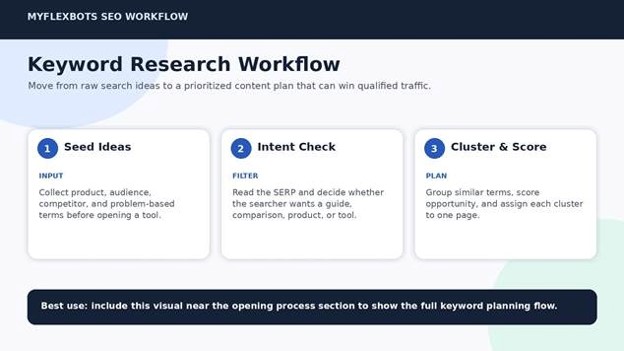
Most SEO campaigns fail before a single word is written because the topic was chosen from opinion, not evidence. If you want traffic that attracts buyers, readers, subscribers, or leads, you need to know how to do keyword research before you build the page.
This guide gives you a practical workflow for turning messy search ideas into a clean content plan. You will learn how to collect keyword ideas, read search intent, evaluate difficulty, cluster topics, build briefs, troubleshoot weak rankings, and maintain your keyword strategy over time.
For MyFlexBots, the goal is not just “more traffic.” The goal is searchable content that supports automation, tools, digital growth, and clear user problems. Strong keyword planning helps every article, landing page, product page, and tutorial serve a measurable business purpose.
| Featured Snippet Box: How to do keyword research To learn how to do keyword research, start with business goals, list seed topics, expand them with keyword tools, check search intent in Google, compare volume and difficulty, group related terms into clusters, then choose keywords that match one page, one audience need, and one realistic conversion goal. |
Essential Tools & Materials Breakdown
A good tool stack makes the keyword research process faster, but the tool is not the strategy. Use tools to collect signals, then use judgment to decide which keywords deserve content, which deserve a landing page, and which should be ignored.
| Tool / Material | Best Use | Estimated Cost | Skill Level | Practical Note |
| Google Search | SERP intent analysis and competitor page review | Free | Beginner | The most honest keyword tool because it shows what already satisfies the query. |
| Google Keyword Planner | Keyword ideas, volume ranges, forecasts, and ad-value signals | Free with Google Ads account | Beginner | Useful for direction, not final truth; volume should be treated as an estimate. |
| Google Trends | Seasonality, geography, rising interest, and topic comparison | Free | Beginner | Best for validating whether demand is stable, rising, or seasonal. |
| Google Search Console | Existing impressions, queries, CTR, and page-level opportunities | Free | Intermediate | Use after your website has data; it is excellent for refreshes and low-hanging wins. |
| Spreadsheet | Scoring, clustering, mapping, and prioritization | Free to low cost | Beginner | A simple sheet prevents keyword chaos and keeps decisions visible. |
| Paid SEO tools | Competitor gaps, difficulty metrics, backlinks, and larger keyword databases | $29+/month depending on tool | Intermediate | Useful when budget allows, but not required for a strong first workflow. |
| Customer language | Sales calls, reviews, support chats, FAQs, and community questions | Free | Beginner | Often gives better long-tail keywords than any tool because it uses real buyer wording. |
| 💡 Quick Hack: Start with a no-cost stack Use Google Search, Keyword Planner, Trends, Search Console, and a spreadsheet before buying expensive SEO software. Paid tools speed up research, but they cannot replace careful intent analysis. |
Comprehensive Step-by-Step Execution Guide
Define the Business Goal Before the Keyword
The first rule of how to do keyword research is simple: never start with volume. Start with the outcome you want the page to support.
A keyword with 20,000 monthly searches can be useless if the visitor has no reason to trust, subscribe, request a demo, buy, or read another page. A keyword with 150 searches can be valuable if it captures a specific buyer problem and has a clear next step.
Before researching keywords, write one sentence that explains the page goal. For example: “This article should attract beginners who want a repeatable SEO workflow and introduce them to MyFlexBots as a practical automation resource.”
Then assign the page to one of these goal types: awareness, comparison, conversion, retention, or support. This prevents you from forcing every keyword into the same blog-post format.
- Goal type
- Primary audience
- Pain point
- Next action
- Proof needed
Build Seed Topics from Real Problems
When people ask how to do keyword research, they often jump into tools too early. A better starting point is a raw list of problems your audience already talks about.
Seed topics are broad ideas that later expand into keyword clusters. They can come from your services, product features, customer questions, competitor pages, YouTube comments, Reddit threads, sales objections, chatbot logs, and internal support tickets.
For a digital growth or automation site, seed topics might include SEO automation, content planning, chatbot workflows, keyword tracking, lead generation bots, AI writing workflows, and content optimization tools.
Do not filter aggressively at this stage. The goal is to create a wide idea pool so that tools can return more useful variations later.
- Your services and offers
- Audience pain points
- Questions customers ask before buying
- Competitor category names
- Problems that repeat in support or sales
Expand Keywords with Tools and Search Features
Now take your seed topics into keyword tools and search surfaces. Use Google Keyword Planner to discover keyword ideas related to your product or service and to understand broad demand signals. Google describes Keyword Planner as a tool for finding relevant keywords and analyzing search frequency over time.
Use Google autocomplete for natural phrase patterns. Type a seed term and note the suggestions before and after it. Search “keyword research for…” and “best keyword research…” to see how people complete the thought.
Use People Also Ask, related searches, YouTube suggestions, and forum titles to collect question-based keywords. These often reveal pain points that keyword databases underreport.
At this stage, collect more than you need. A messy list becomes useful once you clean it, group it, and score it.
- Seed keyword
- Suggested keyword
- Source
- Search intent guess
- Notes
Read the SERP Before Trusting the Numbers
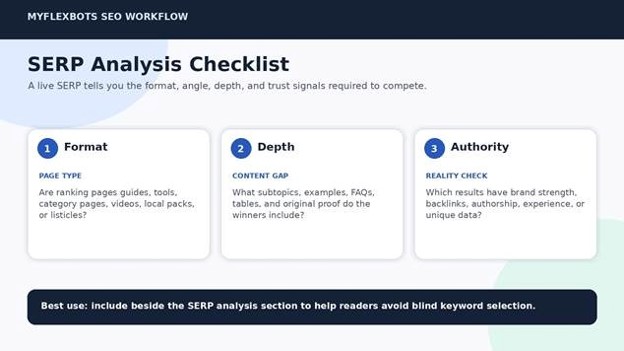
This is where how to do keyword research becomes strategic. Search volume tells you that people search a phrase; the SERP tells you what Google believes those people want.
Open an incognito browser window, search the keyword, and study the first page. Look at the type of ranking pages. Are they tutorials, product pages, comparison posts, free tools, videos, local businesses, definitions, listicles, or documentation?
If the top results are beginner guides, do not build a product page. If the top results are pricing pages, do not publish a broad educational article and expect it to rank. Match the dominant intent unless you have a strong reason and unique asset to challenge it.
Also check the SERP features. Featured snippets, People Also Ask boxes, videos, shopping results, map packs, and AI answers all shape click potential. A keyword with good volume but low organic click opportunity may not be your best first target.
- Dominant page type
- Content angle
- Required depth
- Visible SERP features
- Brands currently ranking
- Missing information you can add
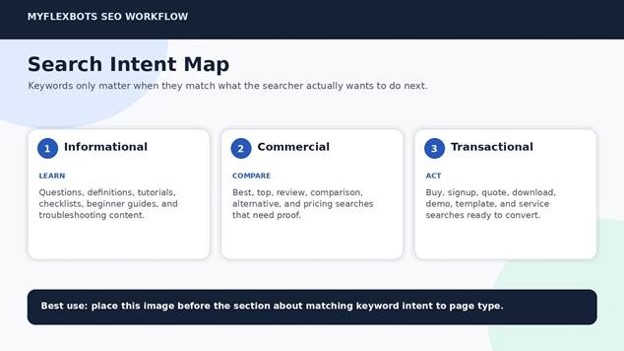
Classify Intent with a Simple Four-Part Model
Intent classification keeps keyword lists from becoming random. Most keywords fall into informational, commercial, transactional, or navigational intent.
Informational keywords are used by people who want to learn. Commercial keywords are used by people comparing options. Transactional keywords signal action. Navigational keywords show that the searcher wants a specific brand, tool, website, or login page.
A strong SEO strategy covers more than one intent type. Educational content builds trust, comparison content captures evaluators, and transactional pages convert demand that already exists.
- Informational: “what is keyword clustering”
- Commercial: “best keyword research tools”
- Transactional: “download keyword research template”
- Navigational: “Google Keyword Planner login”
Evaluate Metrics Without Becoming a Slave to Metrics
Keyword metrics are useful, but they are estimates. Search volume, keyword difficulty, CPC, competition, trend direction, and SERP strength should guide your decision, not replace it.
For a newer website, a lower-volume long-tail keyword with clear intent can outperform a broad keyword that is dominated by major publishers. Look for topics where your page can be more useful, more specific, or more actionable than what is already ranking.
CPC can reveal commercial value. If advertisers pay for a keyword, it often means the searcher has business potential. But high CPC also means the topic may be competitive and requires stronger proof.
- Search volume
- Keyword difficulty
- CPC or commercial value
- Trend direction
- SERP strength
- Business relevance
- Content effort required
| Pro-Tip: Use a three-score filter Give every keyword a 1-5 score for relevance, ranking opportunity, and business value. Add the scores. Anything under 9 goes into the backlog unless it supports a strategic topic cluster. |
Find Long-Tail Keywords That Beginners Miss
Long-tail keywords are specific phrases that usually have lower volume but clearer intent. They are powerful because they reveal context: audience level, industry, problem, location, tool, budget, or desired outcome.
The biggest difference between knowing how to do keyword research and guessing is the ability to find these specific phrases before competitors turn them into content.
Examples include “keyword research for SaaS blogs,” “low competition keywords for new website,” “how to map keywords to blog posts,” and “keyword research template for content planning.”
Use modifiers to uncover long-tail opportunities: for beginners, step by step, checklist, template, free, for small business, for WordPress, for ecommerce, mistakes, examples, alternatives, and pricing.
- Audience modifiers
- Problem modifiers
- Tool modifiers
- Industry modifiers
- Comparison modifiers
- Cost and budget modifiers
Cluster Keywords Instead of Creating Duplicate Pages
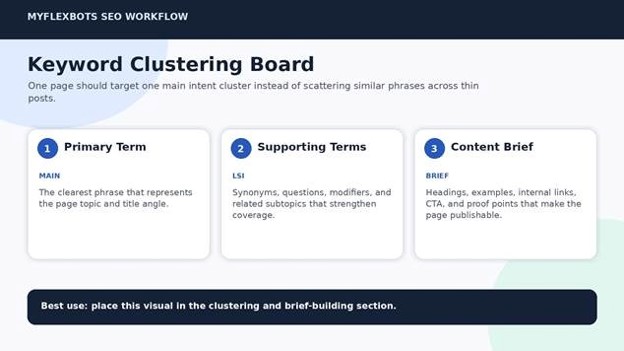
Keyword clustering means grouping related phrases that share the same search intent. One strong page can rank for dozens or hundreds of related queries when the intent is the same.
Do not create separate thin articles for “keyword research guide,” “keyword research tutorial,” and “keyword research step by step” if the search intent overlaps. Build one comprehensive page and include supporting terms naturally.
A good cluster has one primary keyword, a clear page type, supporting subtopics, question keywords, and a conversion goal. The cluster becomes the foundation for your outline.
- Primary keyword
- Secondary keywords
- Question keywords
- Search intent
- Page type
- Internal links
- CTA
Prioritize Keywords with an Opportunity Score
After clustering, prioritize. A giant keyword list is not an SEO strategy. A ranked publishing plan is.
Create a simple scoring model using relevance, opportunity, value, urgency, and effort. Relevance asks whether the keyword fits your business. Opportunity asks whether you can realistically compete. Value asks whether the visitor could become a lead, customer, subscriber, or returning reader.
Urgency considers timing. Is demand rising? Is the topic tied to a product launch or seasonal campaign? Effort estimates whether the content needs original data, screenshots, expert quotes, tools, or only a clear written guide.
- Relevance score
- Opportunity score
- Business value score
- Urgency score
- Content effort score
Build the Content Brief Before Writing
A content brief is where research becomes execution. It protects the writer from guessing and keeps the page aligned with intent.
Your brief should include the primary keyword, page goal, target reader, search intent, working title, meta description, H2 structure, key questions, internal links, external sources, examples, original insights, and CTA.
For MyFlexBots, the brief should also ask: can automation improve this workflow? Can a downloadable template, calculator, checklist, bot, or AI prompt make the page more useful than competing content? That is the kind of added value Google’s people-first guidance pushes creators to consider.
- Primary keyword and cluster
- Reader pain point
- SERP notes
- Unique angle
- Required examples
- Internal links
- External references
- CTA
Optimize the Page Without Keyword Stuffing
A clean page shows the keyword research workflow in practice: the main keyword appears naturally, supporting terms strengthen context, and every heading helps the reader move forward.
Use the primary keyword in the title, URL slug, intro, one or two headings if natural, meta description, image alt text, and conclusion. Then use semantic terms throughout the body instead of repeating the same phrase awkwardly.
Google’s own SEO guidance focuses on helping search engines understand content and helping users decide whether to visit a page. That means clarity, structure, usefulness, and trust matter more than forced repetition.
- Title tag
- Meta description
- URL slug
- H1 and H2s
- Image alt text
- Internal links
- FAQ section
Publish, Measure, Refresh, and Expand
Keyword research does not end on publishing day. After a page is indexed, Search Console can reveal queries that the page is earning impressions for, even if you never targeted them directly.
Look for queries with impressions but low CTR. Improve the title and meta description. Look for queries ranking on page two. Add missing sections, examples, FAQs, screenshots, or internal links. Look for unrelated queries. Tighten the page so it stays focused.
Refresh the page every 90 to 180 days for competitive topics. Update tool names, screenshots, pricing references, examples, and outdated advice. Old content often loses rankings because it stops being the best answer.
- Indexing status
- Impressions
- CTR
- Average position
- Conversion events
- Internal link support
- Content freshness
| 💡 Quick Hack: Mine Search Console for “almost winners” Filter queries with average position 8-20 and strong impressions. These keywords often need a better title, one missing subtopic, or two internal links to move into higher visibility. |
Common Mistakes to Avoid
- Mistake 1: Thinking how to do keyword research means chasing only high-volume keywords: High-volume terms often attract broad, unfocused searchers and stronger competitors. Fix it by balancing volume with intent, relevance, and ranking feasibility.
- Mistake 2: Ignoring SERP intent: If Google ranks product pages and you publish a beginner guide, you are fighting the wrong battle. Fix it by matching the page type that dominates the result.
- Mistake 3: Creating one page for every keyword variation: This creates duplicate, thin content. Fix it by clustering similar terms and assigning one strong page to each intent group.
- Mistake 4: Trusting difficulty scores blindly: Difficulty metrics vary by tool and cannot understand your unique expertise. Fix it by manually reviewing ranking pages, backlinks, brand authority, and content gaps.
- Mistake 5: Forgetting the conversion path: Traffic without a next step rarely builds business value. Fix it by adding relevant CTAs, internal links, templates, demos, newsletters, or service pages.
| Pro-Tip: Create a “do not target” column Not every keyword deserves action. Mark keywords as too broad, wrong intent, too competitive, duplicate intent, or low business value. This keeps the team from revisiting bad ideas every month. |
Advanced Tips and Next-Level Hacks
- For MyFlexBots, how to do keyword research should connect SEO with automation.: Use repeatable templates, bots, and workflows so research does not depend on memory or scattered notes.
- Build comparison clusters: People searching alternatives, versus, best tools, and pricing terms are often close to action. These pages need proof, feature breakdowns, honest pros and cons, and clear recommendations.
- Use topic authority maps: Group articles around parent topics. A keyword research hub can support guides on search intent, SEO automation, content briefs, AI content planning, and ranking tracking.
- Track query language changes: AI search and conversational search encourage longer, more specific queries. Add natural-language questions and direct answers to sections where they help the reader.
- Use source-backed claims: When you mention search systems, helpful content, or tool features, link to primary sources. Strong external references improve trust and make the article more useful.
| 💡 Quick Hack: Turn one keyword into five assets A strong keyword cluster can become a blog post, checklist, short video, LinkedIn carousel, email tip, and chatbot answer. This stretches research value without creating duplicate website pages. |
| 💡 Quick Hack: Build a keyword swipe file Save good title formulas, PAA questions, featured snippet formats, competitor angles, and strong CTAs. Over time, your research gets faster and more precise. |
| Pro-Tip: Watch AI search language Google’s guidance says foundational SEO remains relevant for generative AI search. Use clear answers, original value, structured sections, and trustworthy sourcing rather than chasing gimmicks. |
Troubleshooting & Maintenance Guide
If you know how to do keyword research but traffic still does not grow, the problem is usually not one thing. It may be intent mismatch, weak authority, poor internal linking, thin content, bad CTR, slow indexing, or a page that targets too many jobs at once.
| Problem | Likely Cause | Fix | Maintenance Check |
| Page gets impressions but low clicks | Title/meta does not match intent or lacks benefit | Rewrite title with clearer promise, number, or specificity | Review CTR monthly |
| Page ranks page two or three | Content is close but incomplete | Add missing sections, examples, FAQs, screenshots, or expert notes | Compare against top 5 pages quarterly |
| Page attracts wrong traffic | Keyword cluster is too broad or mixed | Narrow the introduction, headings, and internal links around one intent | Check query list in Search Console |
| Page is indexed slowly | Weak internal links or crawl priority | Link from related articles, hub pages, and navigation where relevant | Audit internal links after publishing |
| Traffic drops after months | Content freshness or competitor improvement | Update data, tools, screenshots, examples, and add new questions | Refresh every 90-180 days |
| Content does not convert | CTA mismatch or no next step | Add a template, demo, service link, checklist, or email signup aligned with the query | Track assisted conversions |

Caption: Keyword research improves after publishing when you track impressions, CTR, ranking movement, and conversion value.
Frequently Asked Questions
How to do keyword research for a new website?
Start with low-competition long-tail keywords that match your services, audience questions, and business goals. New websites usually do better with specific tutorials, comparisons, templates, and problem-solving pages than with broad head terms dominated by established brands.
What is the best free keyword research tool?
The best free starting stack is Google Search, Google Keyword Planner, Google Trends, and Google Search Console. Search Console becomes more useful after your website has impressions and query data.
How many keywords should one article target?
One article should target one primary intent cluster, not one isolated keyword. Use one main keyword, several close variants, related subtopics, and question keywords that naturally support the same searcher need.
Is keyword difficulty always accurate?
No. Keyword difficulty is a useful estimate, but each tool calculates it differently. Always check the live SERP, the authority of ranking pages, content depth, backlinks, brand strength, and whether you can add something better.
How often should keyword research be updated?
Update priority pages every 90 to 180 days, or faster for tools, pricing, AI, software, laws, and fast-changing industries. Review Search Console data monthly for pages with impressions, weak CTR, or page-two rankings.
Can AI tools replace keyword research?
AI tools can speed up brainstorming, clustering, and brief creation, but they should not replace SERP analysis, customer insight, source checking, or business judgment. Use AI as an assistant, not the decision maker.
Conclusion: Turn Search Demand into a Content System
Now you know how to do keyword research as a practical system, not a guessing exercise. The process starts with business goals, expands through tools and customer language, sharpens through SERP analysis, and becomes useful when keywords are clustered, scored, mapped, written, measured, and refreshed.
The best keyword plan is not the biggest spreadsheet. It is the plan your team can actually publish, improve, and connect to measurable outcomes.
What is the hardest part of keyword planning for your website right now: finding ideas, choosing the right keyword, matching intent, or turning research into content? Share your answer in the comments and use it as the starting point for your next SEO improvement.
editor's pick
latest video
news via inbox
Nulla turp dis cursus. Integer liberos euismod pretium faucibua
[…] MyFlexBots’ guide on how to do keyword research to map query intent, variations, and page type before […]