How to Write a Business Plan (Step-by-Step Guide)
A business idea feels exciting until someone asks for numbers, proof, and a clear path to profit. That is where most founders stall: they have energy, but not a document that turns the idea into decisions.
This guide shows you how to write a business plan in a practical, step-by-step way, without filling pages with corporate fluff. You will build a plan that explains the customer, offer, market, operations, costs, risks, and next actions clearly enough for partners, lenders, investors, or your own team to use.
Featured Snippet Box: What Is the Best Way to Write a Business Plan?
| Direct Answer
The best way to write a business plan is to define the problem, identify the target customer, prove demand with research, explain your product, map operations, build realistic financial projections, list risks, and turn the plan into a 90-day execution roadmap. |
Essential Tools & Materials Breakdown
A strong plan is built from evidence, not optimism. Before writing, gather the inputs you would need if you were repairing a machine: measurements, parts, constraints, and a reliable test method.
Use the table below as your business plan toolbox. Some items are free. Some require paid research or expert review. The goal is not to spend more; it is to reduce guesswork before your money is on the line.
| Tool / Material | Use in the Plan | Estimated Cost | Skill Level |
| Business plan outline | Gives the document a clean structure so you do not miss executive summary, market, operations, and financial sections. | Free | Beginner |
| Customer interview notes | Reveals pain points, buying triggers, objections, and language customers actually use. | Free to low cost | Beginner |
| Competitor pricing sheet | Shows market rates, feature gaps, weak reviews, and positioning opportunities. | Free | Beginner |
| Market data source | Supports market size, demographics, location demand, and industry trends. | Free to $100+ | Intermediate |
| Business model canvas | Condenses partners, activities, channels, customers, costs, and revenue into one page. | Free | Beginner |
| Spreadsheet forecast | Calculates startup costs, revenue, margin, cash flow, and break-even timing. | Free to $20/month | Intermediate |
| Brand and offer brief | Clarifies your promise, guarantee, packages, and differentiators. | Free | Beginner |
| Legal/tax checklist | Helps identify business structure, licenses, tax setup, and compliance questions. | Free to paid advisor | Intermediate |
| Review checklist | Catches weak claims, unsupported numbers, confusing sections, and missing risks. | Free | Beginner |
Decide What Type of Business Plan You Need
Do not start with a 40-page document just because a template told you to. Start with the reader and the decision the plan must support.
If you are deciding how to write a business plan for the first time, start with purpose, not page count.
The U.S. Small Business Administration explains that business plans commonly fall into traditional and lean startup formats. A traditional plan is detailed and often expected by lenders or investors, while a lean plan is shorter and focused on the essential parts of the model.
Reference: SBA business plan guide.
Use a traditional plan when you are applying for financing, pitching partners, buying equipment, opening a physical location, or building a multi-person team. Use a lean plan when you are testing a small service, launching a digital product, validating a side hustle, or exploring a new internal project.
For most founders learning how to write a business plan, the best workflow is simple: build a lean one-page version first, then expand only the sections that need proof. This prevents “template bloat,” where a document looks impressive but avoids the hard questions.
| 💡 Quick Hack:
Write the reader at the top of your draft: “This plan is for a lender,” “This plan is for my co-founder,” or “This plan is for internal execution.” That one line keeps every section focused. |
Traditional Business Plan vs. Lean Business Plan
A traditional business plan is like a full operating manual. It covers the company, market, competitors, products, operations, management, marketing, funding needs, and financial projections in detail.
A lean business plan is like a job-site sketch before the build. It usually fits on one page and focuses on the business model, customer segments, value proposition, channels, revenue streams, and key costs.
Choose the format based on risk. The more money, people, inventory, equipment, or legal exposure involved, the more detailed your plan should be.
Build the Executive Summary Last
The executive summary appears first, but you should write it last. It is the finished snapshot of the whole plan, not a place to brainstorm.
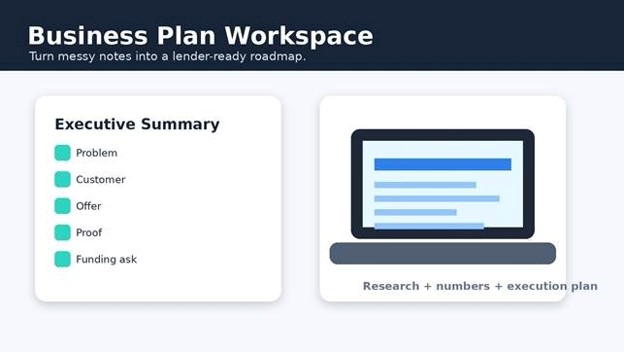
A good executive summary answers five questions quickly: What is the business, who does it serve, why will customers buy, how will it make money, and what is needed next? If a busy investor reads only this page, they should understand the opportunity and the next decision.
When you learn how to write a business plan, this section can feel like a sales pitch. Keep it direct instead. Avoid inflated claims like “massive potential” unless you back them with market data, customer proof, or traction.
Use this mini-structure:
- Business concept: one sentence explaining what you sell and to whom.
- Problem: the painful customer issue your offer solves.
- Solution: your product, service, platform, or system.
- Market proof: interviews, search demand, competitor gaps, revenue tests, or local data.
- Financial snapshot: expected revenue model, margin, startup cost, and break-even goal.
- Ask or next step: funding request, partnership need, hiring plan, or launch milestone.
| Pro-Tip:
Keep the executive summary under one page for most small businesses. If it needs two pages, the business model is probably not clear enough yet. |
Define the Business Problem With Proof
Weak plans describe the product first. Strong plans describe the pain first.
Customers do not buy “features.” They buy relief, speed, status, convenience, trust, savings, or revenue growth. Your business plan must show the exact reason someone changes behavior and pays you instead of ignoring the problem.
Write the problem in plain language: “Small clinics miss follow-up appointments because staff manually call patients after hours,” or “busy parents want healthy lunches but do not have time to cook every morning.” Specific beats clever.
Then prove the problem exists. Use customer interviews, support tickets, search demand, review mining, survey data, complaints in forums, competitor reviews, and sales tests. If the problem is painful enough, people will already be spending time or money trying to fix it.
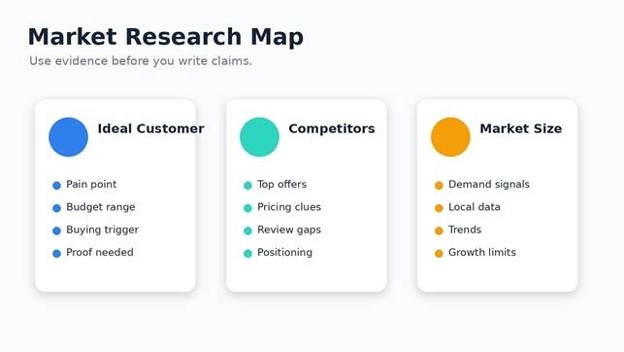
A practical way to validate the problem is to create a “proof folder.” Save screenshots, interview quotes, competitor pricing, negative reviews, market data, and examples of customers asking for the solution. This folder becomes the evidence behind your plan.
For market research, tools like Census Business Builder can provide demographic and economic data that supports location-based decisions, customer assumptions, and market comparisons.
Use: Census Business Builder market data when you need credible research for location, customer, or competitor analysis.
Identify the Target Customer Narrowly
“Everyone” is not a target market. It is a warning sign.
Your plan should define the buyer so clearly that your marketing, pricing, and operations become easier. A narrow target market does not mean your business can never serve others. It means your launch strategy has a sharp first audience.
Create a customer profile with these details:
- Buyer type: consumer, business owner, manager, parent, student, agency, retailer, or enterprise team.
- Situation: what is happening when they need the product?
- Pain level: is this annoying, expensive, urgent, risky, or mission-critical?
- Budget: what can they realistically pay?
- Buying trigger: what event makes them search, call, compare, or request a quote?
- Objections: price, trust, switching effort, timing, risk, or lack of awareness.
If your business sells to companies, separate the user from the buyer. A receptionist might use your tool, but the clinic manager approves the purchase. A sales team might want automation, but the owner signs the contract.
The clearer this section becomes, the easier it is to understand how to write a business plan that actually supports marketing and sales decisions, not just funding conversations.
| 💡 Quick Hack:
Copy 20 real customer reviews from competitors into a document. Highlight repeated complaints in red and repeated compliments in green. The red phrases reveal pain. The green phrases reveal what customers already value. |
Explain the Product or Service Like a Buyer
This section is not a brochure. It is a buyer-facing explanation of what you sell, how it works, and why it is better than the current alternative.
Start with the core offer. Then list the main features, delivery method, pricing model, support model, and limits. If there are packages, explain who each package is for.
Use simple language. Instead of saying “AI-enabled omnichannel customer experience optimization,” say “a chatbot that answers common customer questions, collects leads, and sends complex requests to your team.”
A clean product section should include:
- The exact product or service name.
- The main customer outcome.
- What is included and what is not included.
- How customers buy, receive, install, use, or renew it.
- Pricing logic: one-time, subscription, hourly, package, commission, or usage-based.
- Proof: samples, pilot results, guarantees, testimonials, demos, or case studies.
If your product has technical complexity, include a simple diagram. Buyers and lenders do not need every backend detail; they need enough clarity to believe you can deliver.
Create the Business Model Before the Long Draft
A business model explains how the company creates, delivers, and captures value. It is the engine behind the plan.
Before you write long paragraphs, use a one-page business model canvas. This forces you to name the most important pieces: customers, value proposition, channels, relationships, activities, resources, partners, costs, and revenue streams.
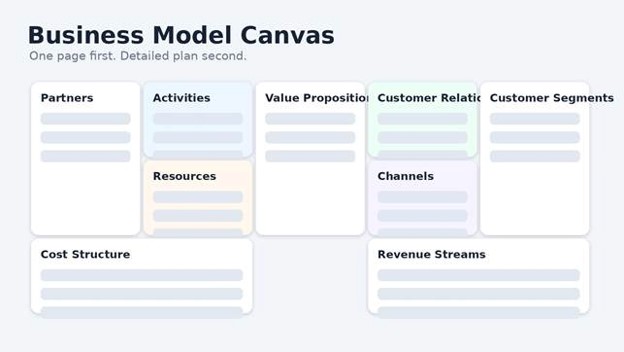
This is where MyFlexBots readers can make the plan sharper. If automation, chatbots, CRM workflows, or AI tools reduce operating costs, mention them in the operations model instead of leaving them as vague “technology.”
Internal link suggestion: connect this section to AI automation for small business so readers can move from planning into implementation.
When founders ask how to write a business plan for a digital, service, or automation-based company, this canvas is especially useful because it exposes delivery bottlenecks early. If customer acquisition, onboarding, support, and fulfillment are not defined, revenue projections will be fantasy.
Write the Market Analysis Without Guessing
The market analysis proves that enough customers exist and that your business can reach them. It should combine industry research, customer research, competitor research, and your own interpretation.
Do not dump random statistics into this section. Every data point must answer a decision question: Is demand growing? Who buys? Where are they? How much do they spend? What alternatives do they use? Why is there room for your business?
At this stage, how to write a business plan becomes a research exercise more than a writing exercise.
Build the section in this order:
- Industry overview: what category you are entering and what major trends affect it.
- Target market: the specific customer segment you will pursue first.
- Market size: realistic serviceable market, not just a huge global number.
- Demand signals: search trends, customer interviews, competitor volume, local data, waitlists, preorders, or pilot results.
- Competitive analysis: direct competitors, indirect alternatives, pricing, strengths, weaknesses, and gaps.
- Positioning: why your offer is different enough to matter.
A useful competitor table includes company name, customer type, offer, price, strengths, weaknesses, review complaints, and opportunity gap. The review complaints are often more useful than the homepage copy.
Your goal is not to prove competitors are bad. Your goal is to show where your business can win: faster service, simpler onboarding, better support, lower friction, stronger specialization, or a smarter pricing model.
Build the Sales and Marketing Plan
A sales and marketing plan answers how strangers become paying customers. It is one of the most practical sections because it connects the business idea to actual revenue.
Start with your first three acquisition channels. Do not list every platform. Choose the channels that fit the target customer and buying journey.
Examples:
- Local service business: Google Business Profile, local SEO, referral partners, before-and-after content.
- B2B software: LinkedIn outreach, demos, content marketing, partner webinars, review platforms.
- E-commerce brand: SEO category pages, paid social, influencer seeding, email flows, marketplace testing.
- Consulting service: authority content, case studies, targeted outreach, webinars, strategic partnerships.
Your marketing section should also include a simple funnel: awareness, lead capture, conversion, onboarding, retention, and referrals. Each stage needs a tactic, owner, tool, and metric.
Internal link suggestion: connect this section to business automation tools for readers who want to automate lead capture, follow-ups, and reporting.
When deciding how to write a business plan for growth, treat marketing as a system, not a wishlist. A channel is only useful if you know the message, budget, timeline, conversion goal, and follow-up process.
| Pro-Tip:
Add a “first 100 customers” subsection. Explain exactly where those customers will come from and what action will convert them. This is more convincing than a broad five-year marketing paragraph. |
Map Operations Like a Daily Workflow
Operations describe how the business actually runs. This is where a plan stops being a pitch and becomes a working manual.
List the steps from customer inquiry to delivery, support, billing, and repeat purchase. If the process needs inventory, equipment, software, staff, suppliers, shipping, scheduling, installation, or quality checks, name them.
A simple operations map can follow this format:
- Lead arrives through website, referral, marketplace, phone call, or ad.
- Customer receives quote, demo, proposal, or checkout page.
- Payment, deposit, subscription, or contract is completed.
- Onboarding information is collected.
- Product or service is delivered.
- Quality check confirms the result.
- Support, follow-up, review request, and retention campaign are triggered.
For MyFlexBots, this is a natural place to explain automation opportunities. Chatbots can qualify leads, CRMs can route deals, email sequences can onboard customers, and dashboards can track performance without manual reporting.
Internal link suggestion: connect customer service workflow ideas to your customer support chatbot guide.
Mention what will be manual at launch and what will be automated later. This keeps the plan realistic while still showing a path to scale.
Write the Management and Organization Section
People fund and support businesses they believe can execute. Your management section should show who is responsible for the main work and why they are capable.
Include owners, key managers, advisors, contractors, and missing roles. A missing role is not a weakness if you name it honestly and explain when you will hire, outsource, or partner.
Cover these points:
- Ownership structure and decision-making roles.
- Relevant experience of founders and managers.
- Current team members and contractors.
- Hiring plan for the next 6 to 18 months.
- Key advisors, mentors, or service providers.
- Legal structure, if already chosen, or professional advice needed.
The IRS notes that business structure affects which income tax return form a business files, and common forms include sole proprietorship, partnership, corporation, S corporation, and LLC. Treat this as a planning checkpoint, not a substitute for legal or tax advice.
Reference: IRS business structure options.
If you are not sure about the structure, say so and list the next step: consult an accountant, review local requirements, compare liability exposure, and confirm tax implications before launch.
Create Financial Projections That Can Survive Questions
Financial projections are where many business plans become unrealistic. The fix is to build from small assumptions that can be checked.
Start with startup costs. Include registration, equipment, inventory, software, website, branding, professional fees, deposits, rent, insurance, launch marketing, and emergency cash. Most founders underestimate cash needs because they ignore the months before revenue stabilizes.
Then build monthly projections for revenue, cost of goods sold, gross margin, operating expenses, owner pay, debt payments, taxes, and ending cash. You do not need a perfect spreadsheet; you need a transparent one.
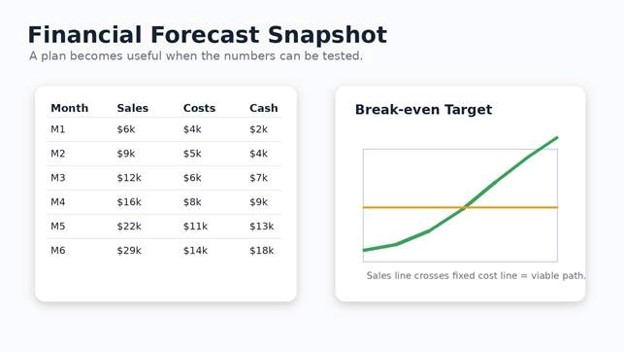
Include three scenarios: conservative, expected, and aggressive. The conservative case is the most important because it shows whether the business can survive slower sales, higher costs, or delayed payments.
When learning how to write a business plan, founders often ask how many years of projections to include. For a small business or startup, 12 months of detailed monthly projections plus a 3-year annual outlook is usually enough for initial planning. Lenders and investors may request more detail depending on the deal.
SCORE provides a business plan template that includes startup expenses, capitalization, financial plan sections, and appendices for supporting documents.
Reference: SCORE business plan template.
| 💡 Quick Hack:
Build your first forecast backward from capacity. If you can serve only 40 clients per month, do not project 120. Capacity keeps revenue assumptions honest. |
Add Risks, Assumptions, and Fallback Plans
A plan with no risks looks inexperienced. Every business has risk: customer acquisition, pricing, supply, staffing, cash flow, competition, compliance, technology, seasonality, and founder bandwidth.
List the top five risks and the response for each. This shows maturity and helps the reader trust your judgment.
Use a simple risk table: risk, likelihood, impact, early warning sign, prevention step, backup plan. For example, if paid ads become too expensive, your backup might be SEO, partnerships, referral programs, or outbound sales.
Assumptions matter too. If your plan assumes a 5% conversion rate, $50 average order value, 30-day sales cycle, or 20% repeat purchase rate, state it. Assumptions hidden inside a spreadsheet are hard to defend.
The best business plans are not risk-free. They are risk-aware.
Turn the Plan Into a 90-Day Execution Roadmap
A business plan is not finished when the writing stops. It is finished when it tells the team what to do next.
Create a 90-day execution roadmap with weekly or biweekly milestones. This keeps the plan connected to action and exposes unrealistic timelines early.
Your roadmap should include:
- Market validation tasks: interviews, surveys, landing page tests, competitor research, or pilot offers.
- Product tasks: prototype, vendor setup, service checklist, onboarding process, quality standards.
- Marketing tasks: website pages, content, ads, email sequences, social proof, Google Business Profile, outreach.
- Sales tasks: script, pricing sheet, proposal template, CRM setup, follow-up cadence.
- Operations tasks: tools, SOPs, suppliers, fulfillment process, support workflow, reporting dashboard.
- Finance tasks: budget, bank account, bookkeeping setup, break-even review, cash reserve target.
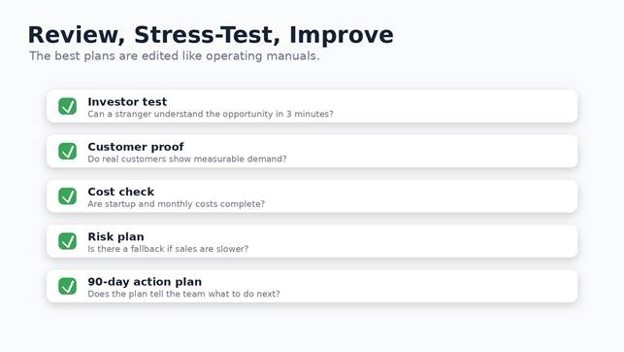
If you want to know how to write a business plan that your team will actually use, do not skip this roadmap. It converts strategy into calendar work.
Common Mistakes to Avoid
Mistake 1: Starting With a Template Instead of a Decision
Templates are helpful, but they can also hide weak thinking. If you fill sections before knowing the reader and purpose, the plan becomes long but unfocused.
Prevent it by writing the decision first: funding approval, co-founder alignment, launch plan, operational clarity, or market validation.
Mistake 2: Using Big Market Numbers Without Serviceable Market Logic
A billion-dollar industry does not prove your business can sell anything. Readers want to know the reachable slice: location, segment, budget, buying behavior, and channel access.
Prevent it by showing total market, serviceable market, and first target segment separately.
Mistake 3: Hiding Weak Competitor Research
Saying “we have no competitors” is rarely true. Customers are already solving the problem somehow, even if the alternative is manual work, spreadsheets, referrals, or doing nothing.
Prevent it by listing direct competitors, indirect substitutes, and the status quo.
Mistake 4: Making Financials Too Optimistic
Smooth revenue growth charts look nice, but real businesses have slow months, delayed payments, churn, returns, refunds, staff gaps, and marketing experiments that fail.
Prevent it with conservative, expected, and aggressive scenarios, plus clear assumptions.
Mistake 5: Writing for Impressiveness Instead of Usefulness
A business plan packed with buzzwords can feel polished while saying almost nothing. Useful plans are specific: who buys, what they pay, how you deliver, what it costs, and what happens next.
Prevent it by asking after every section: “Could someone make a decision from this?”
Advanced Tips and Next-Level Hacks
Create a One-Page Scorecard
Build a scorecard with 8 to 12 metrics: leads, conversion rate, average order value, gross margin, cash balance, repeat purchase rate, churn, delivery time, support tickets, and customer satisfaction.
Attach this to the end of the plan. It gives founders and managers a simple way to review progress every month.
Use a “No-Go” Criteria List
Smart founders define when they will stop, pivot, or change tactics. For example: if customer acquisition cost stays above a set amount for 60 days, the channel gets paused.
This prevents emotional spending and protects cash.
Write the Investor Version After the Operator Version
The operator version explains how the business works. The investor version explains the opportunity, traction, return potential, and use of funds.
Do not write the investor version first. It may look persuasive but miss operational reality.
| 💡 Quick Hack:
Record yourself explaining the plan in five minutes. Transcribe it. The cleanest spoken lines often become the best executive summary copy. |
Add Proof Blocks Throughout the Plan
After major claims, add proof: interview count, pilot result, quote, competitor data, waitlist size, cost estimate, vendor quote, or customer behavior.
This makes the document feel researched instead of imagined.
Use Automation as a Scaling Section
If your business will use AI, chatbots, workflow automation, CRM routing, or automated reporting, show where those systems reduce cost or improve service speed.
Automation belongs in operations, sales, customer support, and financial assumptions. It should not appear as a trendy add-on.
| Pro-Tip:
Create a “manual now, automated later” table. It shows investors and partners that you understand both launch reality and scale potential. |
Troubleshooting and Maintenance Guide
Problem: The Plan Feels Too Long
Fix it by cutting repeated explanations and moving support material to the appendix. The main plan should carry the argument. Extra charts, resumes, leases, product specs, and detailed research can sit behind it.
Problem: The Financials Do Not Match the Strategy
If the marketing plan says premium positioning but the forecast assumes low pricing, the plan will feel inconsistent. Recheck pricing, volume, conversion rate, and delivery capacity together.
Problem: The Market Section Sounds Generic
Add customer interviews, competitor review patterns, location data, or search behavior. Specific proof makes the section useful.
Problem: The Plan Has No Clear Next Step
Add a decision box at the end: approve budget, schedule launch, build prototype, run pilot, hire role, secure supplier, or prepare funding package.
Problem: The Team Stops Using the Plan
Turn it into a monthly review document. Update assumptions, compare projections to actual numbers, and add lessons learned. A stale plan becomes decoration; a maintained plan becomes management equipment.
Maintenance Schedule
- Weekly: update active tasks, blockers, and customer feedback.
- Monthly: review sales, costs, cash flow, conversion rates, and customer acquisition costs.
- Quarterly: revise market assumptions, competitor changes, pricing, hiring needs, and automation opportunities.
- Annually: rebuild the strategy, funding needs, and 12-month financial forecast.
Once you understand how to write a business plan, the maintenance habit matters just as much as the first draft. The market changes, costs shift, and customer feedback exposes what the original draft missed.
Frequently Asked Questions
How long should a business plan be?
A lean plan can be one page. A traditional plan may be 15 to 40 pages, depending on the complexity of the business, funding needs, and amount of research required. The best length is the shortest document that answers the reader’s decision questions clearly.
Can I write a business plan myself?
Yes. Many founders can write the first draft themselves if they gather customer research, competitor data, cost estimates, and financial assumptions. You may still want an accountant, mentor, or industry expert to review the financial and legal sections.
What is the most important part of a business plan?
The most important part is the connection between customer demand, revenue model, operations, and financial projections. A great executive summary helps, but the plan only works if the underlying business logic is sound.
Do I need a business plan if I am not seeking funding?
Yes, but it can be shorter. Even without funding, a plan helps you clarify the customer, pricing, costs, delivery workflow, marketing strategy, risks, and first 90 days of action.
What should I include in a startup business plan?
Include an executive summary, company description, problem and solution, target market, competitor analysis, product or service details, marketing plan, operations plan, management section, financial projections, risks, and appendix.
How often should I update my business plan?
Review the plan monthly during launch and quarterly once the business stabilizes. Update the financial forecast, marketing assumptions, competitor research, pricing, team needs, and operational workflows whenever real data proves the original assumptions wrong.
Conclusion: Build a Plan You Can Actually Use
A business plan is not paperwork. It is a pressure test for your idea, a decision tool for your team, and a roadmap for the money, people, systems, and actions required to make the business work.
The smartest way to write one is to start narrow, prove demand, make the numbers visible, and turn strategy into a 90-day execution plan. If you came here wondering how to write a business plan, you now have the structure, tools, mistakes, hacks, and maintenance system to build one with confidence.
Knowing how to write a business plan is a repeatable operating skill, not a one-time startup chore.
What part of your business plan feels hardest right now: market research, financial projections, marketing strategy, or operations? Share it in the comments so we can break it down into a practical next step.
editor's pick
latest video
news via inbox
Nulla turp dis cursus. Integer liberos euismod pretium faucibua