How to Write a Business Plan Step by Step: 10 Steps
How to write a business plan step by step can feel intimidating because a good plan asks you to think about customers, competition, operations, money, and growth at the same time. The easiest way to make progress is to treat the document as a sequence of decisions rather than a school-style report.
This guide walks you through a practical 10-step process you can use for a new startup, a side business, an existing company, or a funding application. You will build the plan from evidence, translate assumptions into numbers, and finish with a document you can actually use to run the business.
Quick Answer: What Is the Best Way to Write a Business Plan?
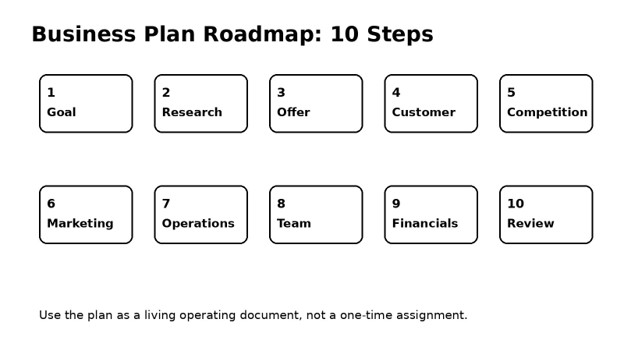
How to write a business plan step by step starts with defining the goal of the plan, researching your market, describing your offer and customer, analyzing competitors, planning marketing and operations, setting responsibilities, building financial projections, testing assumptions, and reviewing the document regularly. Keep every claim specific, measurable, and supported by evidence.
Essential Tools & Materials Breakdown
You do not need expensive software to create a serious business plan. A browser, a spreadsheet, reliable research sources, and a clear writing tool are enough for most small businesses. The table below shows what you need, what it should cost, and how difficult each part is for a beginner.
| Tool / Material | Purpose | Estimated Cost | Skill Level | Practical Note |
| Word processor | Draft the plan | Free-$15/mo | Beginner | Google Docs, Word or LibreOffice works. |
| Spreadsheet | Forecast sales, costs and cash | Free-$15/mo | Beginner-Intermediate | Use formulas; avoid typing totals manually. |
| Market data | Size demand and demographics | Free | Beginner | Use government and industry sources. |
| Competitor research | Compare offers, pricing and proof | Free | Beginner | Websites, reviews, directories and calls. |
| Accounting records | Ground projections in real numbers | Existing system | Intermediate | Use actual margins and payment timing. |
| Customer interviews | Validate demand and objections | Free | Beginner | Five useful interviews beat fifty assumptions. |
| Calculator / break-even model | Test unit economics | Free | Beginner | Check contribution margin and cash needs. |
| Review checklist | Check consistency | Free | Beginner | Make narrative and numbers agree. |
| 💡 Quick Hack: Start with a plain document and spreadsheet before buying business-plan software. Paid templates can make a weak idea look polished, but they cannot fix weak research, unrealistic margins, or unclear customer demand. |
Before You Start: Choose the Right Type of Business Plan
Before learning How to write a business plan step by step, decide who will read the document. The same business may need a short internal plan for the founder and a more detailed version for a bank, investor, partner, landlord, or grant application.
Traditional business plan
Use a traditional plan when an outside reader needs detail. It usually includes an executive summary, company description, market analysis, organization, products or services, marketing and sales, funding needs, and financial projections. The SBA notes that there is no single correct format; the useful format is the one that fits your business and audience.
Lean business plan
A lean plan is better when speed matters. It can fit on one or two pages and summarize the problem, customer, solution, channels, costs, revenue, key metrics, and immediate priorities. It is ideal for testing an idea before spending heavily.
| Pro-Tip: Write the lean version first even if you ultimately need a traditional plan. If you cannot explain the economics, customer and advantage on one page, adding 30 pages usually creates more words, not more clarity. |
Define the Purpose of Your Business Plan
The first move in How to write a business plan step by step is to define what the document must help you accomplish. A plan for your own decision-making should emphasize assumptions, milestones and cash. A plan for a lender should make repayment capacity and risk easy to understand. A plan for an investor should clarify scale, market opportunity and return potential.
Write one sentence that begins: “This business plan will help us…”
Name the primary reader: founder, lender, investor, partner, grant reviewer or management team.
Choose the planning horizon. Three years is often detailed enough for a small business; five years may be appropriate for capital-heavy or long-cycle businesses.
List the three decisions the reader should be able to make after reading the plan.
This purpose statement becomes your editing filter. If a paragraph does not help the reader make one of those decisions, shorten it, move it to an appendix, or delete it.
Research the Market Before You Write Claims
A business plan is only as strong as the evidence behind its assumptions. Research demand, customer demographics, local competition, price ranges, industry conditions, and the practical constraints that could affect your launch.
For U.S.-focused plans, the Census Business Builder provides demographic and economic data designed for entrepreneurs and small-business research. It can help you compare locations, explore market characteristics and create reports for planning. For staffing assumptions, BLS wage data can help you estimate realistic labor costs by occupation and geography.
| 💡 Quick Hack: Create a research folder with three subfolders: Customer, Competition and Costs. Save every useful source, screenshot, quote, price and data table there before drafting the narrative. This prevents “I know I saw that number somewhere” problems later. |
How to estimate market demand
Do not confuse a large industry with an accessible market. Start from the number of plausible buyers you can realistically reach, multiply by purchase frequency, then test whether your likely share is sensible given your budget, location, capacity and competitors.
For a local service company, your obtainable market might be households or businesses within a defined drive time. For an online service, narrow the audience by industry, company size, job role, need and geography. A smaller credible market is more valuable than a giant number that does not connect to your sales plan.
Define Your Product, Service and Value Proposition
A key part of How to write a business plan step by step is explaining exactly what you sell and why a customer would choose it. Avoid vague statements such as “high quality,” “excellent service,” or “innovative solutions.” Every competitor can say the same thing.
Instead, describe the job your customer is trying to get done, the pain or cost of the current alternative, your specific solution, the proof that supports your claim, and the trade-off you make. A strong offer might compete on speed, specialization, convenience, reliability, location, customization, price transparency or measurable outcomes.
What does the customer buy?
What result do they expect?
What makes your version meaningfully different?
What must be true for you to deliver that promise consistently?
What evidence can you show: reviews, experience, certifications, case studies, samples, guarantees or response-time data?
| Pro-Tip: Write your value proposition in this structure: “For [customer] who needs [outcome], we provide [specific offer] that delivers [primary benefit] because [proof or capability].” Then remove every word that is not necessary. |
Build a Clear Customer Profile
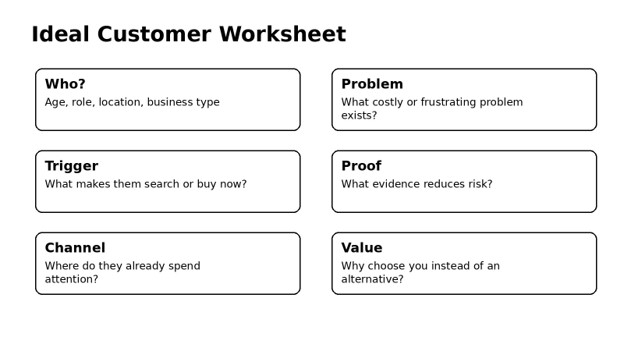
A useful customer profile goes beyond demographics. You need to understand the moment that creates demand. A homeowner does not buy a repair because of age or income alone; they buy because something broke, became unsafe, became expensive, or created urgency.
Document the buyer’s trigger, decision criteria, objections, budget, preferred channels, buying timeline, and who else influences the decision. For B2B customers, include company size, industry, decision-maker role, procurement process, contract length and approval steps.
If you serve multiple segments, choose a primary segment first. Trying to make one launch plan for “everyone” makes pricing, messaging and channel decisions much harder.
Analyze Competitors and Find a Defensible Gap
When you work through How to write a business plan step by step, competitor research should answer one question: where can your business be meaningfully better, easier, faster, safer, more specialized, or more convenient? The goal is not to prove competitors are bad. The goal is to understand the standard customers already expect.
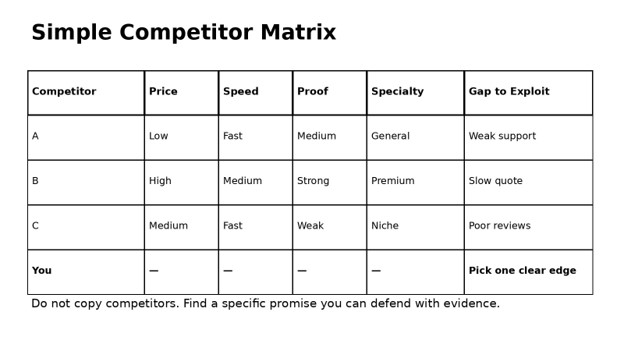
Review direct competitors, indirect alternatives, do-it-yourself options, and the choice to do nothing. Compare price, turnaround time, offer design, reviews, guarantees, distribution, customer experience, specializations and weaknesses visible in public feedback.
| 💡 Quick Hack: Read the lowest and highest customer reviews, not only the average rating. Repeated complaints reveal operational gaps; repeated praise reveals what customers truly value enough to mention. |
Create the Marketing and Sales Plan
A marketing plan should connect audience, message, channel, budget and measurable conversion steps. Avoid writing “we will use social media, SEO and ads” without explaining who each channel reaches and what should happen next.
Build the customer journey
Awareness: How will the right person discover you?
Consideration: What proof will make them take you seriously?
Conversion: What is the next action—call, quote request, checkout, booking or demo?
Follow-up: How will you recover leads who do not buy immediately?
Retention: What creates repeat business, referrals or renewals?
Give each channel a target metric. Paid search might be measured by qualified cost per lead. SEO may track non-branded organic leads and ranking coverage. Email might track replies, booked calls or repeat purchases rather than opens alone.
Design the Operations Plan
An operations section is where How to write a business plan step by step becomes practical. Describe what must happen after a customer says yes. Map the flow from inquiry or order to delivery, quality control, payment, support, and follow-up.
Location, equipment and software required
Suppliers and backup suppliers
Capacity per day, week or month
Lead times and delivery standards
Inventory or material requirements
Quality-control checks
Customer support process
Licenses, insurance, data protection or industry compliance relevant to the business
Then identify the bottleneck. A business can generate demand faster than it can deliver, and that can create refunds, poor reviews and cash stress. Planning capacity is as important as planning sales.
| Pro-Tip: Write one “failure mode” beside every critical operation. Example: if the main supplier is late, what happens? If the owner is unavailable, who can quote? If the payment gateway fails, what is the backup? Resilience is a competitive advantage. |
Define the Team, Roles and Responsibilities
Investors and lenders care about the people who will execute the plan, but founders also need this section for themselves. List the roles the business needs now, the roles the founder will cover temporarily, and the roles that should be hired or outsourced when specific milestones are reached.
For each role, define the result it owns, not just a title. “Marketing Manager” is vague; “owns qualified lead volume and cost per acquisition” is operational. “Operations” becomes clearer when it owns delivery time, quality and capacity.
Use current wage data where possible when estimating payroll. BLS Occupational Employment and Wage Statistics can provide location- and occupation-based wage benchmarks for U.S. planning, though your actual pay should reflect your market, seniority and employment model.
Step 9: Build Financial Projections From Assumptions
The financial section is where How to write a business plan step by step becomes testable. Do not start by typing the profit you hope to make. Build the model from operating assumptions: customers, purchase frequency, price, gross margin, staffing, overhead, payment timing and growth.
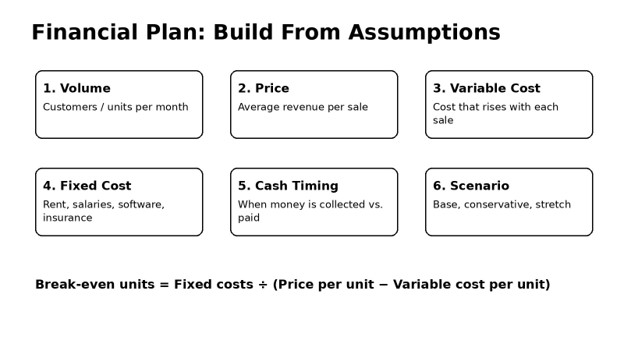
Start with the sales forecast
Estimate units, customers or projects by month. Multiply volume by average selling price. If the business has several products, forecast them separately because margins and growth rates may differ.
Calculate variable costs
Variable costs change as sales change. They may include materials, packaging, payment processing, commissions, shipping, contractor labor or usage-based software. Subtract variable cost from revenue to understand contribution margin.
List fixed costs
Fixed or semi-fixed costs include rent, core salaries, subscriptions, insurance, professional fees, internet, basic utilities, and minimum marketing commitments. Some expenses step up when the business grows, so note the point at which you need another employee, vehicle, machine or location.
Build cash flow, not just profit
A profitable business can still run out of cash. If customers pay in 45 days but suppliers require payment in 10, you need working capital to cover the gap. Show when cash actually enters and leaves the bank account.
Calculate break-even
A simple unit break-even formula is: fixed costs divided by contribution margin per unit. If fixed costs are $10,000 per month, price is $100 and variable cost is $40, contribution margin is $60. Break-even is about 167 units per month before taxes and financing costs.
| 💡 Quick Hack: Create three scenarios: conservative, base and stretch. Change only a few major drivers—sales volume, average price, conversion rate, gross margin and hiring date. This shows which assumptions matter most and makes your plan more credible. |
Write the Executive Summary Last and Review the Whole Plan
The final stage of How to write a business plan step by step is to write the executive summary after the research, operations and numbers are complete. The summary should compress the plan, not introduce a different version of the business.
In one to two pages, explain the business, customer problem, solution, target market, business model, evidence of demand, competitive advantage, team, major financial points, funding need if any, and the next milestones. A busy reader should be able to understand the core opportunity without reading 30 pages first.
Then perform a consistency check. The marketing budget must match the customer-acquisition plan. The sales forecast must fit operational capacity. Hiring dates must match payroll expenses. Funding needs must match the cash forecast. Contradictions are one of the fastest ways to make a plan feel unreliable.
| Pro-Tip: Read the executive summary by itself 24 hours after finishing the plan. If it still makes sense without the rest of the document, it is doing its job. |
What a Strong Business Plan Should Contain
A complete traditional plan usually contains the following sections. You can adjust the order for your audience, but the logic should remain easy to follow.
Executive summary
Company description
Problem and customer need
Products or services
Market and customer analysis
Competitive analysis
Marketing and sales strategy
Operations plan
Management and organization
Financial projections
Funding request, if applicable
Milestones, risks and appendix
Common Mistakes to Avoid
- Starting with a 30-page template before validating the idea
A long template can create false progress. Validate the customer, problem, price range and basic economics first. Expand the document after the idea survives those tests.
- Using market-size numbers without explaining your reachable market
“The global market is worth billions” tells the reader almost nothing about your sales potential. Show where your first customers live, how many fit your target profile, and how you will reach them.
- Forecasting revenue without capacity or conversion logic
A revenue target needs a chain of assumptions. If you need 100 customers, show how many leads, calls, proposals or website visits are needed at realistic conversion rates.
- Ignoring cash timing
Profit and cash are not the same. Include customer payment terms, supplier terms, deposits, inventory purchases, taxes, payroll and debt payments in cash planning.
- Treating the plan as finished after it is printed
The best plan becomes a management tool. Review assumptions and actual performance every month or quarter, depending on how quickly the business changes.
Advanced Tips and Next-Level Hacks
Once you understand How to write a business plan step by step, the next improvement is to turn the plan into a decision system. Use the following techniques to make it useful after launch.
Tie assumptions to leading indicators
Revenue is a lagging result. Track the activities that create it: qualified leads, demos, proposals, conversion rate, average order value, repeat rate and delivery capacity. When a leading indicator changes, you can react before the monthly accounts show the full impact.
Add an assumptions register
Create a one-page table with each important assumption, current estimate, evidence, owner, review date and confidence level. Example: “Average quote-to-sale conversion = 30%; source = last 60 quotes; review monthly.”
Use milestones with kill, change and invest-more rules
Instead of saying “grow marketing,” define thresholds. If a channel produces qualified customers below your target cost for eight weeks, increase the budget. If it remains above the ceiling after two controlled tests, pause and reallocate.
Separate facts from hypotheses
Label evidence clearly. “Our current customers reorder every 60 days” is a fact if you have transaction data. “New customers will reorder every 60 days” is a hypothesis. That small distinction prevents optimism from becoming fake certainty.
| 💡 Quick Hack: Use a one-page “What changed?” log during monthly reviews. Record changes to price, costs, conversion, staffing, competition and regulation. This makes future forecasts faster and gives you a history of why decisions were made. |
Troubleshooting Guide: What to Fix When the Plan Does Not Add Up
Problem: Revenue looks good but cash runs negative
Check payment timing, inventory purchases, deposits, taxes, debt service and one-time setup costs. Add a working-capital line and model the slowest realistic collection period.
How to write a business plan step by step
You have only a few levers: raise price, improve gross margin, lower fixed cost, increase purchase frequency, or change the business model. Do not hide an impossible break-even point with an aggressive sales forecast.
Problem: Marketing costs are too high
Break customer acquisition into channel-level economics. Improve targeting, conversion rate, offer quality, follow-up and retention before assuming you simply need more ad spend.
Problem: The target customer is still vague
Interview real buyers. Ask what triggered the purchase, which alternatives they considered, what nearly stopped them, how they chose, and what outcome mattered most. Use their language in the plan.
Problem: Competitors all look similar
Segment them by customer type, speed, specialization, convenience, price model, delivery method or trust signal. A useful competitive map often appears only after you choose the dimensions customers actually care about.
Problem: The document is too long
Move supporting detail to an appendix. Keep the main plan focused on decisions. A reader should not need to dig through pages of background to find the customer, business model, key assumptions and financial logic.
How to Maintain Your Business Plan Long Term
Review the plan monthly during the first year if the business is new or rapidly changing. Mature businesses may use a quarterly strategic review plus monthly financial monitoring. Update the document when evidence changes—not merely because the calendar changed.
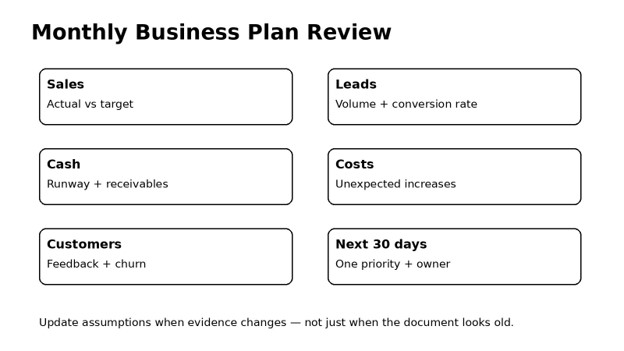
Compare actual revenue, margin and cash with the plan.
Update the sales pipeline and conversion assumptions.
Check whether prices or supplier costs changed.
Review customer feedback and churn or repeat behavior.
Revisit hiring and capacity timing.
Record one to three priorities for the next 30 days.
Good recordkeeping matters here. The IRS explains that reliable business records support financial statements, track income and expenses, and help monitor business progress. Even outside the United States, the principle is universal: your next plan is only as good as the records behind it.
Frequently Asked Questions
How long should a business plan be?
There is no mandatory length. A lean internal plan can be one to five pages. A traditional plan for a lender or investor may be 15 to 30 pages plus an appendix. Use the shortest format that answers the reader’s important questions with evidence.
Can I write a business plan without an accountant?
Yes, especially for an early-stage plan. You can build simple sales, expense, cash-flow and break-even projections yourself. For loans, investors, tax-sensitive structures or complex financing, have an accountant or qualified adviser review the assumptions and statements.
What is the most important section of a business plan?
It depends on the reader. Founders need clear assumptions and cash. Lenders focus on repayment ability and risk. Investors focus on market opportunity, scale, team and returns. Every plan still needs a coherent connection between customer demand, delivery and financial results.
Should I use AI to write a business plan?
AI can help organize research questions, outline sections, challenge assumptions and edit wording. It should not invent market data, customer interviews, prices, legal requirements or financial evidence. Treat AI as a drafting assistant, not as a source of facts.
What financial statements should a business plan include?
Most detailed plans include a sales forecast, profit-and-loss projection, cash-flow forecast and balance-sheet assumptions. Funding applications may require additional schedules, debt details, owner contributions and sensitivity scenarios.
How often should I update my business plan?
Update it whenever a major assumption changes and review it on a predictable schedule. New businesses often benefit from monthly reviews, while established businesses may conduct a deeper quarterly review and annual reforecast.
Conclusion
Learning How to write a business plan step by step is less about producing a perfect document and more about forcing the right decisions into the open. A useful plan explains who the customer is, why they will buy, how the business will deliver, what it costs, where cash comes from, and what evidence would make you change course.
Start with the lean version, validate the riskiest assumptions, then expand only where detail improves a decision. Once the business is operating, compare the plan with reality and update it as new evidence arrives.
editor's pick
latest video
news via inbox
Nulla turp dis cursus. Integer liberos euismod pretium faucibua