best-apps-to-learn-a-language-free-in-2026-top-pick
Paying for a language app before learning your first useful sentence is rarely necessary. The best free apps to learn a language can teach vocabulary, pronunciation, listening, and everyday conversation—but their free plans vary enormously. This guide shows which apps deserve your time, where the paywalls are, and how to build a repeatable learning routine without subscribing.
What are the best free language learning apps in 2026?
The Best apps to learn a language free include Duolingo for daily beginner lessons, Busuu for structured courses and community corrections, Memrise for natural-sounding phrases, Language Transfer for free audio instruction, and AnkiDroid for vocabulary review. Add Tandem or HelloTalk for real conversation and specialist resources for English or German. The ideal choice depends on your language and learning goal.
Quick comparison: 10 free language learning options
| App or service | Best for | Free access | Watch out for |
| Duolingo | Daily beginner habit | Courses with ads | Free-tier interruptions; variable course depth |
| Busuu | Structured courses | Core lessons + community | Extra review/offline tools paid |
| Memrise | Useful vocabulary & video | Limited free features | Full flexibility and some lists paid |
| Language Transfer | Understanding grammar | Free audio courses | Smaller selection; little built-in tracking |
| AnkiDroid / Anki | Long-term recall | Android / desktop free | iOS official app paid; setup required |
| HelloTalk | Native-speaker interaction | Basic exchange features | Limits and safety/moderation considerations |
| Tandem | Conversation partners | Basic exchange features | Free features and partner availability vary |
| Clozemaster | Context sentences | Limited free practice | Not a full beginner curriculum |
| DW Learn German | German courses | Free DW materials | German only |
| British Council LearnEnglish | English skill practice | Large free resource library | Not one universal linear app course |
Important: “free” does not mean feature-identical across countries, devices, or dates. Pricing screens, daily limits, and trial offers can change. Check the current free-plan screen before entering payment details.
What you actually need: tools, costs, and skill level
| Tool or material | Typical cost | Skill level | Purpose |
| Smartphone or computer | Existing device / $0 incremental | Beginner | Run lessons and record speech |
| Headphones with microphone | Existing pair / optional purchase | Beginner | Clear listening and speaking practice |
| Main lesson app | Free plan / $0 | Beginner | Guided sequence and progression |
| Flashcards or spaced repetition | Free on AnkiDroid / desktop Anki | Beginner–intermediate | Remember words beyond the first week |
| Notes or simple spreadsheet | Free / $0 | Beginner | Track phrases and recurring mistakes |
| Conversation partner | Free basic matching where available | Intermediate confidence | Use language with real people |
| Optional paid subscription | Not required | Any | Convenience rather than prerequisite |
Budget reality: A fully workable setup costs $0 in subscriptions if learners already own a connected device. Data charges and optional hardware still apply. Paying for premium is a convenience decision—not evidence of better discipline.
How we evaluated these apps
This editorial comparison weighs six practical questions: Can a beginner start without paying? Does the free material provide a meaningful learning path? Is speech used in realistic contexts? Are review and feedback available? How intrusive are upgrades? Can learners carry skills into a real conversation?
The rankings are use-case recommendations, not laboratory test scores or claims of hands-on testing. Product features were checked against official service descriptions available in October 2026; all vendors can revise plans. This distinction protects readers from exaggerated “100% free forever” promises.
The 10 best free language learning apps, explained
- Duolingo — best for building a daily habit
Duolingo makes the first ten minutes approachable. Small exercises introduce words, short sentences, listening, and translation while immediate feedback helps learners notice errors. For absolute beginners, it solves a common problem: deciding what to study next.
The company says its language courses remain accessible without payment and are supported by ads and optional subscriptions. Free learners should expect friction from advertising and features designed around paid upgrades; the exact daily mechanics can change. When comparing the Best apps to learn a language free, this makes Duolingo a useful baseline for beginner access.
Use it well: Complete one short lesson, then close the screen and say three example sentences without looking. If recall fails, review that lesson instead of grinding points. Treat streaks as a reminder, not your measure of fluency.
Best match: Learners starting Spanish, French, German, Italian, Japanese, or another supported course. Visit Duolingo.
- Busuu — best for a more structured learning path
Busuu organizes bite-sized courses around situations such as introductions, ordering food, and everyday communication. Its community element gives learners the chance to submit written or spoken exercises for feedback from other users. That social correction can expose unnatural sentences an automated checker might miss. For readers comparing the Best apps to learn a language free, its community feedback offers a distinct advantage.
Busuu’s published plan comparison lists essential courses, basic progress tracking, and community access on the free tier. Offline mode, specialized review tools, and several advanced speech features belong to paid tiers. Ads can appear before free lessons.
Use it well: Write an original response for each topic before reading suggested answers. When someone corrects you, copy the corrected sentence into a mistake log and reuse it the following day. Visit Busuu.
- Memrise — best for everyday expressions and listening
Memrise emphasizes practical words and spoken phrases, including video of language used in real contexts. Seeing ordinary people pronounce an expression can help learners become comfortable with different voices and speeds rather than a single clean studio recording. That real-voice focus earns Memrise a place among the Best apps to learn a language free for listening practice.
Its official free-plan descriptions list beginner access to courses, videos, and review tools; paid access expands flexibility and removes some limits. Availability depends on the current plan and chosen language.
Use it well: Take five phrases from one situation—buying tickets, checking into a hotel, or meeting a colleague—and practice them together as a short dialogue. Visit Memrise.
- Language Transfer — best truly free audio-first option
Language Transfer teaches through guided audio prompts rather than constant tapping. The instructor poses a question, pauses, and encourages the learner to build an answer. It is especially useful for people who want to understand how a language works instead of memorizing disconnected phrases. Among the Best apps to learn a language free, this approach is unusually focused on reasoning aloud.
The project offers free audio courses, but course completeness varies by language. It also does not replace extensive conversation or listening immersion.
Use it well: Pause before every answer and speak aloud—even when walking or washing dishes. Replay a lesson if you cannot construct its key sentence unaided. Explore Language Transfer.
- AnkiDroid and Anki — best for remembering vocabulary
Anki is not a complete language course. It is a spaced-repetition memory tool that schedules review near the point a word might be forgotten. This makes it excellent for words discovered in other apps, reading, or conversations. It complements the Best apps to learn a language free because long-term recall requires dedicated attention.
The desktop Anki application and AnkiDroid on Android are free. The official AnkiMobile app for iOS is paid, so iPhone users should not assume that every app with “Anki” in the name offers the same free experience.
Use it well: Make cards from whole phrases rather than isolated translations. Put a short example and, where helpful, audio on the back. Keep new cards manageable so daily reviews do not become a punishment. Anki and AnkiDroid.
- HelloTalk — best for casual language exchange
HelloTalk connects learners with speakers of their target language. Text, voice and social-style interactions help turn studied vocabulary into actual communication. It works best once a learner can introduce themselves and ask several simple questions.
Basic access is available without a subscription, while paid upgrades add conveniences and restrictions vary. Interactions involve other people, so learners should use privacy controls and avoid sharing sensitive personal details.
Use it well: Exchange short voice messages around a single topic. Ask your partner to correct only one or two important errors per message; constant correction can derail the conversation. Visit HelloTalk.
- Tandem — best for planned speaking practice
Tandem is useful for learners who want to arrange deliberate language exchanges instead of simply browsing public posts. A good session can split time evenly: one part speaking in the target language, one part helping the other person.
Free matching and communication opportunities depend on language, region, and current app features. Finding an active partner may take longer than finishing a solo lesson, but the conversational payoff can be higher.
Use it well: Agree on the topic before the call and prepare five questions. Afterward, note useful corrections and schedule a follow-up only if both partners want one. Visit Tandem.
- Clozemaster — best for words in context
Clozemaster tests vocabulary inside sentences with missing words, giving intermediate learners practice in choosing terms based on surrounding meaning. It is a good follow-on tool once core grammar and common vocabulary feel familiar.
Free access is limited relative to its paid offering, and the sentence-focused format is less suitable as a learner’s only introduction to a new language.
Use it well: Explain why a choice fits the sentence, then write a second original sentence using the same expression. Visit Clozemaster.
- DW Learn German — best free German-specific course
Deutsche Welle provides free German lessons with video, audio, texts, and level-appropriate practice. A learner interested in study, work, or relocation to a German-speaking country can benefit from this focused pathway more than an app trying to teach dozens of languages equally.
Start by selecting an appropriate level rather than repeating extremely easy material. Short video scenes are useful for shadowing: replay a line and imitate its rhythm before checking the written transcript.
Best match: German learners who prefer a substantial free curriculum. Explore DW Learn German.
- British Council LearnEnglish — best free English practice
British Council LearnEnglish offers accessible listening, grammar, reading, writing and pronunciation resources. It is particularly helpful for learners who know basic English but need focused practice in one weak skill. The British Council also publishes mobile apps for specific purposes.
A resource library requires more self-direction than a single gamified path. Choose materials at a suitable difficulty and keep an orderly record instead of hopping randomly between videos.
Best match: English learners building practical skills or preparing for more advanced study. Visit British Council LearnEnglish.
Choose one language and a useful 30-day goal
The first mistake is beginning with “I want to be fluent.” That goal cannot guide tomorrow’s study session. Choose a task that can be observed: introducing yourself for one minute, ordering lunch, understanding a short podcast summary, or asking for directions.
Match the goal to what you will actually use. Someone traveling soon should prioritize greetings, directions, numbers, transport, and food. Someone studying abroad may need classroom instructions and common academic verbs. A learner using English at work should practice meetings, questions, and polite clarification.
The Council of Europe’s CEFR framework can give longer-term direction, but a thirty-day app routine is not a guarantee of reaching a CEFR level. Measure a small, functional outcome instead.
💡 Quick Hack: Record a 30-second “day zero” introduction. Repeat the same prompt after 30 days. Comparing two recordings reveals changes in fluency and pronunciation more clearly than counting badges.
Build a three-part free learning stack
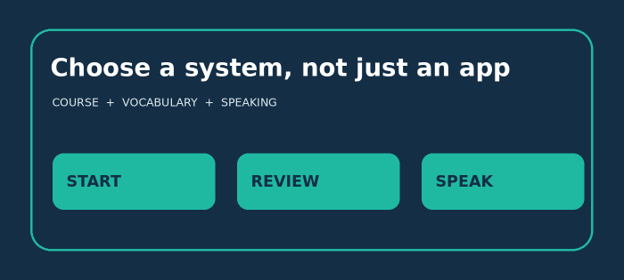
Choose one main course, one review method, and one output channel. For example, Duolingo + AnkiDroid + weekly Tandem exchange makes a coherent routine. Busuu + Memrise review + short self-recorded voice notes is another. Installing seven starter courses rarely improves learning. The Best apps to learn a language free work better together when each has a clear role.
A strong starter setup covers input (hearing and reading), recall (retrieving old material), and output (speaking or writing). When any part is missing, the learner may recognize a phrase in an app yet fail to use it in conversation.
💡 Quick Hack: Make a “no duplicate apps” rule: every tool must do a different job. Delete or silence any app whose function is already covered by another.
Follow a realistic 20-minute daily schedule
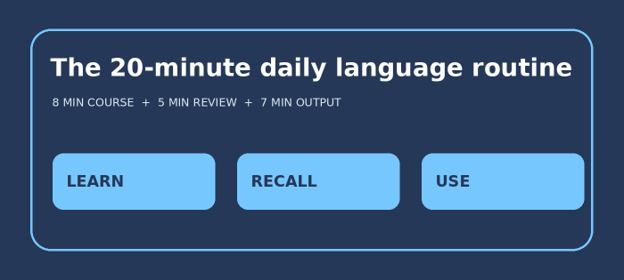
Minutes 0–8: guided lesson. Complete one focused unit. Read the example sentences, listen carefully, and repeat aloud; avoid rushing through prompts merely to preserve a streak.
Minutes 8–13: recall. Review vocabulary or useful sentence cards. When an answer is difficult, retrieve it before flipping the card; effortful recall is the point of the exercise.
Minutes 13–20: output. Speak to yourself, record a voice memo, or write four sentences about your day. Use at least two expressions from today and one from last week.
On busier days, complete a five-minute minimum session. Consistency matters more than a perfect plan that collapses after a weekend.
💡 Quick Hack: Attach practice to a habit that already exists—after breakfast, before the commute, or directly after charging your phone. A regular cue removes the daily decision of when to begin.
Turn passive lessons into real speaking
The biggest transfer gap appears when users can tap the right multiple-choice response but hesitate when speaking. To close it, use a three-pass routine: listen without reading, repeat with the transcript, then explain the idea in your own words. Even the Best apps to learn a language free need a separate speaking habit to transfer knowledge beyond the screen.
Begin with scripts that solve practical problems. For a restaurant conversation, practice greeting someone, asking about a dish, stating a preference, and requesting the bill. Swap nouns and verbs so the exchange becomes flexible rather than memorized.
For safe conversation exchanges, begin with the in-app messaging system. Respect a partner’s time zone, offer help in return, and keep sessions brief. Never send money, identity documents, addresses, or private account credentials to a stranger.
💡 Quick Hack: Use the “one-minute speaking loop”: record an answer, listen once, identify the single most disruptive problem, and record again. Fixing one issue per loop is less overwhelming than chasing perfection.
Learn vocabulary that survives beyond tomorrow
A new word matters only if the learner can remember and apply it later. Instead of collecting huge decks, save common phrases encountered repeatedly. “Could you repeat that?” is often more useful than twenty obscure nouns.
Use a simple spaced review calendar when flashcard software feels complicated: review new material that evening, the following day, three days later, and roughly one week afterward. Adjust the intervals when recall is easy or difficult.
Include pronunciation and context. A card for an everyday verb should contain a natural phrase, not merely a dictionary definition. Avoid importing thousands of unfamiliar cards before learning how to pronounce the language.
💡 Quick Hack: Keep a “missed twice” deck. Anything forgotten on two separate sessions gets a personal sentence or voice recording. The extra context often makes the word more memorable.
Select materials that match your level
Beginners need frequent words, clear audio, predictable topics, and enough repetition. Intermediate learners need exposure to longer, more natural content, including speakers who differ in accent and speed. Advanced learners benefit from specialized topics and extended conversation.
If a lesson is nearly impossible, choose easier material rather than assuming a paid upgrade will fix the issue. If every activity is effortless, raise the difficulty or switch from selection exercises to open responses.
For German, DW’s staged learning materials provide a useful specialist route. For English, the British Council resource library offers skill-specific materials; its listening exercises are a productive supplement to mobile apps.
A practical 30-day plan: from first lesson to first conversation
Days 1–7: Build the foundation
Set your daily reminder, learn essential greetings and question words, and establish a consistent study time. Capture ten to twenty genuinely useful phrases, not an arbitrary vocabulary target. Record a simple introduction by the end of the week.
Days 8–14: Understand and respond
Add short listening practice and replace some multiple-choice review with typed or spoken answers. Learn to ask for repetition, clarification, prices, times, and directions. Try a two-minute simulated conversation with notes nearby.
Days 15–21: Introduce real-world material
Listen to short, level-appropriate clips and attempt to identify the topic before reading subtitles. Use a language exchange platform if comfortable, or record a voice memo in response to a conversation prompt. Save corrections rather than trying to memorize everything.
Days 22–30: Test what you can do unaided
Practice three real-world tasks: introduce yourself, explain a daily routine, and ask several follow-up questions. Record the same introduction as day zero. Identify one persistent weakness and choose the next month’s focus accordingly.
Pro-Tip: Review your progress weekly using tasks completed, not minutes logged. “I can describe my work for forty seconds” is more actionable than “I studied for 280 minutes.”
Five critical mistakes beginners should avoid
Mistake 1: Downloading too many apps
Multiple beginner paths repeat the same easy nouns and create a false feeling of progress. Fix: Choose one primary course and two complementary tools, then keep them for at least two weeks before reassessing.
Mistake 2: Treating streaks as speaking ability
Daily points reward attendance, not necessarily recall under pressure. Fix: Add one weekly spoken or written challenge that cannot be completed by guessing.
Mistake 3: Memorizing words without context
Isolated translations leave learners unsure when a word sounds natural. Fix: Learn phrases, notice collocations, and create an original example for each important expression.
Mistake 4: Ignoring pronunciation until later
Pronunciation habits become harder to change when never practiced. Fix: Listen carefully from day one, imitate short audio clips, and compare a brief recording against a clear model.
Mistake 5: Paying before identifying a specific obstacle
An upgrade might remove ads while leaving the real problem—lack of conversation—untouched. Fix: Write down the barrier first. Only pay if a feature solves that barrier better than a free alternative.
Next-level tactics for faster improvement
Use narrow immersion. Replace a few minutes of familiar entertainment with short target-language clips on a topic already understood. Familiar subject matter lowers cognitive load, making language easier to notice.
Shadow short audio. Listen to a sentence, pause, and imitate its timing and intonation. Start with clean recordings, then attempt natural speed. Accurate rhythm matters alongside individual sounds.
Recycle mistakes deliberately. Keep a two-column log: incorrect expression and corrected expression. Once a week, produce new sentences from the corrections without checking notes.
Run an output-first session. Before opening a lesson, attempt a short explanation of your day. Study only the missing phrases needed to complete it. This creates a reason to remember new material.
Make the environment bilingual. Change labels on a few familiar objects, follow one appropriate news or hobby account, and read simple instructions in the target language. Avoid switching every device setting until it interferes with essential tasks.
💡 Quick Hack: Create a reusable “conversation rescue kit” of ten phrases: asking someone to speak slowly, repeating a question, giving yourself a moment, and checking understanding. These phrases make early practice far less intimidating.
Troubleshooting: solve common app-learning problems
“I remember answers in the app but freeze in conversation”
Cause: too much recognition practice and too little spontaneous production. Solution: close the lesson, answer open-ended prompts aloud, and begin with rehearsed thirty-second scripts. Gradually lengthen each exchange.
“My progress has plateaued”
Cause: repeating comfortable material or not getting useful feedback. Solution: choose a slightly harder listening source, add weekly correction, and test a real task. Do not automatically add more daily minutes.
“I keep forgetting vocabulary”
Cause: excessive new cards, weak context, or irregular recall. Solution: cut new vocabulary by half for a week, review difficult phrases, and connect each phrase to a situation you genuinely encounter.
“The free tier keeps asking me to upgrade”
Cause: a service monetizes additional tools or convenience. Solution: dismiss trials, verify cancellation requirements, and move a missing feature to another free tool. For example, use separate free flashcards rather than paying only for review convenience.
“I cannot find someone to practice with”
Cause: partner availability varies by language, time zone, and profile quality. Solution: write a friendly and specific introduction, suggest a clear topic, and use voice memos while searching. Never pressure strangers to reply.
“The audio is too fast or the accent is unfamiliar”
Cause: the recording is above the learner’s current comprehension level. Solution: listen for the main idea, use a transcript to identify key words, then replay in short segments. Avoid translating every word in real time.
How to maintain progress for six months without paying
Set a monthly checkpoint built around real activities: understanding a short audio clip, describing your week, and discussing one practical topic. Save a dated recording so improvements are visible. Refresh your study materials when they become easy, not merely when you become bored.
Maintain a small number of evergreen habits: brief daily input, spaced review several times a week, and a longer weekly speaking or writing activity. On busy weeks, reduce intensity but keep some contact with the language.
Review app permissions, subscription settings, and exchange-platform privacy periodically. Remove unused apps and export notes or vocabulary when the platform allows. An effective language routine should survive a changed app policy or an unavailable internet connection.
Frequently asked questions
- Can someone really learn a language using only free apps?
Yes, free materials can support meaningful beginner and intermediate progress, particularly when guided lessons are combined with active recall, listening, and speaking. No app guarantees fluency, and real-world practice remains important. A learner can start with the Best apps to learn a language free without buying a subscription.
- Which free language app is best for complete beginners?
Duolingo is an accessible starting point for many widely taught languages because lessons are short and guided. Busuu may suit those wanting a more conventional course structure, while Language Transfer works well for learners who enjoy understanding sentence construction through audio.
- What is the best free alternative to Duolingo?
Busuu is a strong option for structured short lessons and community correction. Memrise emphasizes everyday expressions and listening, while Language Transfer provides a different, audio-first approach. The best alternative depends on which feature a learner feels is missing.
- Are free language-learning apps enough to become fluent?
Apps alone rarely provide the breadth and spontaneity of regular conversations, extensive listening, and reading. Fluency develops through repeated meaningful use across several situations. Free apps can support the process, but the learner must practice beyond app exercises.
- How many minutes a day should beginners study?
A consistent 15–25 minutes is a practical starting routine, not a scientifically guaranteed threshold. Divide the session among learning, recall, and spoken or written output. Increase time when motivation and comprehension remain healthy, rather than pursuing a rigid target.
- What are the best free apps for learning English, Spanish, or German?
For English, British Council LearnEnglish offers targeted skill practice. For Spanish, Duolingo, Busuu, Memrise, and Language Transfer can be combined according to preference. For German, Deutsche Welle is a particularly useful specialist resource alongside a review tool. Check language availability and course depth before committing.
Final verdict: choose a free system you will actually use
The Best apps to learn a language free are not necessarily the ones with the most games, features, or downloadable lessons. They are the options that help someone learn useful material, remember it a week later, and speak or write with increasing independence.
For most beginners, start with Duolingo or Busuu; use Memrise for additional spoken examples; add Language Transfer when available; and use flashcards for long-term recall. When ready, practice with a conversation partner. A purposeful twenty-minute routine is more valuable than a stack of unused subscriptions.
editor's pick
latest video
news via inbox
Nulla turp dis cursus. Integer liberos euismod pretium faucibua