15 Trending Business Ideas for 2026 That Can Make You Money
A promising market can still become an expensive mistake when founders choose a fashionable idea before checking who will pay, how the work will be delivered, and whether profit remains after customer acquisition. This guide turns trending business ideas 2026 into a practical decision system, with realistic startup ranges, first-offer examples, validation steps, and a 90-day path from research to repeat revenue.
You will learn which models fit technical, creative, local-service, and operations-focused founders; how to test an idea before building it; what tools are actually necessary; and how to prevent a side project from becoming a pile of subscriptions, half-finished branding, and weak demand.
What Are the Best Business Ideas to Start in 2026?
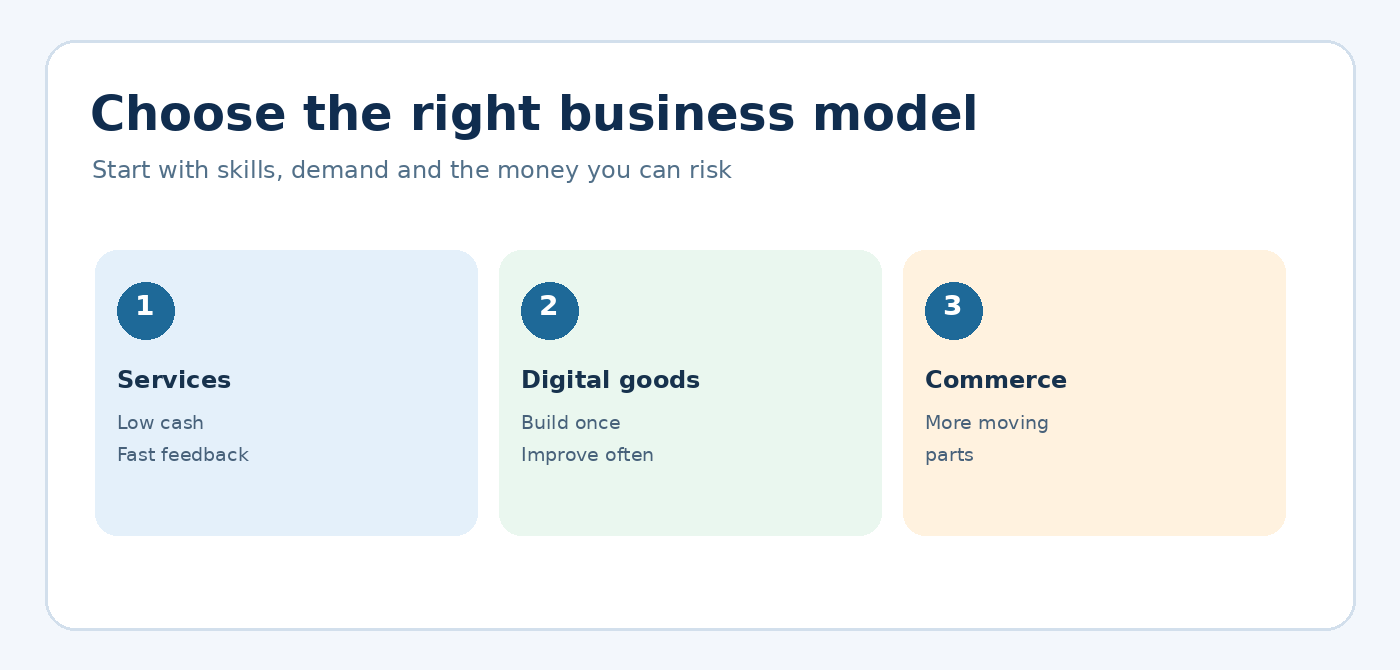
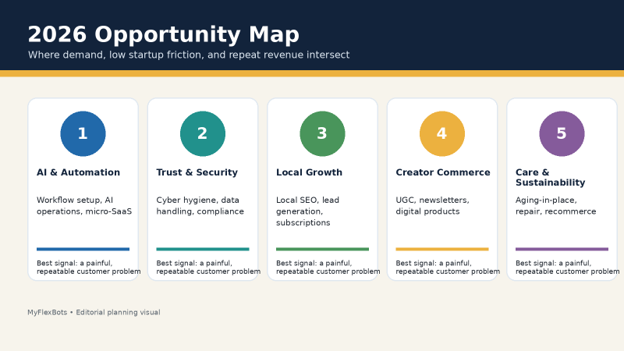
Trending business ideas for 2026 are concentrated in AI-enabled services, cybersecurity, local customer acquisition, creator commerce, recurring home services, digital products, aging-in-place support, and sustainability. The safest choice is not the biggest trend; it is the idea with a reachable buyer, urgent pain, simple pilot, healthy margin, and repeatable delivery.
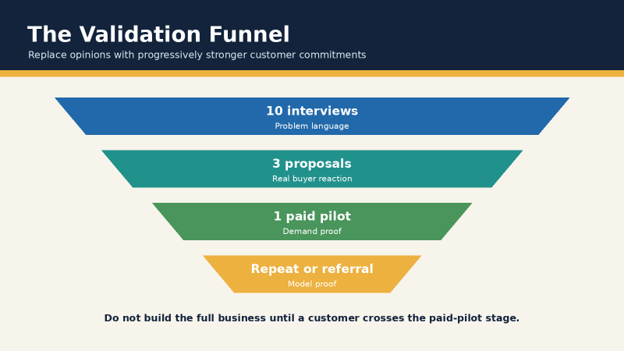
| Featured Snippet Answer: Choose a 2026 business by scoring customer pain, buyer reach, startup cost, gross margin, repeat-purchase potential, and proof speed. Validate the winner through ten interviews, three proposals, and one paid pilot before investing in a full website, inventory, staff, or expensive automation. |
Why 2026 Creates Unusual Openings for Small Operators
The strongest trending business ideas 2026 are not based on one viral app or temporary social-media format. They sit where several durable forces overlap: wider AI adoption, pressure to reduce administrative work, rising cyber risk, fragmented local marketing, demand for short-form content, aging customers, and buyers who want repair, reuse, and lower-waste alternatives.
The U.S. Census Bureau’s report on AI use at U.S. businesses found that overall business AI use hovered between 17% and 20% from December 2025 to May 2026, while 20% to 23% expected to use it within the following six months. That gap creates work for implementers who can turn tools into safe, measurable workflows rather than merely selling prompts.
New-business activity also remains substantial. The Census Bureau reported 531,423 seasonally adjusted business applications in June 2026. More applications mean more young firms that need bookkeeping, websites, customer support, automation, lead generation, and basic cybersecurity—but many cannot yet afford a large agency.
| 💡 Quick Hack: Look for “implementation gaps.” When companies buy a tool but fail to configure, document, train, measure, or maintain it, a service business can be built around the missing step. |
Essential Tools & Materials Breakdown
This is a business-launch toolkit, not a shopping list. Costs are broad U.S.-dollar estimates for a lean start and exclude location-specific registration, taxes, licenses, insurance, inventory, and professional advice. Use free plans until a paid feature removes a proven bottleneck.
| Tool or Resource | Primary Use | Lean Cost | Skill Level |
| Laptop or capable smartphone | Research, outreach, delivery, invoicing | $0 if already owned | Beginner |
| Spreadsheet and notes workspace | Lead tracking, costs, pricing, interview notes | $0–$15/month | Beginner |
| Professional email and calendar | Credibility, scheduling, follow-up | $0–$12/month | Beginner |
| Simple landing page or portfolio | Explain offer, proof, next action | $0–$30/month | Beginner |
| AI assistant | Drafting, summarizing, analysis, SOP creation | $0–$30/month | Beginner–Intermediate |
| CRM or pipeline board | Track prospects, proposals, renewals | $0–$25/month | Beginner |
| Payment and invoicing system | Deposits, invoices, payment records | Transaction fees vary | Beginner |
| Cloud storage and backup | Secure file delivery and recovery | $0–$20/month | Beginner |
| Password manager and MFA | Protect accounts and customer data | $0–$8/month | Beginner |
| Design/video tools | Sales assets, UGC, product visuals | $0–$40/month | Beginner–Intermediate |
| Legal and tax checklist | Structure, contracts, permits, tax setup | Location-dependent | Intermediate |
| Specialist equipment | Only for the chosen model | $0–$2,500+ | Varies |
| Pro-Tip: Do not buy software to feel organized. Buy it only when you can name the manual task, weekly time cost, error rate, and expected payback period. |
Score the Opportunity Before You Fall in Love With It
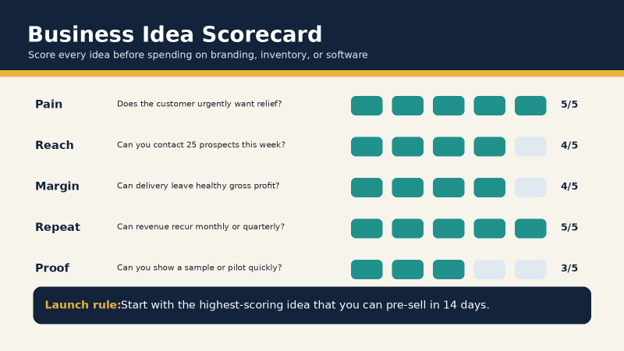
A disciplined review keeps trending business ideas 2026 from becoming trend-chasing. Score each candidate from one to five across six factors, then investigate the top two instead of trying to launch five models at once.
Pain: Does the problem cost the buyer money, time, risk, missed sales, or repeated frustration?
Reach: Can you identify and contact at least 25 suitable prospects without paid ads?
Proof speed: Can you demonstrate value through an audit, sample, setup, prototype, or small pilot within two weeks?
Margin: After direct labor, contractors, tools, refunds, and payment fees, is enough gross profit left?
Repeatability: Can the customer renew, subscribe, reorder, refer, or buy a related service?
Founder fit: Do your skills, access, credibility, schedule, and risk tolerance match the work?
Eliminate ideas that require large fixed costs before demand is proven. A high-upside concept with no reachable buyer is weaker than a modest service you can sell, deliver, and improve this month.
| 💡 Quick Hack: Use a 30-point scorecard. Investigate only ideas scoring 22 or higher, and reject any idea that scores below three for customer pain or buyer reach. |
Compare the 15 Strongest Business Models
The list below treats trending business ideas 2026 as operating models, not slogans. Each option includes the customer, the first sellable offer, likely startup range, and the main risk to control.
- AI Workflow Setup Service
Small firms often own AI subscriptions but still copy data between tools, rewrite the same emails, and rely on undocumented processes. An AI workflow setup service maps one repetitive process, removes unnecessary steps, creates approved prompts or automations, trains staff, and measures the time saved.
Best customers: clinics, agencies, property firms, recruiters, accountants, online stores, and professional services. First offer: a fixed-price “workflow audit plus one working automation.” Lean startup: $0–$300. Main risk: promising autonomous systems before data quality, permissions, and exception handling are understood.
MyFlexBots readers can compare tools in best AI tools for productivity, but the service should be sold around a business result, not a tool name.
- AI Content Repurposing Studio
Experts, founders, coaches, and B2B teams create webinars, podcasts, meetings, and long videos but fail to distribute the material consistently. A repurposing studio turns one source asset into short clips, carousels, email drafts, article outlines, FAQs, and sales enablement pieces while preserving the client’s voice.
First offer: one long-form asset converted into a two-week content pack. Lean startup: $0–$500 for editing, transcription, storage, and templates. Differentiate through niche expertise, fact-checking, approvals, and measurable publishing speed—not by claiming that AI replaces editorial judgment.
- No-Code Micro-SaaS for a Narrow Workflow
Micro-SaaS works best when it solves a tiny, repeated problem for one profession: quote follow-up for contractors, document reminders for property managers, intake tracking for consultants, or simple report generation for agencies. Start as a manual service, then productize the most stable steps.
First offer: a paid concierge version that produces the result manually behind a simple form. Lean startup: $50–$1,500 depending on databases, automation, hosting, and specialist help. Main risk: building features before proving that users will pay for the outcome every month.
- Small-Business Cyber Hygiene Service
Many small companies need practical basics—asset lists, multifactor authentication, backups, access reviews, phishing awareness, vendor checks, and an incident contact plan—rather than a complex enterprise program. A qualified operator can package assessments, implementation support, and recurring checks.
Use the Small Business Cybersecurity Quick-Start Guide as a recognized framework reference, and do not claim certifications or provide regulated services you do not hold. First offer: a basic-security assessment and 30-day action plan. Lean startup: $0–$600. Main risk: handling sensitive information without clear scope, secure storage, and professional liability protection.
- Local SEO and Review Operations
Local businesses often have incomplete profiles, inconsistent service information, weak location pages, unanswered reviews, and no system for requesting feedback. A focused service can improve visibility and conversion without selling vague “rank number one” promises.
First offer: profile cleanup, competitor gap review, review-request workflow, and a 30-day local content plan. Lean startup: $0–$250. The trending business ideas 2026 opportunity here is operational consistency: recurring updates, response standards, lead tracking, and clear reporting.
- Vertical Virtual Assistant Agency
Generic virtual assistance competes heavily on price. A vertical agency sells familiarity with one workflow: podcast production, real-estate transaction support, legal intake administration, ecommerce catalog updates, construction estimating support, or clinic scheduling administration.
First offer: a fixed weekly package with named tasks, response times, and boundaries. Lean startup: $0–$400. Start by delivering personally, document the workflow, then add trained contractors only after quality standards and communication rules are stable.
- UGC and Short-Form Product Demo Studio
Brands need believable demonstrations, customer-style explanations, comparison clips, and ad variations. A small studio can specialize by product category and create scripts, shoots, edits, captions, hooks, and multiple aspect ratios from one production session.
First offer: three concept angles and six edited vertical videos. Lean startup: $100–$1,500 depending on phone, lighting, audio, props, and sample products. Protect margin by defining reshoots, usage rights, raw-footage access, revisions, and paid-ad licensing.
- Paid Niche Intelligence Newsletter
Decision-makers pay for compressed, relevant information when the alternative is monitoring dozens of sources. Strong niches include procurement notices, regional construction activity, regulation updates, ecommerce category movements, funding opportunities, local development, or specialized software changes.
First offer: a free weekly brief plus a paid version with alerts, summaries, templates, or a searchable archive. Lean startup: $0–$300. The defensible asset is not generic AI summarization; it is source quality, selection judgment, consistent taxonomy, and trust.
- Corporate Micro-Training and SOP Creation
Teams adopt tools faster when training is short, role-specific, and tied to real work. Package 45-minute workshops, screen-recorded lessons, checklists, quizzes, and operating procedures for AI use, CRM hygiene, remote onboarding, customer-service writing, or security basics.
First offer: one live workshop plus a customized SOP and recording. Lean startup: $0–$400. Avoid broad “digital transformation” language. Sell a clear behavior change, such as reducing proposal preparation time or standardizing customer-response quality.
- Aging-in-Place Technology Setup
Families need help configuring smartphones, video calling, medication reminders, smart-home devices, scam protections, password recovery, digital documents, and emergency contacts for older relatives. This is a trust-heavy service where patience and documentation matter as much as technical skill.
First offer: an in-home or remote “digital safety and connection setup.” Lean startup: $100–$800 for travel, insurance, screening, and basic equipment. Keep the service non-medical, protect privacy, use written consent, and define when a licensed professional is required.
- Non-Medical Accountability and Habit Support
Many customers do not need another information course; they need scheduling, reminders, tracking, and human accountability. A narrow service can support study routines, meal-prep planning, walking groups, digital decluttering, job-search organization, or creator publishing schedules.
First offer: a four-week program with weekly planning, check-ins, and a simple dashboard. Lean startup: $0–$200. Stay within your qualifications, avoid health claims, and clearly distinguish coaching or administrative support from medical, therapeutic, legal, or financial advice.
- Repair, Refurbishment, and Recommerce
Buyers increasingly consider repair and second-life products when replacement costs are high. Opportunities include furniture refresh, electronics cleaning and resale, appliance coordination, clothing alterations, tool refurbishment, office-equipment liquidation, or curated used-product sourcing.
First offer: a narrow category with transparent condition grading and pickup rules. Lean startup: $200–$2,500+. Main risks include inventory quality, storage, warranties, returns, safety, parts availability, and local waste or resale regulations. Start with consignment or pre-sold sourcing to reduce cash tied in stock.
- Clean-Energy Lead Qualification and Project Coordination
Solar, insulation, EV charging, energy audits, and efficiency upgrades involve long sales cycles and confused buyers. A non-installing business can focus on education, appointment qualification, documentation, vendor comparison, or project coordination where permitted.
First offer: qualified appointments or a homeowner project-readiness package. Lean startup: $100–$1,000. Be transparent about referral fees, avoid pretending to be a licensed installer, and verify advertising, contractor, and consumer-protection rules in the target location.
- Personalized Niche Ecommerce Brand
Broad dropshipping stores are easy to copy. A stronger model serves a narrow identity or use case with thoughtful bundles, personalization, useful content, fast support, and reliable fulfillment. Examples include organization kits for mobile technicians, travel packs for a specific activity, or accessories for one hobby community.
First offer: one hero product or bundle sold through a preorder, small batch, or print-on-demand test. Lean startup: $100–$2,000. Track landed cost, returns, packaging, platform fees, paid acquisition, and customer support before calling gross sales “profit.”
- Subscription-Based Local Service
Recurring local services turn irregular jobs into predictable routes and retention. Possibilities include vehicle detailing, home technology checkups, filter replacement coordination, pet-waste cleanup, office plant care, property photo updates, bin cleaning, or seasonal maintenance reminders.
First offer: a tightly defined monthly package in one small service area. Lean startup: $100–$2,500 depending on transport, equipment, insurance, and licensing. Route density is the hidden profit lever; too much driving can destroy an otherwise attractive price.
Validate Demand in 14 Days
A good list of trending business ideas 2026 is useful only when it leads to evidence. Validation should answer four questions: Is the problem current, does the buyer already spend time or money on it, can you produce a meaningful result, and will someone commit before the full business is built?
Days 1–3: Define the Buyer and the Costly Problem
Write one sentence: “I help [specific buyer] achieve [measurable result] without [major frustration].” Then collect ten examples of the problem from reviews, job posts, forums, sales calls, support questions, or your own industry experience. Save the buyer’s exact language.
Days 4–7: Run Ten Problem Interviews
Ask about the last time the problem occurred, what the person tried, what it cost, who approves a purchase, and what a successful result would look like. Do not ask, “Would you buy my idea?” Hypothetical praise is not demand.
The SBA guide to market research and competitive analysis is a useful external reference for demand, market size, saturation, pricing, and competitive research.
Days 8–10: Build a Paid Pilot
Create the smallest paid package that proves the outcome. Define the deliverable, deadline, information required, number of revisions, price, payment timing, and what happens after the pilot. A diagnostic, setup, audit, prototype, or one-time service is often easier to approve than a long contract.
Days 11–14: Send Three Real Proposals
A proposal is a test of positioning and price. Track objections carefully: “not urgent” signals weak pain, “not for us” signals poor targeting, “too expensive” may signal weak proof or a mismatched buyer, and “need approval” reveals the real decision process. One paid pilot is stronger evidence than 100 likes.
| 💡 Quick Hack: Pre-sell the first three delivery slots with a specific start date. Scarcity should come from your real capacity, not a fake countdown timer. |
Turn the Idea Into a Clear Offer
The easiest way to sell trending business ideas 2026 is to remove ambiguity. State the buyer, result, deliverables, timeline, proof, boundaries, and next step in plain language.
Use this formula: “We help [buyer] get [result] by delivering [package] within [timeframe], starting at [price].” Add one sentence explaining what is excluded. A narrow offer is easier to price, deliver, compare, and improve than a menu of twenty services.
Create two packages: a focused starter and a recurring or expanded option. For example, an AI workflow audit can lead to monthly monitoring; a local profile cleanup can lead to review operations; a UGC test can lead to a monthly production batch.
| Pro-Tip: Price the first pilot for learning, but never make the scope unlimited. Set revision limits, response deadlines, data requirements, and change-order rules in writing. |
Build a Minimum Viable Business Presence
You do not need a custom website with ten pages. You need a credible path from interest to action: a clear headline, a one-page offer, proof, a short process, contact details, scheduling, and payment instructions.
A profile headline that names the buyer and result.
One proof asset: sample, audit, before-and-after demonstration, mini case study, or prototype.
A one-page offer sheet with scope, timeline, price range, and next action.
A basic intake form that collects goals, current tools, deadlines, stakeholders, and constraints.
A simple pipeline showing contacted, replied, discovery, proposal, won, lost, and follow-up.
Secure file storage, password management, backups, and multifactor authentication.
Founders operating on a tight budget should also read start a business with no money before purchasing domains, premium themes, or software bundles.
Create a 90-Day Execution Plan
A practical launch turns trending business ideas 2026 into weekly work. Do not create a five-year fantasy before you can consistently acquire and satisfy one type of customer.
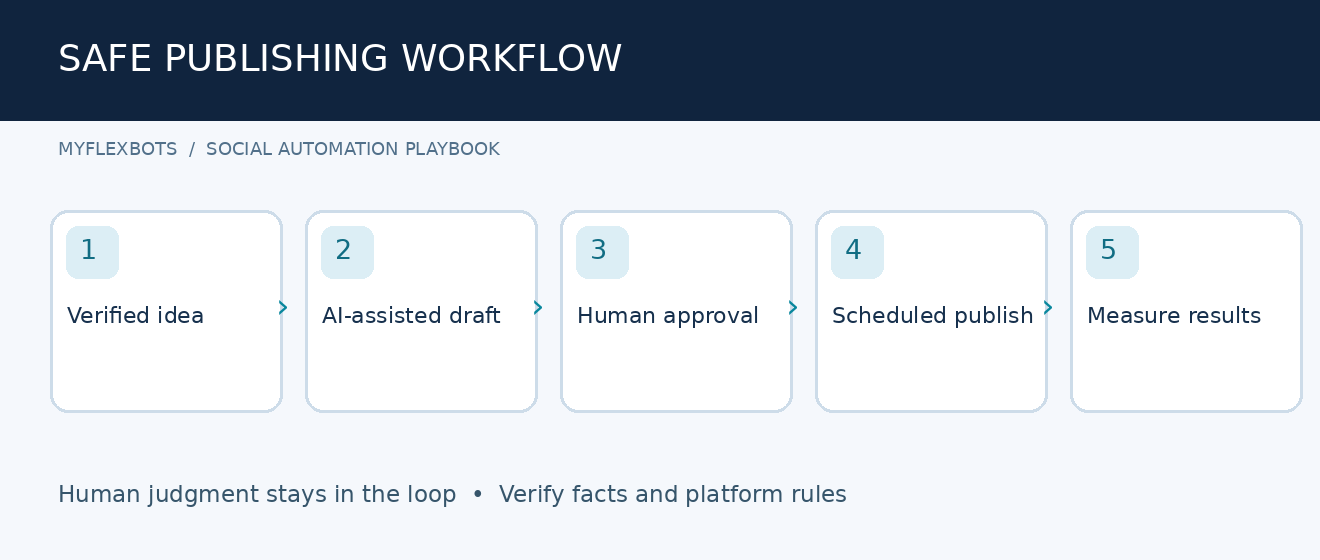
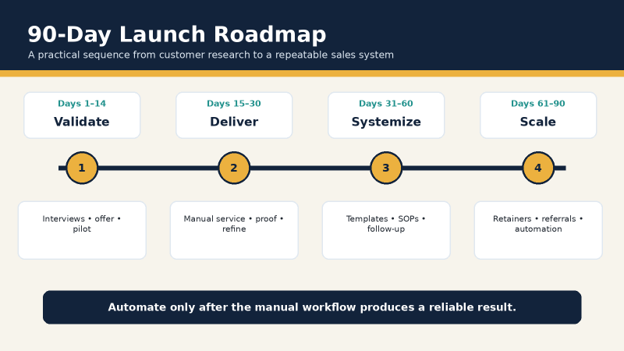
Days 1–14: Validate
Complete ten interviews, build one paid pilot, send three proposals, and document why prospects say yes or no. Select a single offer and a single customer segment.
Days 15–30: Deliver Manually
Deliver the pilot without hiding behind automation. Record every input, decision, handoff, delay, revision, and customer question. Collect a testimonial only after the result is real and permission is explicit.
Days 31–60: Systemize
Turn repeated steps into checklists, templates, naming rules, onboarding forms, quality controls, and follow-up messages. Track delivery time, direct cost, gross margin, satisfaction, and scope changes.
Days 61–90: Build Repeat Revenue
Offer maintenance, reporting, content batches, monitoring, support, subscription visits, training refreshers, or related implementation. Ask successful customers for one introduction. Automate only the stable, repeated steps.
For a deeper planning framework, connect this roadmap to MyFlexBots’ guide on how to write a practical business plan.
Common Mistakes to Avoid
Beginners often fail with trending business ideas 2026 for predictable reasons. The market may be real, but the launch sequence, price, scope, or delivery system is weak.
- Choosing a Trend Without a Reachable Buyer
“AI,” “wellness,” and “sustainability” are not customer groups. Narrow the market until you can list real prospects, find their language, and identify who controls the budget.
- Building Before Selling
A polished website, app, course, or inventory purchase does not prove demand. Sell a pilot, preorder, consultation, or manual concierge version first.
- Underpricing the Hidden Work
Founders calculate production time but ignore sales calls, revisions, travel, project management, refunds, payment fees, software, tax administration, and customer support. Measure full delivery cost before scaling.
- Automating a Broken Process
Automation accelerates whatever already exists—including errors. Stabilize the manual workflow, define exceptions, protect data, and establish a human review point before connecting tools.
- Ignoring Compliance and Risk
Registration, tax, licensing, insurance, privacy, consumer protection, contracts, employment rules, and industry restrictions vary. Low startup cost does not mean low responsibility. Consult the appropriate local authority or qualified professional.
Advanced Tips and Next-Level Hacks
The best trending business ideas 2026 become stronger when the founder builds a narrow system that competitors cannot copy with a generic tool subscription.
Productize the first result. Define the inputs, deliverables, timeline, quality standard, and price.
Choose a vertical. Specialized language, examples, data, and integrations increase trust and delivery speed.
Create a proof engine. Turn successful work into anonymized metrics, approved case studies, checklists, and demos.
Add a maintenance layer. Monitoring, updates, support, reporting, and recurring service visits improve retention.
Build referral partners. Accountants, agencies, installers, consultants, community groups, and software vendors may serve the same buyer without offering the same service.
Measure payback. Track how many weeks of gross profit are needed to recover acquisition and setup costs.
| 💡 Quick Hack: Create a “not included” list before the sales page. Scope boundaries often improve conversion because buyers understand exactly what will happen. |
| 💡 Quick Hack: Use customer questions as product-development data. A repeated question can become a template, add-on, training module, FAQ, or automated check. |
Troubleshooting and Maintenance Guide
A business needs maintenance just like a system: inspect the signals, locate the constraint, make one controlled change, and measure the result. Use the guide below when growth stalls or delivery becomes chaotic.
| Symptom | Likely Cause | Corrective Action |
| Prospects reply but do not book | The message creates interest but the next step feels risky or unclear. | Offer a short diagnostic, show one relevant proof asset, reduce form fields, and state the exact outcome of the call. |
| Calls happen but proposals do not close | Pain, authority, urgency, proof, scope, or price is weak. | Review call notes, qualify decision-makers, tighten the result, add a pilot, and follow up on a specific date. |
| Sales grow but cash stays tight | Deposits are low, payment is slow, direct costs are high, or scope expands. | Request deposits, shorten payment terms, track gross margin per job, charge for changes, and pause unprofitable packages. |
| Delivery takes too long | Inputs arrive late, work is custom, or quality checks are unclear. | Use intake deadlines, templates, standard options, a definition of done, and a customer approval checkpoint. |
| Customers do not renew | The ongoing value is invisible or unnecessary. | Report outcomes, schedule reviews, add monitoring or maintenance, and avoid forcing subscriptions where a one-time service is enough. |
| Automation produces errors | The source data, permissions, prompts, or exception rules are unstable. | Return to manual review, log failure cases, restrict access, test with non-sensitive data, and add approval gates. |
| Founder is overloaded | The offer contains too many services, customers, and communication channels. | Pause low-margin work, narrow the package, set office hours, document the top repeated task, and delegate only after quality is measurable. |
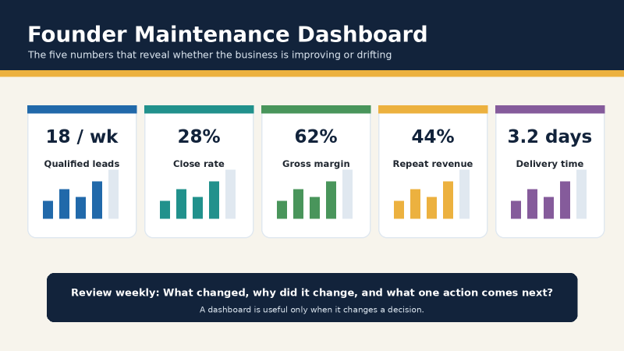
Review five numbers every week: qualified leads, close rate, average gross profit, on-time delivery, and repeat or referral revenue. Add one model-specific metric, such as route density, content approval time, automation failure rate, return rate, or subscriber churn.
Frequently Asked Questions
What business is most profitable to start in 2026?
Profitability depends on price, acquisition cost, delivery cost, repeat revenue, and founder capability. Lean B2B services—such as workflow implementation, vertical administration, local lead operations, training, or security basics—can reach profit faster because they avoid inventory and can begin with paid pilots.
Which business can I start with little or no money?
Start with a service based on skills and tools you already have: research, writing, editing, local profile management, virtual assistance, tutoring, setup support, or digital organization. Sell a narrow result first and reinvest revenue into tools that reduce a measured bottleneck.
Are AI businesses too competitive in 2026?
Generic AI content and prompt services are crowded. Opportunity remains in implementation: connecting a tool to a specific workflow, protecting data, training staff, documenting exceptions, integrating approval steps, and proving a financial or operational result.
How do I know whether a business idea has real demand?
Look for repeated customer language, current workarounds, existing spending, urgency, decision authority, and willingness to take a concrete step. Ten interviews, three proposals, and one paid pilot provide better evidence than surveys, likes, or compliments.
Should I start an online business or a local service?
Choose based on access and economics. Online models offer broader reach but more competition. Local services can win through trust, speed, route density, and referrals. A hybrid model—local delivery with digital booking, reminders, and reporting—often combines the strengths of both.
How often should I review my list of business ideas?
Review trending business ideas 2026 quarterly, but do not switch models every time a new trend appears. Once a paid pilot works, give the offer enough focused execution to produce reliable data. Change direction when customer evidence disproves the model, not when motivation briefly drops.
Conclusion: Choose Evidence Over Excitement
The right trending business ideas 2026 opportunity is not simply the newest category. It is the model where you can reach a specific buyer, solve an expensive problem, prove the result quickly, retain healthy margin, and build repeat demand without taking reckless upfront risk.
Score the ideas, interview customers, sell one paid pilot, deliver it manually, document the workflow, and automate only what has become stable. That sequence is slower than buying a logo and announcing a startup—but it is much faster than recovering from six months of building something nobody wanted.
Which idea fits your skills and market best: AI implementation, local growth, creator services, recurring home support, or a specialized digital product? Share your choice in the comments and explain the first customer problem you plan to validate.
editor's pick
latest video
news via inbox
Nulla turp dis cursus. Integer liberos euismod pretium faucibua