

How to Start a Business with No Money in 2026
Most people do not postpone entrepreneurship because they lack ideas. They postpone it because they assume every legitimate business begins with inventory, paid advertising, a premium website, and a large cash reserve. The practical truth is that learning how to start a business with no money is mostly an exercise in replacing money with focused effort, customer conversations, and disciplined reinvestment.
This guide shows you how to select a zero-cost model, validate demand before building, create an offer people understand, win the first customer without ads, deliver professionally, and turn the first payment into a repeatable operating system. It also explains what “no money” realistically means: you can avoid major startup spending, but you still invest time, attention, credibility, and existing resources.
The goal is not to look like a large company on day one. The goal is to solve one valuable problem for one reachable type of customer, collect proof, and use revenue—not personal savings—to fund the next stage.
How Can You Start a Business Without Startup Capital?
| Direct answer: To learn how to start a business with no money, choose a service or digital model based on skills and tools you already have, validate the problem with real prospects, pre-sell a clear outcome, deliver manually, collect proof, and reinvest the first revenue into only the tools that remove a proven bottleneck. |
Essential Tools & Materials Breakdown
A zero-budget launch uses a lean operating stack. “Estimated cost” means the incremental amount required to begin, assuming you already own or can access basic devices and internet service. Registration, licensing, insurance, and taxes vary by location and business type.
| Tool or Resource | Zero-Cost Option | Estimated Cost | Skill Level | What It Does | |
| Phone | Existing smartphone | $0 | Beginner | Calls, research, photos, payments, and outreach | |
| Computer access | Existing device, library, or shared computer | $0 | Beginner | Documents, proposals, delivery, and recordkeeping | |
| Business email | Gmail or Outlook | $0 | Beginner | Professional communication and account setup | |
| Planning workspace | Google Docs/Sheets, Notion, or Trello | $0 | Beginner | Offer notes, lead tracker, tasks, and cash records | |
| Design tool | Canva Free | $0 | Beginner | Simple proposals, social graphics, and one-page service menus | |
| Video meetings | Google Meet or Zoom free tier | $0 | Beginner | Discovery calls, demonstrations, and client reviews | |
| Scheduling | Google Calendar or free booking tool | $0 | Beginner | Appointment reminders and time blocking | |
| Payment and invoicing | Available payment link or bank transfer | $0 upfront | Beginner | Deposits, invoices, and payment collection; transaction fees may apply | |
| Website or landing page | Free profile, marketplace page, or one-page builder | $0 | Beginner–Intermediate | Explains the offer and gives prospects a next step | |
| Domain name | Optional until validation | $10–$20/year | Beginner | Improves brand control after the offer proves demand | |
| Registration and permits | Depends on jurisdiction | Location-dependent | Intermediate | Keeps the operation compliant with local rules | |
| �� Quick Hack: Delay any purchase that does not directly help you validate demand, close a customer, deliver the promised result, or meet a legal requirement. A logo redesign, premium theme, paid CRM, and large software bundle rarely pass that test before the first sale. | |||||
Step 1: Choose a Business Model That Converts Skill Into Cash
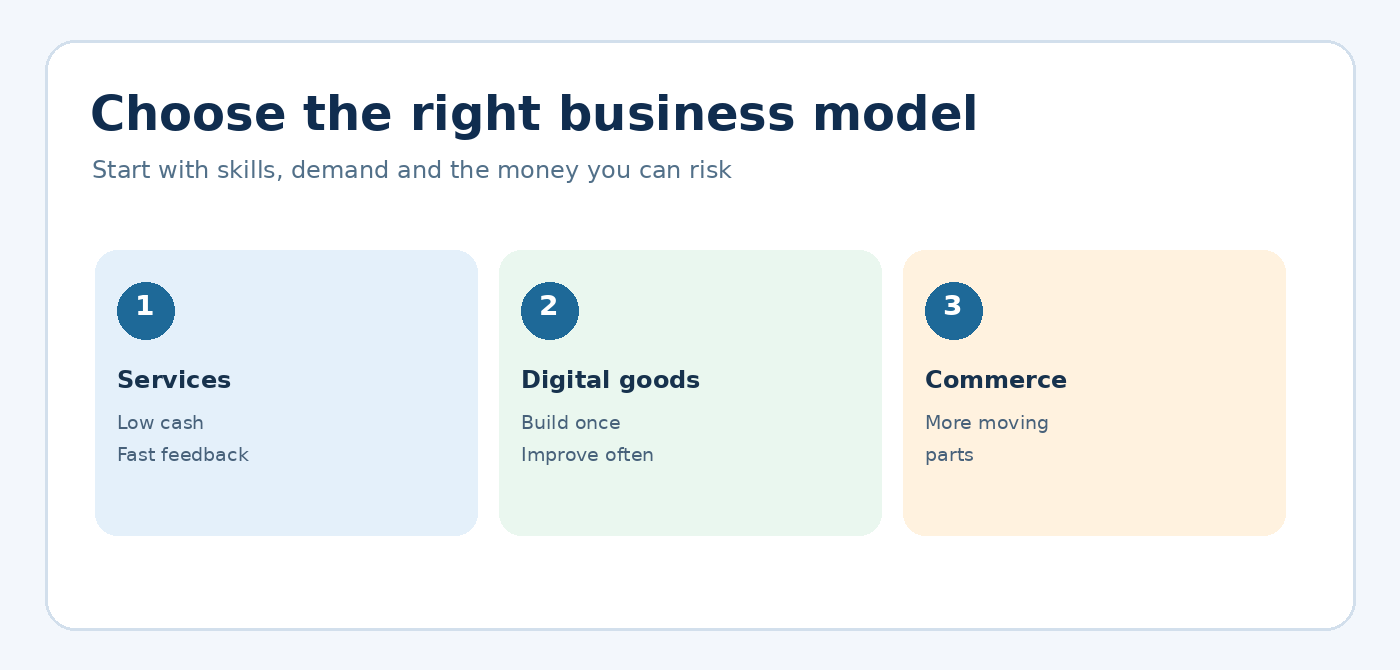
The safest way to understand how to start a business with no money is to begin with a model that does not require inventory, leased space, specialized equipment, or paid traffic. Service businesses are usually fastest because a customer pays for an outcome created by your time and expertise.
Strong zero-cost starting models include:
- Freelance services: writing, design, video editing, bookkeeping, virtual assistance, translation, research, SEO support, or website maintenance.
- Local services: cleaning, organizing, tutoring, pet care, errand support, lawn maintenance using customer equipment, or home technology setup.
- Productized services: a fixed package with a clear deliverable, timeline, and price—for example, “10 optimized product descriptions in five days.”
- Broker or referral models: connect a qualified customer with a reliable provider and earn a disclosed referral fee where legal and appropriate.
- Digital products: templates, checklists, mini-guides, prompt libraries, spreadsheets, or training materials created with free tools.
- Audience-first businesses: publish useful niche content, build trust, and later earn through services, sponsorships, affiliates, or products.
Avoid a model simply because it is fashionable. Choose one where you can name the buyer, identify an urgent problem, produce a result with existing resources, and reach potential customers without paying for access.
Use the Zero-Cost Model Test
Score each idea from one to five on the following questions. The highest total is usually the best launch candidate, not necessarily the idea you find most exciting.
- Can I deliver a useful result with tools I already have?
- Can I identify at least 25 potential buyers today?
- Does the problem cost the buyer time, money, risk, or frustration?
- Can I demonstrate competence through a sample, audit, or small pilot?
- Can I collect payment before taking on significant expenses?
Step 2: Audit the Assets You Already Control
People researching how to start a business with no money often focus only on cash and ignore other forms of startup capital. Your skills, reputation, access, time, relationships, language ability, industry knowledge, and unused digital files can all become commercial assets.
Create a one-page asset inventory under five headings:
- Skills: tasks you perform well enough to create a measurable result.
- Proof: projects, employment results, before-and-after examples, certificates, testimonials, or personal projects.
- Access: communities, former coworkers, local groups, suppliers, professional associations, and online audiences.
- Tools: phone, laptop, software, workspace, transport, camera, internet, and reusable templates.
- Constraints: available hours, family commitments, physical limitations, location, legal restrictions, and delivery deadlines.
Then convert assets into outcomes. “I know Excel” is not an offer. “I build a weekly cash-flow dashboard that shows a shop owner which expenses are rising” is an outcome. “I can use Canva” is not an offer. “I produce a 30-day social post pack for local clinics” is an outcome.
| Pro-Tip: Ask three former coworkers or clients, “What problem do people usually ask me to solve?” Their answers often reveal a marketable skill you treat as ordinary because it is easy for you. |
Step 3: Find a Painful, Reachable Customer Problem
The next part of how to start a business with no money is market selection. A useful market is not merely “people who might like this.” It is a recognizable group with a repeated problem, a reason to act, and a place where you can contact them.
Start with a narrow customer statement: “I help [specific customer] achieve [valuable result] without [major frustration].” Examples include:
- I help independent contractors turn scattered receipts into a simple monthly expense record.
- I help local restaurants refresh outdated menu descriptions without hiring a full agency.
- I help busy families organize one high-clutter room in a single weekend.
- I help small online stores answer repetitive customer questions with a clear FAQ and response library.
Research the problem before designing the solution. Read public reviews of competing services, browse relevant forums, study job posts, note questions in community groups, and analyze how customers describe frustration in their own words. Save exact phrases; they become stronger sales copy than invented marketing language.
Caption: Free research and a one-page plan are more valuable than expensive branding when you are testing whether a problem is worth solving. Photo source: Unsplash
Conduct Ten Problem Interviews
Talk to ten people who match the target profile. Do not pitch immediately. Ask about behavior and recent events, not hypothetical opinions.
- When did this problem last happen?
- What did you try?
- What was frustrating about the current solution?
- What happens if the problem remains unsolved?
- Have you paid for help before? What made that worthwhile or disappointing?
- What would a good result look like in practical terms?
Signals of real demand include repeated language, existing workarounds, money already being spent, missed deadlines, lost revenue, risk, or emotional urgency. Compliments such as “That is a cool idea” are weak evidence unless the person also takes a concrete step.
Step 4: Validate the Offer Before You Build It
Validation is the discipline that makes how to start a business with no money possible. Instead of spending weeks building a website, course, product catalog, or complex workflow, ask prospects to commit to a simple pilot.
A credible validation ladder moves from low commitment to high commitment:
- Conversation: the prospect confirms the problem is current and important.
- Permission: the prospect agrees to receive a sample, audit, or proposal.
- Time commitment: the prospect books a call or shares information needed for a diagnosis.
- Small paid pilot: the prospect pays for a tightly scoped result.
- Repeat or referral: the customer buys again or introduces another buyer.
The paid pilot is the strongest early proof. Keep the scope narrow enough to finish quickly and learn. A pilot is not an excuse to work indefinitely for a token fee; it is a controlled test with a defined deliverable, deadline, feedback point, and next-step price.
| �� Quick Hack: Sell the “diagnostic” before the full service. A paid audit, setup session, measurement visit, strategy call, or prototype can produce revenue while showing you exactly what the larger job requires. |
Step 5: Build a One-Sentence Offer and Sensible Price
A strong offer removes ambiguity. The prospect should understand who it is for, the result, the deliverable, the timeline, the boundaries, and the next step.
Use this formula: “I help [customer] get [result] by delivering [specific package] within [timeframe] for [price or starting price].”
For example: “I help independent real estate agents turn raw property notes into five polished listing descriptions within three business days for a fixed package price.” That statement is easier to buy than “I offer content writing.”
Price Without Guessing
Do not price only from the number of hours you expect to work. Consider the value of the result, the urgency, the amount of coordination, revisions, risk, and the customer’s alternatives. Still, use an internal minimum to avoid accepting work that cannot be delivered responsibly.
- Define the base scope: what is included, what is excluded, and how many revisions are allowed.
- Request a deposit: for project work, a reasonable upfront payment confirms commitment and can fund necessary direct costs.
- Offer two choices: a focused starter package and a more complete package. Too many tiers slow decisions.
- Charge for rush work: urgent delivery disrupts your schedule and should not be treated as normal scope.
- Document change requests: new deliverables require a revised price or deadline.
| Pro-Tip: When you lack market data, quote a small fixed-scope pilot rather than an open-ended hourly promise. You will learn the true delivery time without exposing yourself to unlimited revisions. |
Step 6: Create a Minimum Viable Business Presence
A professional presence matters, but how to start a business with no money does not require a custom website on day one. Your minimum viable presence needs only enough information to establish relevance, reduce risk, show proof, and make contacting or paying you easy.
Create these five assets with free tools:
- A clear profile headline: state the customer and outcome, not a vague title such as “entrepreneur” or “consultant.”
- A one-page offer sheet: problem, deliverables, process, timeline, price range, and call to action.
- Two proof samples: personal projects, mock examples, volunteer work, or anonymized before-and-after demonstrations.
- A simple intake form: collect goals, deadlines, existing materials, decision-makers, and budget range.
- A payment and scheduling path: remove unnecessary back-and-forth once the prospect is ready.
Use the platform where buyers already spend time. A local service may need a Google Business Profile, neighborhood groups, and a concise WhatsApp catalog. A B2B service may perform better with a focused LinkedIn profile, a one-page portfolio, and direct email. A digital product may begin on a marketplace that handles hosting and checkout.
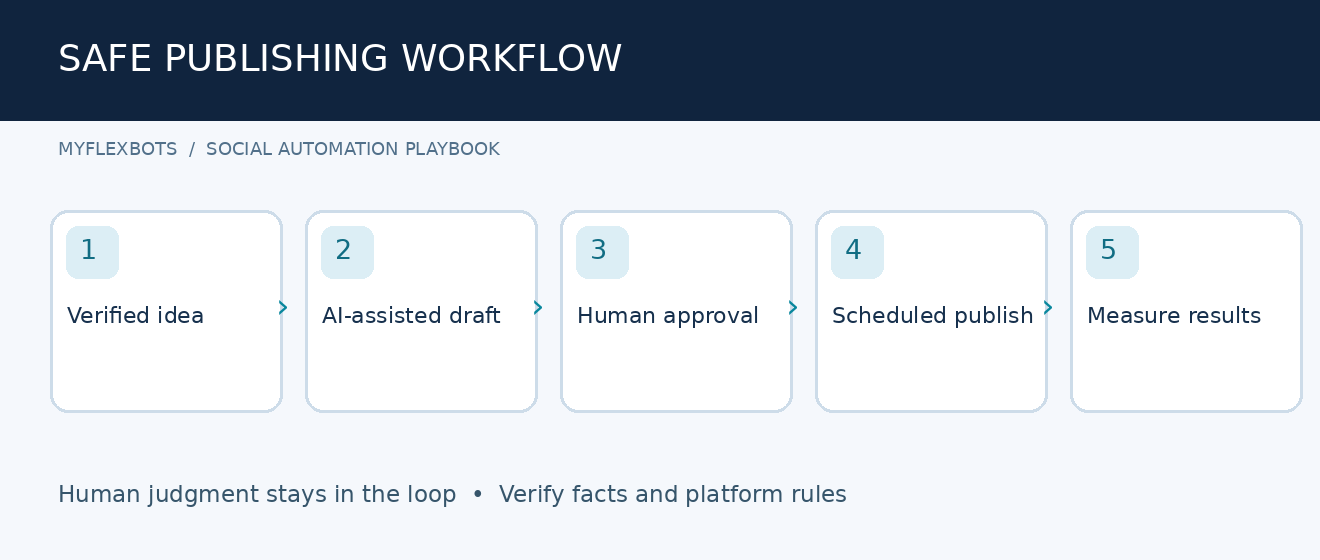
For practical ideas on using free AI tools for small businesses to speed up research, drafting, and routine administration, connect this section to the relevant MyFlexBots automation silo.
Caption: A minimum viable online presence should explain the problem, promised result, proof, and next action—not overwhelm visitors with unnecessary pages. Photo source: Unsplash
| �� Quick Hack: Before buying a domain, publish the offer on a free profile or one-page document and send it directly to ten qualified prospects. If nobody engages, improve the offer before improving the website. |
Step 7: Handle Legal, Tax, and Recordkeeping Basics
Any serious guide to how to start a business with no money must distinguish low-cost launching from ignoring compliance. Business structure, registration, licenses, sales tax, privacy duties, contracts, and insurance depend on your country, state, industry, and activity.
Before accepting work, identify the rules that apply to your exact operation. Regulated trades, food, childcare, financial services, health services, transportation, and work performed inside a customer’s home may require specific permits, training, insurance, or inspections.
For U.S.-based planning, the U.S. Small Business Administration guide to writing a business plan provides traditional and lean planning approaches. Businesses that need a federal tax identifier can apply for an Employer Identification Number directly through the IRS. Entrepreneurs who need experienced feedback can also get free business mentoring through SCORE. Outside the United States, use the equivalent official government and tax authority resources.
At minimum, maintain a separate business income-and-expense record, save receipts, record customer agreements, back up files, and set aside the appropriate portion of income for taxes. A separate bank account is often useful and may be legally required depending on the structure and jurisdiction.
| Pro-Tip: Create a “compliance before growth” checklist: registration, tax account, invoice requirements, customer terms, data handling, insurance, and renewal dates. Review it before adding a new service or entering a new region. |
Step 8: Win the First Customer Without Paid Advertising
The customer-acquisition stage is where how to start a business with no money becomes a daily practice rather than a theory. Your first sales usually come from focused conversations, direct outreach, partnerships, communities, and visible proof—not viral content.
Build a list of 50 reachable prospects. Start with warm contacts, former coworkers, suppliers, local businesses, association members, community groups, and companies already showing signs of the problem. Record the contact, observed problem, date, response, next action, and outcome in a simple spreadsheet.
Use an Observation-Based Outreach Message
Generic messages feel automated because they make no connection to the recipient’s actual situation. A better message includes a genuine observation, a relevant consequence, a useful idea, and a low-pressure next step.
Example: “I noticed several product pages on your store use manufacturer descriptions, which can make the pages harder to differentiate in search. I rewrote one short sample to show a clearer benefit-led structure. Would it be useful if I sent it over?”
The sample proves attention and ability. It also asks permission instead of forcing a full pitch. Keep it small; never perform the entire project for free.
- Warm outreach: tell trusted contacts exactly who you help and ask for one relevant introduction—not a vague request to “spread the word.”
- Direct outreach: contact a small number of highly relevant prospects with personalized observations.
- Partnerships: build referral relationships with complementary providers serving the same customer.
- Communities: answer real questions consistently before promoting your service.
- Content: publish proof-oriented posts such as audits, before-and-after examples, checklists, and mistakes to avoid.
Caption: Direct conversations with qualified prospects reveal which problems are urgent, how buyers describe value, and what they are willing to pay for. Photo source: Unsplash
| �� Quick Hack: Use a “five-by-five” routine for two weeks: contact five carefully chosen prospects and make five helpful public contributions each weekday. Consistency produces better information than sending 200 generic messages in one afternoon. |
Step 9: Deliver Manually, Document Everything, and Collect Proof
At the beginning, manual delivery is an advantage. It places you close to the customer, exposes confusing steps, and shows where templates or automation will later save time. Do not automate a process you do not yet understand.
Use a simple delivery sequence:
- Confirm scope in writing: deliverables, deadline, inputs, price, payment schedule, revisions, and exclusions.
- Collect inputs once: use a checklist or form so important information does not arrive across ten messages.
- Set milestones: for longer projects, share an early direction before completing all work.
- Communicate risk early: tell the customer as soon as a missing input or changed requirement threatens the deadline.
- Close the project formally: deliver files, explain next steps, confirm completion, and request feedback.
Ask for a specific testimonial: What problem existed before? Why did the customer choose you? What changed? What result or improvement did they notice? Specific proof reduces risk for future buyers far more than “Great service.”
With permission, turn the project into a compact case study: customer type, challenge, approach, result, and lesson. Remove confidential information and never exaggerate outcomes.
Step 10: Reinvest Revenue Into the Constraint, Not the Ego
The first payment is not permission to imitate a mature company. Treat it as evidence and working capital. Reinvest only where spending will improve compliance, reliability, customer experience, delivery speed, or access to qualified demand.
A sensible reinvestment order is:
- Taxes, required registration, permits, and insurance.
- A reliable delivery tool or replacement for a fragile free workaround.
- A domain and professional email after the offer proves demand.
- Templates, software, or equipment that remove a repeated delivery bottleneck.
- Training tied to an immediate customer need.
- Measured marketing only after you know the offer converts through direct sales.
Track three numbers weekly: qualified conversations, offers made, and cash collected. Add delivery time and customer acquisition source once volume grows. Vanity metrics such as followers or website impressions matter only when they lead to meaningful actions.
| Pro-Tip: Create a reinvestment rule before revenue arrives—for example, reserve a percentage for taxes, a percentage for business improvement, and the remainder for owner pay. A rule prevents emotional spending after a good week. |
A Practical 30-Day Zero-Budget Launch Plan
Use this schedule to turn the question of how to start a business with no money into daily actions. The workload can be compressed or expanded, but keep the order: problem, validation, offer, outreach, delivery, proof, and reinvestment.
| Days | Primary Goal | Actions | Completion Test |
| 1–3 | Select a market | Audit assets; list five ideas; score each with the zero-cost model test. | One customer group and one problem selected. |
| 4–7 | Research the problem | Study reviews, groups, job posts, and alternatives; schedule interviews. | Ten repeated pain statements captured. |
| 8–10 | Validate demand | Conduct interviews; propose a small pilot to qualified prospects. | At least three people take a concrete next step. |
| 11–13 | Build the offer | Define result, scope, timeline, price, intake, and payment terms. | A one-page offer can be understood in under two minutes. |
| 14–17 | Create proof | Produce two samples or a mini case demonstration; prepare outreach messages. | Proof shows the before, process, and expected after. |
| 18–24 | Sell consistently | Use warm introductions, direct outreach, communities, and partnerships. | At least 25 qualified conversations initiated. |
| 25–28 | Deliver the pilot | Confirm scope, complete milestones, communicate, and close formally. | Customer receives the agreed result on time. |
| 29–30 | Improve the system | Collect feedback, request testimonial, review numbers, and choose reinvestment. | One documented improvement and next sales target. |
Common Mistakes to Avoid
Beginners often fail at how to start a business with no money because they spend effort in the wrong order. These five errors consume time, hide weak demand, and create avoidable risk.
1. Building Before Selling
A polished website, large course, app, or inventory order can feel productive while protecting you from the uncomfortable work of asking customers to commit. Prevent this by requiring a validation milestone—such as three paid pilots—before building the full version.
2. Targeting “Everyone”
Broad targeting weakens your message and makes prospecting inefficient. Choose a narrow starting segment you can reach and understand. You can expand after learning which outcomes and buying triggers are strongest.
3. Working for Free Without a Learning Goal
A free project can be useful when it produces a specific sample, testimonial, referral, or process insight. It becomes harmful when the scope is unclear, the customer has no commitment, or you repeatedly replace paid providers without building an asset of your own.
4. Underpricing Uncontrolled Scope
A low fixed price combined with unlimited revisions can turn a small project into a loss. Define deliverables, communication channels, revision limits, due dates for customer inputs, and change-order rules before work begins.
5. Ignoring Cash, Tax, and Compliance Records
Money arriving in an account is not the same as profit. Record revenue, direct costs, operating expenses, taxes reserved, owner withdrawals, and unpaid invoices. Compliance problems can erase the advantage of a low-cost launch.
Advanced Tips and Next-Level Growth Hacks
Productize the Repeated 80 Percent
After several projects, identify the tasks that repeat: discovery questions, file requests, research steps, templates, quality checks, delivery notes, and follow-up. Standardize those pieces while keeping the final solution tailored where customer context matters.
Build a Proof Flywheel
Every completed project should produce at least one growth asset: a testimonial, case study, before-and-after sample, referral, reusable template, improved checklist, or stronger pricing insight. This turns delivery work into future customer acquisition.
Create a Referral Trigger
Do not ask, “Do you know anyone?” Make the request specific and timely: “Which other independent shop owner do you know who struggles to keep product descriptions updated?” Ask immediately after a visible win, not months later.
Use Partnerships to Borrow Distribution
Find businesses that serve the same customer without competing directly. A web designer might partner with a product photographer; an organizer might partner with a moving company; a bookkeeper might partner with a tax preparer. Agree on expectations, disclosure, referral handling, and customer ownership before exchanging leads.
Automate Only Stable Workflows
Once a process has been delivered manually several times, automate reminders, intake routing, file naming, recurring reports, or follow-up messages. Keep judgment-heavy tasks human. Automation should reduce errors and waiting—not create a confusing maze for the customer.
| �� Quick Hack: Keep a “manual pain log” during every project. Each time you copy information, search for a file, repeat an explanation, or wait for an input, record it. The most frequent entries become your automation roadmap. |
Troubleshooting & Long-Term Maintenance Guide
A business launched cheaply still needs maintenance. Review the following problems by identifying the broken stage: market, message, offer, outreach, sales conversation, delivery, cash collection, or retention. Fix the stage with evidence instead of changing everything at once.
Problem: Prospects Do Not Reply
Check relevance before rewriting the message. Are the recipients a close match? Is the problem visible or likely? Does the opening show a real observation? Is the requested next step small? Shorten the message, improve targeting, and test one variable at a time.
Problem: People Reply but Do Not Buy
The offer may be vague, low priority, poorly timed, unproven, or difficult to trust. Ask what prevented the decision. Add a smaller pilot, stronger proof, clearer scope, or a more specific result. Do not respond automatically by cutting price.
Problem: Every Project Takes Too Long
Track time by delivery stage for three projects. Look for missing inputs, excessive customization, unclear approval, too many revisions, or work that should be templated. Tighten the intake checklist and add an early milestone so wrong directions are caught sooner.
Problem: Cash Arrives Late
Use written payment terms, deposits, milestone billing, invoice due dates, and polite reminders. Pause work when required inputs or agreed payments are overdue. For recurring services, move to advance billing where appropriate and lawful.
Problem: The Business Depends on One Customer
Do not wait until the relationship ends. Reserve weekly time for prospecting even during busy delivery periods. Build at least two acquisition channels and avoid commitments that prevent you from serving other customers unless the compensation justifies the risk.
Weekly and Monthly Maintenance
- Weekly: update leads, send follow-ups, review delivery deadlines, reconcile payments, back up files, and schedule next week’s outreach.
- Monthly: review revenue, expenses, tax reserve, conversion rates, average project time, customer source, satisfaction, and outstanding obligations.
- Quarterly: review pricing, legal requirements, insurance, data access, service profitability, customer concentration, and which tools still earn their cost.
Caption: A simple weekly dashboard for leads, offers, delivery deadlines, cash collected, and follow-ups keeps a lean business under control. Photo source: Unsplash
Frequently Asked Questions
Can I really start a business with zero dollars?
You can start testing and selling many service, referral, content, and digital-product ideas with no meaningful upfront cash by using existing equipment and free tools. However, some businesses require registration, insurance, licenses, transport, supplies, or transaction fees. Treat “zero dollars” as a lean launch principle, not permission to ignore unavoidable costs.
What is the easiest business to start without capital?
The easiest model is usually a narrow service based on a skill you already possess and a customer group you can already reach. Examples include tutoring, editing, virtual assistance, organization, local support, basic design, research, and productized administrative services. Ease depends on your proof, access, and delivery ability.
How do I get customers without paying for ads?
Use warm introductions, personalized direct outreach, referral partners, local groups, professional communities, useful public answers, simple case demonstrations, and follow-up. Paid advertising magnifies an offer; it does not repair unclear positioning or weak demand.
Should I build a website before launching?
Not necessarily. Begin with a complete profile, one-page offer, samples, intake form, scheduling method, and payment path. Build a website when it will increase trust, support search visibility, organize several offers, or reduce repeated explanations. A website should follow validated demand rather than substitute for it.
When should I register the business?
Registration requirements vary. Some jurisdictions allow limited activity under an individual’s legal name, while others require registration, permits, tax accounts, or insurance before trading. Check official local guidance before accepting payment, using a business name, entering a regulated field, hiring, or collecting sales tax.
How long does it take to earn the first sale?
A tightly scoped service sold to a warm or reachable market can earn a first sale in days or weeks, but no timeline is guaranteed. Speed depends on the urgency of the problem, proof, access to buyers, quality of outreach, pricing, and willingness to ask for a concrete commitment.
What should I spend the first revenue on?
First cover taxes, required compliance, and direct delivery costs. Then remove the most expensive recurring bottleneck, such as unreliable equipment, slow software, missing insurance, or inefficient administration. Avoid status purchases until the business has stable demand and cash reserves.
Conclusion: Start With a Customer, Not a Shopping List
The central lesson in how to start a business with no money is that revenue should follow evidence. Choose a low-overhead model, study a painful problem, validate it with real people, sell a narrow result, deliver carefully, document proof, and reinvest in the constraint that is actually limiting growth.
You do not need to feel fully prepared. You need a clear next action that produces information: schedule an interview, send a tailored message, publish a sample, offer a pilot, or request a referral. Small, measurable commitments build a business faster than months of private planning.
Which skill, customer group, and urgent problem could you combine into a paid pilot this week? Share your idea in the comments and describe the smallest result you could deliver within seven days.
Image Credits and Publishing Notes
All photographs in this document are sourced from Unsplash and embedded for editorial use. Keep the captions and alternative text when publishing, compress images for web performance, and confirm the current Unsplash license and your publication’s media policy before redistribution.
Legal and tax information is general education, not legal, tax, or financial advice. Requirements differ by jurisdiction and industry; link readers to the relevant official authority for their location.
editor's pick
latest video
news via inbox
Nulla turp dis cursus. Integer liberos euismod pretium faucibua
[…] and create pages for services or products. If budget is tight, the same lean approach used when you start a business with no money applies here: buy only the infrastructure that supports a real next […]