How to Start an Online Business: Step-by-Step Guide
A profitable website does not begin with a logo, a theme, or a stack of paid apps. It begins with a specific customer problem, evidence that people will pay for a solution, and a launch process small enough to finish.
Learning how to start an online business becomes far less confusing when the work is handled in the right order. This guide explains how to choose a model, validate demand, calculate costs, set up the legal and financial basics, build a lean website, win the first customers, troubleshoot weak results, and create a system that can grow.
Direct Answer: Start an Online Business in 8 Steps
| Featured snippet: To launch an online business, choose a specific customer problem, validate demand with conversations or preorders, build the smallest offer that solves it, register and separate the finances, publish a simple sales page, secure payments, win the first customers manually, then improve using conversion, margin, retention, and cash-flow data. |
Essential Tools, Accounts, and Startup Cost Breakdown
The figures below are practical starter ranges, not fixed quotations. Costs change by country, vendor, traffic volume, business model, transaction level, and whether the founder performs the work or hires specialists.
| Requirement | What it covers | Typical starter cost | Skill level | Buying rule |
| Market research | Search results, customer interviews, review mining, survey form | $0-$50 | Beginner | Validate a painful problem before buying software. |
| Domain name | Short, readable brand domain | $10-$30/year | Beginner | Avoid odd spelling, hyphens, and names that sound like competitors. |
| Website or store | Hosted builder, ecommerce platform, CMS, or marketplace | $0-$100+/month | Beginner-Intermediate | Choose for the sales process, not for the prettiest template. |
| Business email | Branded inbox on the company domain | $0-$15/user/month | Beginner | Improves trust and separates business communication. |
| Payments | Gateway, merchant account, invoices, fraud controls | Usually transaction-based | Intermediate | Confirm supported countries, currencies, payout timing, and dispute fees. |
| Design | Logo, product graphics, lead magnets, social templates | $0-$50/month | Beginner | Start with a clean wordmark and consistent visual rules. |
| Analytics | Traffic, conversion, event, and revenue tracking | $0-$100+/month | Intermediate | Track only metrics tied to decisions. |
| Bookkeeping | Income, expenses, invoices, tax records, reconciliation | $0-$80+/month | Intermediate | Set categories before transactions become messy. |
| Customer support | Shared inbox, chat, FAQ, ticketing | $0-$50+/month | Beginner | A fast, documented response process beats a fancy chatbot. |
| Security and backup | Password manager, MFA, updates, backups, access controls | $0-$30+/month | Intermediate | Protect the accounts that control money, domains, and customer data. |
| Content and automation | Writing, research, scheduling, workflows | $0-$100+/month | Beginner-Advanced | Automate only after the manual process works. |
| Inventory or delivery | Samples, packaging, shipping, storage, digital delivery | Model-dependent | Intermediate | Test one small batch or a manual delivery process first. |
| 💡 Quick Hack: Create a “must earn its keep” rule for every subscription. Before paying, write the exact task the tool replaces, how often that task occurs, and the monthly value of the time or errors saved. Cancel anything that cannot pass that test within 30 days. |
Choose the Right Online Business Model
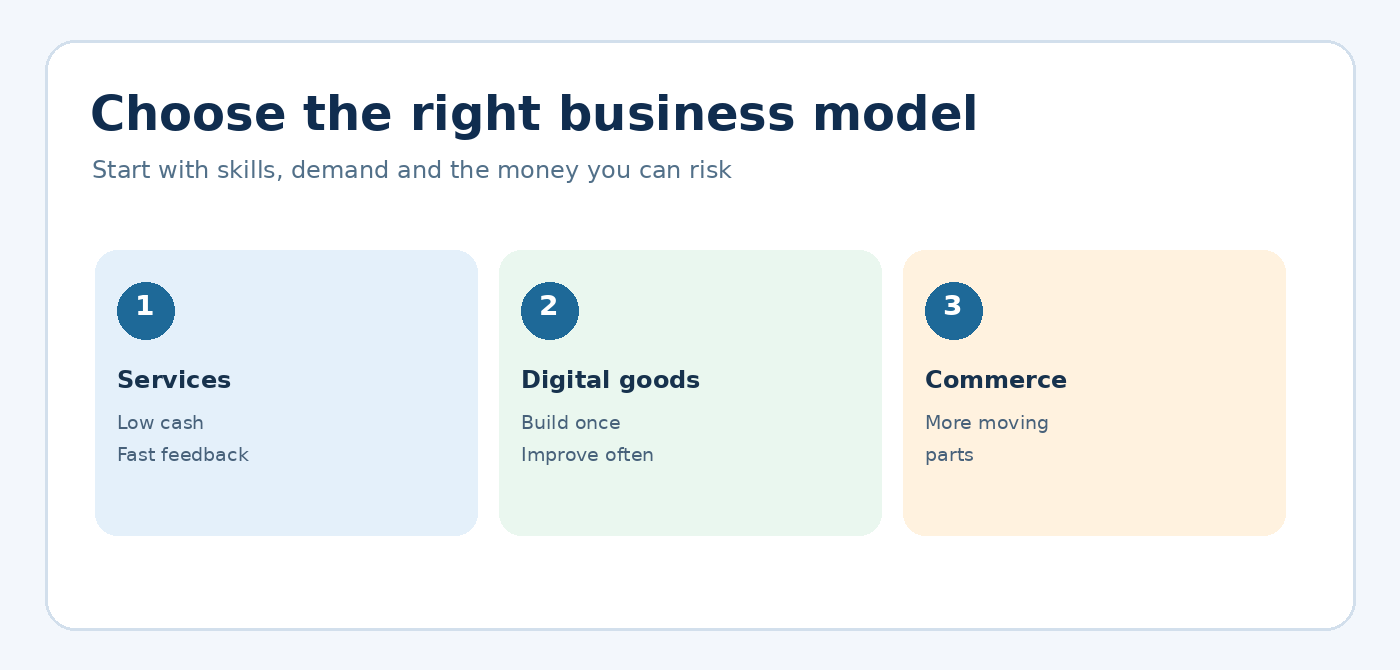
The first decision in how to start an online business is not the brand name. It is the operating model: what will be sold, how value will be delivered, when cash arrives, what must happen after the sale, and which risks the founder carries.
| Model | What customers buy | Main advantage | Main constraint |
| Freelance or productized service | Skills and time | Fastest route to revenue; little inventory | Founder capacity can become the ceiling |
| Physical ecommerce | Products shipped to buyers | Tangible value and repeat purchase potential | Inventory, returns, shipping, and cash tied up in stock |
| Digital products | Templates, courses, guides, files, licenses | High gross margin and instant delivery | Needs a trusted audience and clear differentiation |
| Membership or subscription | Recurring access, content, tools, or community | Predictable recurring revenue | Retention pressure and continuous value creation |
| Affiliate or content business | Attention and recommendations | Low product-creation burden | Slow trust-building and dependence on partner rules |
| Marketplace or reselling | Sourced products sold through an existing platform | Built-in buyer traffic | Fees, competition, policy risk, and limited customer ownership |
| Software or micro-SaaS | A repeatable digital utility | Scalable recurring model | Development, support, reliability, and security demands |
Use three filters to shortlist a model: access to customers, ability to deliver a useful result, and acceptable risk. A model that looks scalable but requires capital, licensing, or technical skills the founder does not have is rarely the best first move.
For a low-budget launch, a service or digital product often produces faster learning because the founder can sell before building a complex operation. MyFlexBots’ guide to start a business with no money provides additional ways to reduce early spending without pretending that every business can be launched at zero cost.
Define a Painful, Specific Customer Problem
Weak ideas describe a category: “fitness,” “marketing,” “home decor,” or “productivity.” Strong opportunities describe a person, a moment, a costly frustration, and a desired result.
A useful problem statement follows this structure: “When [specific customer] tries to [important job], they struggle with [pain or obstacle], which causes [cost, risk, delay, or frustration].” The tighter the statement, the easier it becomes to research competitors, write an offer, and find the first prospects.
Customer: Who experiences the problem and controls the buying decision?
Trigger: What event causes the person to look for help now?
Current workaround: What do they use, tolerate, outsource, or do manually?
Consequence: What money, time, reputation, comfort, or opportunity is lost?
Proof of urgency: Are people searching, asking, complaining, switching, or already paying?
| Pro-Tip: Do not define the audience as “everyone who wants X.” Choose one reachable segment for the launch. A narrow initial market improves messaging and sales conversations; the business can broaden after the offer works. |
Validate Demand Before Building the Full Business
Anyone researching how to start an online business should treat validation as evidence collection, not encouragement collection. Friends saying “great idea” is weak evidence; a stranger paying, booking a call, joining a waitlist, or sharing detailed buying objections is far stronger.
Run a Seven-Day Validation Sprint
- Write one customer segment and one painful problem. Do not test five audiences at once.
- Study 10-20 competitors. Record price, promise, target customer, proof, delivery model, guarantees, negative reviews, and unanswered questions.
- Collect the exact language customers use in forums, reviews, support questions, social comments, and search suggestions.
- Interview at least five potential buyers. Ask about the last time the problem happened, what they tried, what it cost, and what would make them switch.
- Create a one-page offer with the outcome, deliverables, price or price range, timeline, proof, objections, and one call to action.
- Put the offer in front of 20-50 relevant people through direct outreach, a niche group, an existing audience, a marketplace, or carefully targeted content.
- Measure behavior: replies, calls, deposits, preorders, waitlist signups, objections, and no-response patterns. Improve the offer based on evidence.

| 💡 Quick Hack: Replace a broad survey with five short interviews and one live offer. Surveys reveal opinions; an offer reveals whether the positioning, price, and urgency are strong enough to produce action. |
Use Search Demand Without Confusing Keywords With Customers
Search data can reveal recurring questions, commercial intent, seasonal patterns, and the words buyers use. It cannot prove that the founder can reach the market profitably or deliver a better outcome.
Use MyFlexBots’ step-by-step keyword research process to build a demand map. Group terms by problem awareness, solution awareness, comparison, purchase intent, and post-purchase support rather than chasing one high-volume phrase.
Build an Offer People Can Understand Quickly
A business idea describes what the founder wants to sell. An offer explains why a specific buyer should act now. The offer must reduce uncertainty about the outcome, process, price, time, and risk.
Use this five-part offer formula:
Audience: The exact type of customer the offer is built for.
Outcome: The measurable or observable result.
Mechanism: The product, process, method, or system used to produce the result.
Proof: Demonstrations, samples, credentials, case evidence, reviews, or transparent process details.
Risk reduction: Trial, milestone billing, clear returns, a limited guarantee, or a low-cost first step.
Example: “A 14-day product-page conversion sprint for independent online stores that includes analytics review, customer-message research, five rewritten pages, and a prioritized test plan.” This is easier to evaluate than “digital marketing services.”
Calculate the Numbers Before Setting the Price
A realistic answer to how to start an online business includes arithmetic early. Revenue can grow while cash disappears if fulfillment, refunds, advertising, fees, taxes, and founder time are ignored.
Revenue per order: Selling price minus discounts and refunds.
Variable cost: Product, packaging, shipping subsidy, payment fees, commissions, and delivery labor.
Gross profit: Revenue minus direct variable costs.
Customer acquisition cost: Marketing and sales spending divided by new customers.
Contribution margin: Gross profit left after the variable cost of winning and serving the order.
Break-even volume: Monthly fixed cost divided by contribution margin per sale.
Cash conversion cycle: The time between paying suppliers and receiving usable cash from customers.
| 💡 Quick Hack: Price the first version with a spreadsheet that includes founder time at a realistic hourly value. Even when the owner does not withdraw that wage, the number exposes offers that create busy work rather than a durable business. |
Write a One-Page Lean Business Plan
The plan is a decision sheet, not a school assignment. It should be short enough to update after every meaningful customer conversation and detailed enough to expose assumptions that could break the launch.
Customer and problem: Who is buying, and what expensive or urgent problem is being solved?
Offer and price: What is included, excluded, delivered, and charged?
Acquisition: Where will the first 10, 100, and 1,000 customers come from?
Operations: Who performs each step after payment?
Economics: Margin, fixed cost, break-even point, cash requirement, and downside limit.
Milestones: The next evidence required before spending more.
Choose a Name, Domain, and Basic Brand System
A good name is easy to hear, type, remember, and extend. It does not need to explain the entire product, but it should avoid confusion with established companies and regulated claims.
- Search the name on major search engines, social networks, marketplaces, and relevant business registries.
- Check the matching domain and common misspellings. Avoid paying a large premium before the offer is validated.
- Review trademark conflicts with the appropriate authority or a qualified professional in the target markets.
- Create a simple brand kit: wordmark, two typefaces, a small color palette, image rules, and a consistent voice.
- Reserve the most important social handles, but do not waste a week opening accounts on every platform.
| Pro-Tip: A clean text logo and one strong product image are enough for an early launch. Buyers forgive a modest brand; they do not forgive an unclear promise, slow checkout, missing policies, or poor support. |
Set Up Legal, Tax, Banking, and Recordkeeping Basics
When people ask how to start an online business, legal setup is often treated as either terrifying or optional. The practical approach is proportional: identify the rules that apply to the location, entity, product, customers, data, employees, and marketing method, then document the decisions.
For U.S. readers, the SBA 10-step business startup guide explains the sequence around planning, structure, registration, tax IDs, permits, banking, and launch. Readers elsewhere should use the equivalent national, provincial, state, or municipal authority.
Where an EIN is required, apply for an EIN directly from the IRS. The IRS warns that the EIN itself is free, so avoid unnecessary third-party fees.
Choose and register the business structure appropriate to the risk, ownership, tax position, and future funding plan.
Obtain required national, state, provincial, county, city, professional, product, import, or home-business permits.
Open a dedicated business bank account and use it for business income and expenses only.
Set up bookkeeping categories, receipt storage, invoice numbering, payment reconciliation, and a monthly close routine.
Publish terms, privacy information, shipping or delivery details, refund rules, and contact methods that match the actual operation.
Review insurance needs, including product liability, professional liability, cyber coverage, property, and employer obligations where applicable.
| Important: This guide provides general operational information, not legal, tax, accounting, or financial advice. A short consultation with a qualified local professional can prevent expensive corrections after the business begins taking payments. |
Build the Minimum Viable Website or Store
The technical part of how to start an online business should be deliberately boring. The first website needs to explain the offer, prove trust, collect payment or leads, answer buying questions, and measure what visitors do; it does not need custom animation or dozens of pages.
Choose the Platform Around the Transaction
Use a hosted ecommerce platform when inventory, checkout, shipping, taxes, discounts, and order management are central.
Use a website builder or CMS when content, lead generation, appointments, or service pages matter more than product operations.
Use a marketplace when built-in demand is worth the fees and limited control, especially for initial validation.
Use a landing-page tool when the immediate goal is a waitlist, preorder, consultation, or one focused offer.
Use custom development only when the business has requirements that standard tools cannot handle economically.
Build the Core Pages First
Home or landing page: Audience, problem, outcome, proof, offer, objection handling, and one primary next step.
Product or service page: Detailed deliverables, specifications, use cases, price, timeline, limitations, policies, and FAQs.
About page: Why the company exists, who is responsible, relevant experience, process, and real contact information.
Checkout or booking flow: Minimal fields, transparent total cost, supported payments, confirmation, and next steps.
Policies and support: Privacy, terms, returns, shipping or delivery, cancellation, accessibility, and contact method.
Use a Conversion Checklist Before Launch
- Open the site on a phone and complete the entire journey with one thumb.
- Test every form, payment method, coupon, confirmation email, download, booking, and support link.
- Compress images, remove unused scripts, and check page speed on the slowest realistic connection.
- Make the total price, delivery time, recurring billing, and refund conditions visible before payment.
- Add genuine proof. Do not create fake reviews, fake scarcity, false countdowns, or unsupported claims.
- Install analytics and record a test conversion so tracking is verified before traffic arrives.
Build the Product or Delivery System
The sales page and the delivery process must describe the same business. Before taking money, create a simple operating checklist that begins at payment and ends when the customer has received the promised outcome, documentation, and support path.
For Physical Products
Order samples and inspect dimensions, durability, packaging, labeling, instructions, and likely return reasons.
Calculate landed cost, including freight, duties, storage, damaged units, packaging, payment fees, and return handling.
Set reorder points using lead time and realistic sales, not optimistic forecasts.
Photograph the actual product and disclose variations that affect the buying decision.
For Services
Define inputs required from the client, kickoff steps, milestones, review rounds, communication windows, and change-request rules.
Create templates for proposals, scopes, invoices, onboarding, status updates, handoff, and feedback.
Limit the first offer so quality can be delivered without heroic effort.
For Digital Products and Memberships
Test downloads, access permissions, passwords, emails, mobile viewing, and refund handling.
Create an onboarding path that gets the buyer to the first useful result quickly.
Plan updates, version history, support limits, and content ownership before adding more features.
| 💡 Quick Hack: Perform one “fake order” from a new email address and a different device. Record every page, message, delay, and question. Fix the journey before asking real customers to tolerate it. |
Set Up Payments, Fraud Controls, and Cash Management
Payment setup is not only about accepting cards. Compare supported countries, currencies, payout delays, reserve policies, transaction charges, dispute fees, recurring billing, wallet support, tax handling, and how the account behaves when sales suddenly increase.
Use strong passwords and multi-factor authentication on payment, domain, hosting, banking, and email accounts.
Limit staff access by role. No contractor should control the domain, bank, and payment gateway at the same time.
Write the refund and dispute process before the first complaint.
Maintain a cash buffer for refunds, supplier payments, advertising bills, taxes, and payout holds.
Reconcile orders, gateway payouts, bank deposits, fees, and refunds every month.
Launch to a Small Audience First
A soft launch is a controlled test, not a smaller celebration. The objective is to find unclear copy, broken automation, unexpected objections, delivery bottlenecks, and support questions while the customer count is still manageable.
Soft-Launch Sequence
- Invite 10-20 ideal prospects or previous interview participants.
- Offer a clear early-customer benefit without creating fake urgency.
- Watch people use the page or ask them to narrate what they think each section means.
- Track where they pause, leave, ask questions, or request reassurance.
- Deliver manually enough to understand the work before automating it.
- Collect structured feedback after the customer reaches the promised result, not immediately after payment.
- Fix the highest-impact friction, then expand traffic gradually.
Choose One Primary Customer Acquisition Channel
A plan for how to start an online business is incomplete without a credible path to customers. New founders often spread limited time across SEO, paid ads, five social platforms, email, video, partnerships, and cold outreach, then learn nothing from any one channel.
| Channel | Best fit | Strength | Constraint |
| Direct outreach | High-value services, B2B, early validation | Fast conversations and detailed objections | Requires manual research and disciplined targeting |
| Search and content | Problems people repeatedly research | Compounding traffic and strong intent | Slow start; demands useful, credible content |
| Marketplaces | Products or services with existing category demand | Access to buyers and transaction infrastructure | Fees, competition, and weak customer ownership |
| Social content | Visual, educational, identity, or community-driven offers | Fast feedback and audience relationship | Consistency and platform dependence |
| Partnerships | Complementary audiences and trusted referrals | Borrowed trust and qualified leads | Needs aligned incentives and clear tracking |
| Paid advertising | Proven offers with measurable conversion economics | Speed and scalable testing | Can lose money quickly when the offer or tracking is weak |
| Email marketing | Nurture, repeat purchase, launches, and retention | Owned relationship and high leverage | Needs permission, useful content, and list growth |
Choose the primary channel using three questions: Where does the customer already look for solutions? Can the founder create a repeated advantage there? Can results be measured within the available time and budget?
Use best AI tools for business to accelerate research, drafts, creative production, support documentation, and analysis. Keep human review, source checks, brand judgment, and approval gates for anything public, financial, legal, or customer-facing.
Win the First 10 Customers Manually
The fastest lesson in how to start an online business comes from founder-led selling. The first 10 customers reveal the words that create interest, the objections that block action, the proof buyers trust, the delivery steps that consume time, and the reasons people ask for refunds or referrals.
Build a list of 50 highly relevant prospects rather than sending 5,000 generic messages.
Lead with a specific observation about the prospect’s situation, not a long company introduction.
Offer a useful next step: a diagnostic, sample, demo, comparison, trial, audit, or short call.
Record the objection and the exact language used. Update the page and offer after patterns appear.
Ask successful customers what nearly stopped them from buying and what made the decision feel safe.
Request a review or referral only after value has been delivered and make honest disclosure easy.
For advertising, endorsements, and review practices, consult the FTC advertising and marketing guidance. Its core principle is simple: claims should be truthful, not deceptive, and supported by appropriate evidence.
Track a Small Set of Business Metrics
Analytics should answer decisions, not decorate a dashboard. Start with a short weekly scorecard and add a metric only when it changes what the team does.
Qualified traffic or conversations: Are the right people arriving?
Lead or checkout conversion rate: Does the page create action?
Average order value: How much revenue does a typical order create?
Gross and contribution margin: Is growth producing usable profit?
Customer acquisition cost: What does a new buyer cost by channel?
Refund, return, cancellation, or churn rate: Is the promise matching delivery?
Cash runway: How many months can the business operate at the current burn?

| Pro-Tip: Review metrics as a funnel. If traffic is weak, fix distribution. If traffic is relevant but conversions are weak, fix the offer and page. If sales are strong but cash is weak, fix margin, pricing, refunds, inventory, or payout timing. |
A Practical 30-Day Launch Plan
| Period | Main work | Required output |
| Days 1-7: Evidence | Choose one segment and problem; interview buyers; map competitors; collect search and review language. | Five interviews, competitor matrix, problem statement, first offer draft |
| Days 8-14: Offer | Set price and scope; calculate margins; create one-page plan; confirm legal and payment requirements. | Offer sheet, unit-economics file, launch checklist |
| Days 15-21: Build | Create the minimum website; set up payments, policies, tracking, delivery, support, and test orders. | Working sales path and documented fulfillment |
| Days 22-30: Sell | Soft launch; contact prospects; publish focused content; deliver; collect objections; fix bottlenecks. | First sales or strong evidence for a pivot |
Common Mistakes to Avoid
Most failures are not caused by misunderstanding how to start an online business at a theoretical level. They happen because founders build too much, spend before validation, ignore the economics, or confuse activity with evidence.
Mistake 1: Building Before Testing the Offer
A polished store can hide a weak proposition. Test the promise, audience, price, and buying objections with a landing page, conversations, sample, preorder, or manual service before building a large catalog or custom system.
Mistake 2: Choosing a Market That Is Broad but Hard to Reach
“Small businesses” or “people who want to be healthier” may describe millions of potential customers but provide no practical route to a first sale. Narrow the launch segment until the founder can name where those people gather, what they search, and why they buy now.
Mistake 3: Underpricing the Work
Beginners often price against the cheapest competitor and ignore support, revisions, returns, payment fees, taxes, administration, and founder time. A sale that creates negative contribution margin is not traction; it is a paid warning.
Mistake 4: Buying Traffic Before Fixing Conversion and Delivery
Advertising magnifies the existing system. If the offer is unclear, checkout is broken, reviews are unconvincing, or delivery disappoints, paid traffic produces faster losses and more public complaints.
Mistake 5: Automating an Unstable Process
Automation makes repeated steps faster, including repeated mistakes. Document the manual workflow, define exceptions, add unique identifiers, test with dummy data, and require approval before messages, refunds, payments, publishing, or deletion.
Advanced Tips and Next-Level Growth Hacks
Once the first offer works, the next challenge is not simply “more traffic.” The advanced version is building a system that protects margin, customer trust, operational clarity, and learning speed as volume increases.
Productize the Repeated Parts
Turn repeated service steps into packages, templates, checklists, standard inputs, and defined outputs. Productization makes pricing clearer, training easier, quality more consistent, and capacity more predictable without removing the expert judgment customers value.
Create a Customer-Question Content Engine
Every sales call, support ticket, return, and onboarding question can become useful content. Group questions by awareness stage, answer them with examples and evidence, then connect the article, email, video, FAQ, and product page so each asset supports the buying journey.
Build an Owned Audience Early
Marketplaces and social platforms can be powerful, but access can change. Give buyers a reason to join an email list, account, community, or useful notification system, and obtain permission clearly rather than relying only on rented distribution.
Use Automation With Guardrails
Start with low-risk tasks such as tagging leads, formatting records, sending internal alerts, generating draft summaries, and updating dashboards. Add human approval before any action that changes money, customer data, public content, access rights, or legal commitments.
| 💡 Quick Hack: Keep a “manual bypass” for every critical automation. The team should know how to take an order, deliver the product, issue a refund, contact customers, and recover data when an integration fails. |
Run Monthly Offer Reviews
Compare the customers with the best results, highest margin, lowest support burden, and strongest referrals. The ideal customer is not always the segment that produces the most leads; it is often the segment where the company creates the clearest value with the least friction.

Troubleshooting and Long-Term Maintenance Guide
Online businesses need routine maintenance because customer expectations, competitors, platforms, costs, fraud patterns, search results, regulations, and software change. The goal is not to prevent every problem; it is to detect weak signals early and recover without losing customer trust.
Problem: People Visit but Do Not Buy
Check traffic relevance before rewriting the page. Wrong visitors create a false conversion problem.
Move the audience, problem, outcome, proof, price, and call to action higher on the page.
Interview non-buyers and ask what felt unclear, risky, expensive, or unnecessary.
Test one major variable at a time: offer, proof, price structure, risk reduction, or checkout friction.
Review the mobile journey and page speed, then run a complete test payment.
Problem: Leads Arrive but Sales Calls Stall
Tighten qualification so the call includes buyers with the right problem, authority, urgency, and budget.
Replace generic presentations with diagnosis, evidence, process, and a clear next step.
Record objections by category and answer recurring concerns on the website before the call.
Offer a smaller paid first step when the full commitment feels risky.
Problem: Sales Grow but Cash Shrinks
Recalculate contribution margin using current fees, discounts, refunds, shipping, support, and advertising.
Compare the timing of supplier payments with customer payouts and credit-card settlement delays.
Reduce slow inventory, long payment terms, unnecessary apps, and low-margin acquisition channels.
Set aside taxes and refund reserves instead of treating the bank balance as available profit.
Problem: Refunds, Returns, or Churn Are High
Compare the sales promise with the product that customers actually receive.
Segment the issue by product, channel, customer type, delivery time, device, and reason code.
Improve onboarding and set expectations before payment, especially around effort, results, shipping, and recurring billing.
Contact a sample of disappointed customers and ask what outcome they expected.
Problem: The Founder Becomes the Bottleneck
Document repeated decisions, not only repeated clicks.
Separate work into eliminate, simplify, template, delegate, and automate categories.
Create a quality checklist and examples before handing off the task.
Track turnaround time, error rate, rework, and customer impact after delegation.
Problem: An Automation or Integration Fails
Pause outbound actions first so duplicate emails, charges, orders, or records do not spread.
Check logs, credentials, rate limits, field mappings, and the last successful run.
Reconcile affected records using a unique order, customer, or transaction identifier.
Notify customers quickly when the failure affects payment, access, delivery, or privacy.
Document the cause, fix, owner, and prevention step before re-enabling the workflow.
Monthly Maintenance Checklist
Reconcile bank, payment gateway, invoices, refunds, fees, and taxes.
Update plugins, themes, apps, integrations, backups, passwords, and user access.
Test checkout, forms, email delivery, digital access, booking, and support links.
Review traffic quality, conversions, margin, refunds, retention, cash, and support themes.
Check top pages, product information, prices, availability, policies, and broken links.
Archive unused tools, remove former-user access, and document changes.
Select one customer-friction problem and one operational bottleneck to improve next month.
Frequently Asked Questions
What is the cheapest way to learn how to start an online business?
Begin with a service, manual process, or small digital product that uses an existing skill. Validate through direct conversations and a simple sales page, use free or low-cost tools, and delay custom development, large inventory, paid advertising, and annual software commitments until customers provide evidence.
How much money is needed to start an online business?
A simple service or digital offer may begin with a domain, basic website, email, payment method, and a small operating reserve. Physical products, regulated services, software, employees, inventory, and paid acquisition can require much more. Build a 90-day cash plan instead of relying on one universal number.
Which online business is best for beginners?
The best beginner model usually matches an existing skill, a reachable customer group, low fixed cost, fast feedback, and a delivery process the founder can control. Productized services, niche freelancing, digital templates, tutoring, and small curated ecommerce offers are common starting points, but demand evidence should decide.
Do online businesses need a license?
Many do, depending on the country, state or province, city, business structure, location, profession, product, tax rules, data collected, and whether the company imports, employs people, or operates from home. Check official authorities and obtain professional advice for regulated or high-risk activities.
How long does it take to make the first sale?
A founder with relevant skills, a clear offer, and direct access to buyers may sell within days. A content site, marketplace brand, subscription, or new product can take months. The useful milestone is not a promised date; it is the number of qualified conversations and offers tested each week.
Can an online business be started while working full time?
Yes, when employment agreements, conflicts of interest, intellectual property, confidentiality, and local rules are respected. Choose a model with controlled delivery, define fixed work blocks, limit the initial offer, and avoid promising response times that the schedule cannot support.
Should a beginner use paid ads immediately?
Usually not before the offer, page, tracking, delivery, and margins have been tested. Small paid tests can be useful for validated offers or to gather controlled data, but advertising should not be used to avoid customer conversations or to rescue unclear positioning.
Conclusion: Launch Small, Learn Fast, Build What Earns Its Place
Now that you know how to start an online business, resist the urge to turn the checklist into a six-month preparation project. Choose one customer, one painful problem, one offer, one sales path, and one acquisition channel; then gather real evidence before adding complexity.
The durable advantage is the ability to learn quickly, protect customer trust, understand the numbers, and improve without losing focus. Which model will you test first, and what evidence will you collect in the next seven days?
editor's pick
latest video
news via inbox
Nulla turp dis cursus. Integer liberos euismod pretium faucibua