viral marketing campaigns to learn from strategies
Most brands do not have a “viral content” problem. They have a shareability problem: the idea may be polished, but it gives the audience no compelling reason to pass it along, participate, remix it, or use it to say something about themselves.
The best viral marketing campaigns to learn from solve that problem in different ways. Some turn customers into the media channel. Others package personal data into identity content, create a public challenge, build a joke people want to join, or respond so quickly that the brand becomes part of the conversation instead of an interruption to it.
This guide shows how those mechanics work, which famous campaigns are worth studying, how to build a repeatable viral campaign process, what a realistic budget looks like, which metrics matter, and what to do when a campaign gets attention but fails to produce useful business results.
What Makes a Marketing Campaign Go Viral?
A marketing campaign becomes more likely to spread when it gives people a strong reason to share: identity, emotion, utility, status, participation, surprise, or social connection. The strongest viral campaigns also make sharing frictionless, seed the idea with the right communities, and give the brand a clear path from attention to measurable action.
Essential Tools, Inputs & Budget Breakdown
A viral campaign is not a single video. It is a small operating system that combines audience insight, creative production, distribution, community management, analytics, and a conversion path. The table below shows a practical starter stack.
| Tool / Input | What It Does | Lean Cost Range | Skill Level | What to Prioritize |
| Audience research | Finds tensions, language, memes, objections and motivations | $0-$300 | Beginner-Intermediate | Real comments, reviews, search queries and community language |
| Social listening | Tracks conversations, trend velocity and brand mentions | $0-$250+/mo | Intermediate | Speed and relevance over dashboard complexity |
| Short-form video production | Produces TikTok, Reels, Shorts and response content | $0-$1,500+ | Intermediate | Strong hook, native format, fast editing |
| Design templates | Creates share cards, memes, quote graphics and story assets | $0-$30/mo | Beginner | Reusable templates that users can personalize |
| Landing page / campaign hub | Captures traffic, emails, entries, sales or sign-ups | $0-$500+ | Intermediate | Mobile speed, one CTA, analytics tags |
| Analytics | Measures reach, shares, conversion and assisted impact | $0-$200+/mo | Intermediate | Event tracking before launch |
| Creator seeding | Puts the idea in front of credible niche communities | Product-only to $10,000+ | Intermediate-Advanced | Relevance and creative fit, not follower count alone |
| Community management | Replies, moderates, remixes and amplifies participation | Staff time to $2,000+/mo | Intermediate | Fast approvals and a defined brand voice |
| Paid amplification | Boosts proven creative after organic signals appear | $100-$10,000+ | Intermediate | Promote winners, not untested guesses |
| Legal / brand review | Reduces disclosure, rights and claims risk | Internal to $2,500+ | Advanced | Pre-approved guardrails for real-time content |
Budget reality: a clever idea can spread with a tiny media budget, but production, moderation, creator payments, permissions, prizes, landing pages, and paid amplification still cost money. “Viral” should never be used as a synonym for “free.”
| 💡 Quick Hack: Before buying another marketing tool, build a one-page campaign dashboard with only six numbers: qualified reach, share rate, participation rate, branded search lift, conversion rate, and cost per incremental action. Add more metrics only when they change a decision. |
The 11 Viral Marketing Campaigns to Learn From
Studying examples is useful only when you separate the mechanic from the spectacle. Copying a brand’s joke, celebrity, color palette, or production value rarely works. Copying the underlying participation loop, emotional trigger, or sharing utility can.
- ALS Ice Bucket Challenge: Make Participation Visible and Nomination-Based
The 2014 Ice Bucket Challenge created a simple public ritual: record yourself taking the challenge, donate or support the cause, publish the result, and nominate other people. That nomination step created a natural distribution loop because every participant had a reason to recruit the next participants.
The ALS Association reports that the original challenge raised $115 million and later enabled major increases in research funding. More important for marketers, it demonstrated how a campaign can become self-propagating when the audience performs the message rather than merely watching it.
Lesson to steal: create a behavior that is easy to understand on mute, easy to repeat, and socially safe to invite others into.
External reference: ALS Association
- Spotify Wrapped: Turn First-Party Data Into Identity Content
Spotify Wrapped works because the output feels personal but the format feels communal. Listeners receive individualized stories about their year, yet millions of other people receive parallel stories at the same time. That creates comparison, conversation, humor, status, nostalgia, and a strong reason to post.
Spotify described its 2025 Wrapped campaign as a global cultural moment and said the design was built for more than 700 million fans. The takeaway is not “make an annual report.” It is to transform customer data into a story people want to use as self-expression.
Lesson to steal: if your product collects meaningful behavioral data, give users a flattering, surprising, useful or amusing way to share it.
External reference: Spotify Newsroom
- Old Spice: Build a Real-Time Content Engine
Old Spice’s “The Man Your Man Could Smell Like” became famous as an ad, but the response campaign is the more useful operational lesson. Wieden+Kennedy says the team produced 186 personalized video responses to fans and celebrities in roughly two and a half days, pulling questions from platforms including Twitter, Facebook and Reddit.
That speed changed the audience role. People were no longer commenting below an advertisement; they were feeding the next piece of content. The agency also reported strong commercial results, including body-wash sales that eventually doubled versus the prior year.
Lesson to steal: virality often requires an operations plan. Fast community response, pre-approved creative rules, a production setup, and decision-makers who are available in real time can matter as much as the original concept.
External reference: Wieden+Kennedy
- Dove Real Beauty Sketches: Put a Human Tension at the Center
Dove’s Real Beauty Sketches campaign used a simple emotional contrast: women described themselves to a forensic sketch artist, then strangers described the same women. The difference between the portraits carried the message without needing a hard product pitch.
Unilever reported that the film achieved more than 175 million views in 2013. The deeper reason it traveled was emotional usefulness: sharing the video allowed people to encourage a friend, discuss self-perception, or signal agreement with the broader idea.
Lesson to steal: emotion spreads farther when the audience can use the content to communicate something to another person.
- Barbie: Build an Ecosystem People Can Enter
The Barbie movie campaign showed the power of a world, not merely a trailer. The color system, collaborations, physical activations, memes, fashion, nostalgia, character posters and shareable creative tools gave different audience segments multiple entry points into the same cultural moment.
For a smaller brand, the practical lesson is to stop thinking in terms of one “hero post.” Build a campaign kit: a main idea, three to five recurring visual codes, a creator angle, a community prompt, templates, behind-the-scenes material, and a conversion destination.
Lesson to steal: a campaign gets stronger when people can recognize it, remix it and join it without needing to see the original ad first.
- “Share a Coke”: Make the Product the Distribution Mechanism
Personalized Coke bottles and cans turned packaging into a social object. People hunted for names, gifted bottles, photographed finds, and posted them. The product itself generated the content prompt.
This is one of the most useful viral marketing campaigns to learn from for ecommerce and retail brands because it demonstrates that personalization does not have to live inside an app. Packaging, receipts, order inserts, product engraving, bundles, QR codes and limited editions can all create reasons to share.
Lesson to steal: ask, “What can we change about the product or delivery experience that makes customers want to photograph it?”
- Apple “Shot on iPhone”: Turn Customers Into Proof
“Shot on iPhone” reduces the distance between marketing and product evidence. Instead of telling people the camera is capable, the campaign repeatedly shows what real creators can produce with the device.
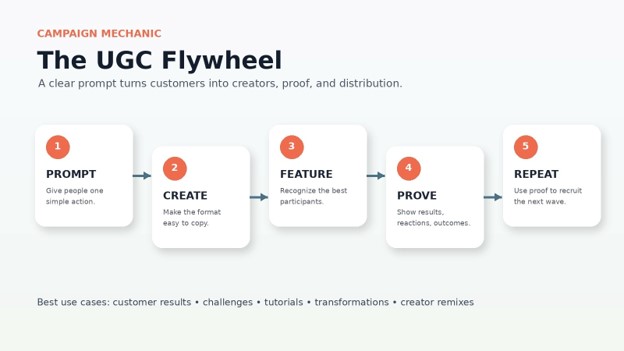
The mechanic is especially valuable for software, tools, home products, food, fitness, education and creative services: make the customer result the creative asset. A strong user-generated content campaign combines proof, aspiration, recognition and an ongoing prompt.
Lesson to steal: give customers a recognizable label, hashtag, format or submission ritual so their work contributes to a larger branded gallery.
- e.l.f. Cosmetics’ TikTok-First Creative: Design for the Platform
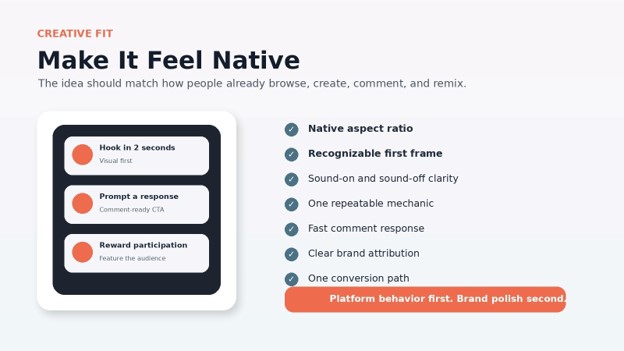
The most effective platform-native campaigns do not look like TV commercials cropped vertically. They use the platform’s language: recognizable audio, participation, creator behavior, comments, remixes, trends and repeatable formats.
For marketers studying viral marketing campaigns to learn from, the key principle is creative fit. A brand should ask what users already do on the platform and then design a branded action that feels like a natural extension of that behavior.
Lesson to steal: before writing the campaign, spend time observing how people create, respond and remix on the target platform. The mechanic should feel native before the logo appears.
- Blendtec “Will It Blend?”: Demonstrate the Product Through a Repeatable Series
The genius of “Will It Blend?” was not simply putting unusual objects into a blender. It created a repeatable question that could produce many episodes. Each new object refreshed the same product proof: the blender was powerful.
This is a valuable pattern for small businesses because series formats reduce creative fatigue. Instead of inventing a new concept every week, create a durable question: “Can it handle this?”, “What happens if…?”, “Before or after?”, “Can we fix it?”, or “Which version wins?”
Lesson to steal: the best campaign idea may be a content franchise that compounds over time rather than a one-week stunt.
- Burger King’s Moldy Whopper: Use Pattern Interruption With a Product Truth
The Moldy Whopper campaign was deliberately uncomfortable. Showing the product decomposing broke the polished conventions of fast-food advertising and supported a message about removing artificial preservatives.
Shock by itself is usually a bad strategy. The reason this type of creative can work is that the visual surprise is connected to a clear product claim or brand position. If you remove the strategic link, you are left with attention that may not transfer to the brand.
Lesson to steal: pattern interruption should make the product truth easier to remember, not merely make the content strange.
- Duolingo-Style Character Marketing: Give the Brand a Repeatable Personality
Brands with recognizable characters or strongly defined social voices can behave more like creators. The advantage is continuity: the audience knows what kind of joke, reaction or dramatic behavior fits the character, so the brand can participate in fast-moving conversations without rebuilding its identity every time.
The practical lesson from character-led viral marketing campaigns to learn from is to create behavioral rules, not just tone-of-voice adjectives. Define what the character wants, what annoys it, how it reacts to fans, what it never says, and which cultural spaces it can credibly enter.
Lesson to steal: a brand personality becomes scalable when a community manager can predict how it behaves in a new situation.
Step-by-Step Execution Guide: Build a Viral Campaign Without Guessing
A strong viral process treats sharing as a design requirement. The viral marketing campaigns to learn from above point to the same practical truth: distribution should be built into the idea, not bolted on at launch. The following steps turn those lessons into a repeatable campaign workflow.
Pick One Business Outcome Before You Chase Reach
Decide what the campaign must move if it succeeds. Common goals include:
- Branded search demand
- Email or account sign-ups
- Product trials
- User-generated content volume
- Store visits
- Qualified leads
- Sales of a specific product
- Brand awareness in a defined audience
Do not use “go viral” as the objective. Virality is a distribution outcome. Your business objective determines the landing page, call to action, measurement plan and audience you should prioritize.
| 💡 Quick Hack: Write the goal as a sentence with a number and a deadline: “Generate 2,000 qualified demo sign-ups from small ecommerce brands in 30 days.” A concrete goal prevents the team from celebrating empty reach. |
Find a Tension the Audience Already Talks About
The best campaign ideas often begin with a familiar frustration, identity signal, private joke, aspiration or contradiction. Research sources should include:
Product reviews, especially 3-star reviews
Reddit and niche communities
TikTok and YouTube comments
Support tickets and sales call notes
Competitor comments
Search suggestions and People Also Ask queries
Creator content that already gets repeated
Customer interviews
Look for exact phrases people use. Do not “professionalize” the language too early. Natural audience language often contains the hook.
Define the Share Trigger
Every campaign should have a clear answer to: Why would a person send this to someone else?
Common share triggers include:
“This is so me.” — identity
“This is so you.” — social recognition
“You need to know this.” — utility
“I cannot believe they did this.” — surprise
“I want to join.” — participation
“I want to show my result.” — achievement
“This says what I have been feeling.” — emotion
“I want my friends to compare.” — status or competition
The most transferable viral marketing campaigns to learn from usually combine at least two triggers. Spotify Wrapped combines identity and comparison. The Ice Bucket Challenge combined participation and nomination. Old Spice combined humor and direct recognition.
Choose a Viral Mechanic, Not Just a Content Format
A 30-second vertical video is a format. A challenge that asks viewers to recreate an action and nominate two friends is a mechanic.
Useful mechanics include:
Nomination loop: participants invite the next participants
Personalized output: users receive a unique result or card
Remix template: users recreate the same structure with their own twist
Public proof: customers show results or transformations
Challenge: a visible behavior with simple rules
Collectible hunt: people search, collect or unlock variations
Real-time response: audience comments become new brand content
Utility object: calculator, checklist, template or tool that earns shares
Debate prompt: a safe, relevant question with defensible opposing positions
Reveal: a surprising result that makes the audience stay and share
Build the Smallest Testable Version
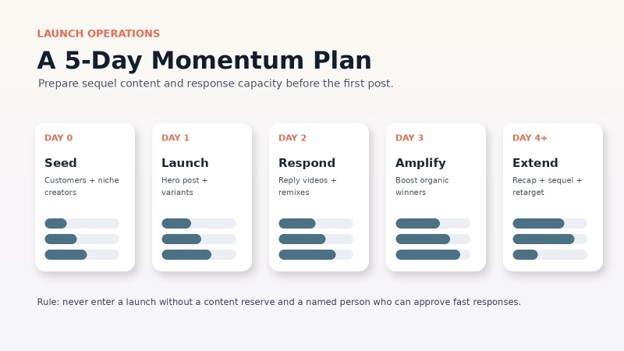
Do not spend six weeks polishing a campaign that has never been exposed to real people. Build three to five rough variants that test different hooks while keeping the core mechanic constant.
For video, test the first two seconds, the on-screen text and the ending CTA. For static creative, test the headline and visual contrast. For a generator or quiz, test whether people actually want to share the result before engineering a sophisticated version.
| Pro-Tip: Test with 20-50 people from the target audience and ask only behavioral questions: “Would you send this?”, “Who would you send it to?”, “What would you write above it?”, and “What would stop you from participating?” Those answers are more useful than asking whether they “like” the idea. |
Create a Share Kit Before Launch
A campaign should be easier to spread than to explain. Prepare:
9:16, 1:1 and 16:9 versions
Caption starters
A short campaign explanation
Brand-safe GIFs or reaction assets
Creator briefing notes
Hashtag or naming convention
Downloadable templates
Press or partner assets
Landing-page links with tracking parameters
FAQ and moderation responses
| 💡 Quick Hack: Put all campaign assets in one shared “launch folder” with filenames that start with the platform and purpose, such as `TIKTOK_Hook-A_9x16.mp4` or `CREATOR_Brief_vFinal.pdf`. This saves critical minutes when momentum appears. |
Seed With the Smallest Relevant Communities First
Mass reach can hide weak resonance. Start with people who have a reason to care:
Existing customers
Employee advocates
Niche creators
Community leaders
Newsletter subscribers
Product power users
Relevant partners
Give creators room to interpret the idea. Over-scripted creator content often loses the native personality that made the creator valuable.
If creators are compensated or receive something of value, use clear disclosure practices. The FTC’s social media influencer guidance explains that material relationships should be disclosed clearly and conspicuously.
External reference: FTC social media influencer guidance
Run a Real-Time Response Room
If the campaign starts moving, your team should already know:
Who can approve a reply in minutes
Which comments deserve video responses
Which creators should be amplified
Which claims require legal review
What to do if a joke is misunderstood
When to add paid amplification
When to stop interacting
This is where the Old Spice lesson becomes operational. Speed must be planned. Otherwise, the approval chain kills the moment.
Amplify Organic Winners, Not Executive Favorites
Wait for evidence. Then put paid budget behind the strongest organic assets, creator posts, audiences or hooks.
A basic rule: if Creative A produces twice the share rate and stronger watch-through than Creative B among the same audience, give A the amplification budget even if B looks more “on brand” in a meeting.
| 💡 Quick Hack: Set a small paid “momentum reserve” before launch. Do not spend it evenly. Release it only when a post clears your predetermined organic threshold for shares, completion rate or qualified site actions. |
Capture the Attention You Earn
A viral spike is perishable. Every campaign needs a bridge from attention to an owned or measurable relationship.
Use a landing page with one dominant action. Add email capture, product trial, store locator, quiz result, downloadable asset or direct purchase path depending on the objective. Keep the page visually consistent with the campaign so users do not feel they landed somewhere unrelated.
If you use AI to speed up ideation, editing, research or content repurposing, connect the campaign workflow to related MyFlexBots resources on the best AI tools in 2026 and best AI tools for productivity.
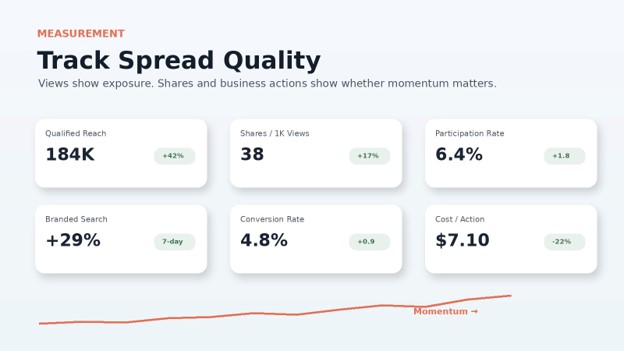
Measure Spread Quality, Not Just Volume
The campaign dashboard should separate exposure, propagation and business impact.
Exposure metrics
Reach
Impressions
Video views
Watch time
Propagation metrics
Shares per 1,000 views
Reposts
Participation rate
UGC submissions
Remix or response volume
Creator adoption
Share-to-like ratio
Business metrics
Branded search lift
Direct traffic
Lead quality
Sign-ups
Conversion rate
Assisted conversions
Revenue
Cost per incremental action
Nielsen’s brand and sales measurement guidance is a useful external reference for thinking beyond surface-level engagement and evaluating both brand and business outcomes.
External reference: Nielsen brand and sales measurement guidance
Common Mistakes to Avoid
Mistake 1: Trying to Manufacture Virality
Teams often start with “we need something viral” and then reach for random humor, controversy or trends. That reverses the process. Start with a real audience tension and a sharing mechanic; virality is the possible result.
Fix: force the team to write one sentence describing why a person would share the campaign without mentioning “because it is funny” or “because it is cool.”
Mistake 2: Targeting Everyone
Broad campaigns can spread, but they usually begin with a specific group that cares intensely. If the first audience feels lukewarm, the algorithm will not rescue the idea.
Fix: design the first version for a defined community. Expansion can happen after the language and mechanic prove themselves.
Mistake 3: Making Participation Too Hard
Every extra instruction reduces participation. Challenges fail when users need special equipment, complex editing, a long explanation or a risky public performance.
Fix: make the action understandable in five seconds and completeable with tools the audience already has.
Mistake 4: Winning Attention but Losing Attribution
Memes can travel so far that the brand disappears. This is especially common when the branded element is only in the caption or original account name.
Fix: make attribution native to the creative: a recurring visual device, product, phrase, character, sound, template or result card that survives reposting.
Mistake 5: Having No Conversion or Crisis Plan
A campaign can generate millions of views while the site crashes, support teams are surprised, inventory runs out, comments turn negative or legal concerns emerge.
Fix: build a launch checklist covering infrastructure, inventory, moderation, escalation, permissions, disclosures, customer support and tracking before the first post goes live.
Advanced Tips and Next-Level Hacks
The difference between a one-off viral hit and a repeatable growth system is what happens before and after the spike. When you review viral marketing campaigns to learn from, study the operating model behind the public creative as closely as the creative itself.
Build a Two-Speed Creative System
Create two approval tracks:
Planned content: high-production assets, major claims, partnerships and long-lead campaigns
Real-time content: pre-approved visual templates, response formats, jokes, comment replies and creator reactions
This reduces the conflict between brand safety and speed.
Measure “Share Density” by Audience Segment
A million views from passive viewers can be less useful than 50,000 views inside a high-intent niche where people repeatedly share the content.
Calculate shares per 1,000 views by audience, creator and platform. Then compare those segments with downstream branded search and conversion behavior.
Design for Private Sharing
Not all virality is visible. A useful calculator, relatable meme, surprising result or practical checklist may move heavily through WhatsApp, Messenger, DMs and group chats.
| 💡 Quick Hack: Add a “copy link” button and UTM-tagged share buttons to campaign landing pages. Public repost counts may understate the real referral loop. |
Create a UGC Rights Workflow
If the campaign depends on customer photos and videos, decide how you will request permission, store approvals, credit creators and reuse assets. A viral UGC program without rights management becomes messy quickly.
Build a Sequel Before the First Campaign Ends
When momentum appears, teams often scramble for a follow-up. Instead, prepare three sequel concepts in advance: a reaction version, a community-results version and a “level two” participation version.
| Pro-Tip: The best sequel often highlights the audience rather than the brand. Publish participant compilations, creator spotlights, surprising results, geographic maps, leaderboards or behind-the-scenes reactions. |
Use AI for Volume, Not for the Core Human Insight
AI can help summarize comments, cluster audience pain points, generate hook variations, resize creative, draft response options and turn long videos into short clips. It should not replace the human judgment needed to decide what the audience genuinely cares about.
For practical tooling ideas, link readers to more practical marketing guides on MyFlexBots and relevant AI workflow resources.
Troubleshooting and Long-Term Maintenance
Problem: The Campaign Gets Views but Almost No Shares
Likely causes: the hook is strong but the content offers no social utility, the CTA is passive, or the audience is curious but not emotionally invested.
Fix: change the ending. Ask for comparison, nomination, prediction, confession, result-sharing or a specific response. Test whether users can use the content to communicate with another person.
Problem: People Share It but Do Not Remember the Brand
Likely causes: weak attribution, generic meme format, product absent from the core mechanic.
Fix: move the brand into the idea itself. Add a recurring phrase, distinctive template, product behavior, character or recognizable result card.
Problem: Engagement Is High, but Traffic Does Not Convert
Likely causes: the campaign promise and landing page do not match, the CTA asks for too much, mobile load time is slow, or the audience is broad but low intent.
Fix: create a campaign-specific landing page with the same visual language and one action. Segment retargeting by engagement depth instead of treating every viewer equally.
Problem: The Comments Turn Negative
Likely causes: the joke punches down, the trend is sensitive, the claim is unclear, or the brand response feels defensive.
Fix: classify the issue quickly. Correct factual errors, acknowledge legitimate criticism, stop scheduled jokes if context has changed, and move complex customer-service problems to an appropriate support channel. Do not argue with people for engagement.
Problem: Creators Post Inconsistent or Off-Brand Content
Likely causes: the brief is too vague or too controlling.
Fix: provide a one-page creator brief with the campaign truth, required disclosure, non-negotiables, examples of acceptable interpretation, forbidden claims, and the single desired action. Leave the creator’s actual voice intact.
Problem: A Trend Moves Faster Than Your Approval Process
Likely causes: too many approvers, unclear risk categories, no pre-approved assets.
Fix: create a response matrix. Low-risk replies can be approved by the community lead, medium-risk posts by marketing leadership, and high-risk legal or reputational issues by the designated escalation team.
Problem: The Campaign Spikes and Dies in 48 Hours
Likely causes: no sequel, no creator wave two, no community spotlight and no paid retargeting.
Fix: plan a three-stage curve: launch, participation amplification, and proof/recap. Use the recap to capture SEO value, email sign-ups, case-study material and retargeting audiences after the trend cools.
Maintenance: Build a Viral Learning Library
After every campaign, record the same inputs and outcomes. This makes your own archive of viral marketing campaigns to learn from more valuable with every launch:
Winning hook
Losing hooks
Best share trigger
Best audience segment
Top creator fit
Response time
Share rate
Participation rate
Brand search change
Conversion result
Negative feedback themes
Reusable assets
What you would repeat or stop
This is how viral marketing campaigns to learn from become an internal operating advantage rather than inspirational screenshots in a presentation.
Frequently Asked Questions
What is viral marketing in simple terms?
Viral marketing is a strategy in which people help distribute a brand message by sharing, participating, remixing, recommending, or publicly using the campaign. The audience becomes part of the distribution system, which can accelerate reach beyond the brand’s directly purchased media.
Can a small business create a viral campaign with a low budget?
Yes, but the goal should be high shareability in a relevant niche, not instant mass fame. A small business can use customer stories, before-and-after proof, local challenges, personalized results, useful templates, founder-led content, or a repeatable demonstration series. A small campaign that reaches the right 20,000 people may outperform a broad campaign with a million low-intent views.
How do you make a marketing campaign more shareable?
Give the audience a reason to use the content socially. Make it useful, identity-driven, emotional, surprising, participatory, or easy to compare. Then reduce friction with mobile-first creative, clear instructions, share-ready assets, and a simple CTA.
Which metrics best show whether a campaign is truly going viral?
Watch growth velocity, shares per 1,000 views, repost rate, participation volume, creator adoption, referral traffic, and the share-to-like ratio. Then connect those signals to business outcomes such as branded search, qualified leads, sign-ups, purchases, or store visits.
How long should a viral marketing campaign run?
There is no fixed duration. A reactive moment may peak in days, while a UGC series can run for months or years. Plan in phases rather than dates: launch, proof of resonance, amplification, community participation, sequel content, and conversion capture.
What can brands copy from famous viral campaigns without copying the creative?
Copy the mechanic. Learn how the campaign created identity, participation, surprise, personalization, social proof, nomination, and real-time response or product demonstration. Then rebuild that mechanic around your own audience truth and product value. That is the safest way to use viral marketing campaigns to learn from without producing a weak imitation.
Conclusion: Engineer the Reason to Share
The strongest viral marketing campaigns to learn from are not magic tricks. They are systems that connect a human motivation to an easy sharing behavior, a recognizable brand idea, and a measurable business path.
Start smaller than you think. Find one audience tension, one strong share trigger, and one simple mechanic. Prototype it quickly, seed it with a relevant community, prepare your response operation, and amplify only after the audience proves the idea deserves more reach.
editor's pick
latest video
news via inbox
Nulla turp dis cursus. Integer liberos euismod pretium faucibua