How to Register a Small Business Online Easy Steps
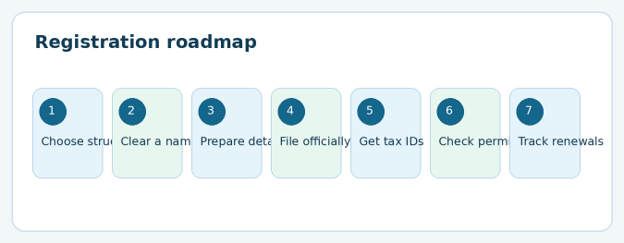
An exciting business idea can stall at the first official form: Which entity should you pick, what documents count, and where do you pay? How to register a small business online becomes much easier when you separate legal formation, tax IDs, licensing, and ongoing obligations. This MyFlexBots guide walks through all seven stages, with U.S. filing examples, cost-saving checks, and a system for avoiding expensive corrections. This practical process for how to register a small business online begins with the decisions you can verify.
Quick Answer: How Do You Register a Small Business Online?
To register a small business online, select your legal structure, confirm your name, gather owner and address details, and file with the correct government agency. Then obtain relevant tax IDs, licenses, and permits. Save approvals and track renewals. Exact steps and fees depend on location and business activities.
Before you start: There is no universal international registration portal. This article explains a practical decision process and uses U.S. state and federal agencies as specific examples. Other countries require their own corporate registry, tax authority, and local permits.
Essential Tools, Documents, Costs, and Skill Levels
You need fewer paid tools than registration-service advertisements suggest. Most basic filings are possible through an official government website; complexity rises when there are multiple owners, regulated activities, international ownership, or complex tax choices.
| Item / tool | Typical cost or fee | Difficulty | Why it matters |
| Government business-registration portal | State filing fee; SBA notes usually under $300 in many U.S. cases | Beginner–intermediate | Creates or registers an entity where required |
| Name and trademark searches | Often free to search; trademark actions may cost extra | Beginner | Prevents obvious naming conflicts |
| Registered agent | Self-service potentially $0; paid services vary | Beginner | Receives official notices when required |
| Articles of organization/incorporation | Usually included in filing fee | Intermediate | Records basic entity details |
| Federal EIN application | Free from the IRS | Beginner | Obtains tax identifier if needed |
| State/local licenses | Variable; may be $0 to hundreds or more | Intermediate | Authorizes specific business activity |
| Password manager and secure storage | Free or subscription | Beginner | Protects accounts and filings |
| Professional legal or tax review | Variable, often substantial | Advanced | Useful for partnerships or complex situations |
Budget reality: A no-employee sole proprietor using their own legal name may have a very different cost profile than a multi-member LLC or a restaurant. Avoid treating any advertised “$0 formation” offer as the complete cost; state fees, registered-agent renewals, licenses, taxes, and reporting may still apply.
Choose the Right Business Structure
A business structure determines who owns the operation, how profits are taxed, how formal governance works, and which personal assets may be exposed to business liabilities. Structure selection comes before purchasing a filing package because the correct form—and even the relevant office—depends on it. For anyone learning how to register a small business online, this choice shapes every form that follows.
Compare sole proprietorship, LLC, partnership, and corporation
Sole proprietorship: Often the simplest route for a person operating alone. In the United States, merely conducting business under your own legal name may not require formal state entity formation, although local licensing, tax and assumed-name requirements can still apply. It generally does not create a separate legal liability shield.
Limited liability company (LLC): A state-created entity with potential liability separation and flexible tax treatment. It usually requires formal state filings, a registered agent where mandated, and possible annual reports or franchise taxes. The protection has limits and proper separation of business and personal activities matters.
Partnership: Multiple owners share a business, but liability and paperwork vary by partnership type. A written partnership agreement is strongly advisable even if a local law does not require it. Clarify capital contributions, voting, compensation, owner exits, intellectual property, and disputes before accepting payments.
Corporation: A more formal entity that may suit ventures seeking outside investment, transferable ownership interests, or a particular governance model. Corporate records, director actions, and tax elections add work. An “S corporation” is generally a federal tax classification/election rather than a distinct universal state entity type.
Decision questions to answer before filing
Will there be one owner or several, and who will make binding decisions?
Does the activity carry substantial injury, product, professional, data, or contract risk?
Will investors demand shares or a conventional corporate structure?
Where is the business physically operating, employing people, or earning revenue?
Can the owners maintain separate bank accounts and required records?
💡 Quick Hack: Write a one-page structure decision memo before filling a form. Include ownership, location, risk level, the selected structure, and the reason for that choice. It prevents impulse decisions caused by “cheap LLC” advertising and becomes useful when speaking to an accountant.
Choose and Verify a Business Name
A memorable name is not enough; you must determine whether the government will accept it and whether it risks infringing someone else’s brand. A state name search checks only part of the picture. Trademark rights, trade names, domains, and usernames can matter independently. A core part of how to register a small business online is verifying the name before committing to the brand.
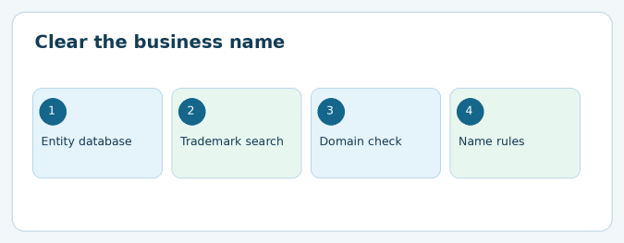
A practical name-clearing workflow
List three to five distinctive names that do not imply a regulated service you cannot legally provide.
Search your state business-entity database for exact matches, close spelling variants, and abbreviations.
Check the U.S. Patent and Trademark Office trademark database or the equivalent authority in your country for potentially conflicting marks.
Check the intended website domain and important social handles, but do not assume domain availability means legal permission.
Confirm whether your entity type must include “LLC,” “Inc.,” or another suffix and whether restricted terms need approval.
Record the dates, databases, and relevant search results before filing.
A doing business as (DBA) or assumed-name registration is not the same as forming a separate LLC or corporation. A person who operates “Blue Pine Studio” instead of their personal legal name might need a DBA, while a corporation may need an additional trade-name filing when using a brand different from its legal company name.
Pro-Tip: Do the expensive part last. Check name conflicts before spending on a logo, sign, packaging, website build, or advertising. A simple naming audit can save the cost of redesigning every customer touchpoint.
Gather Your Registration Information
When people ask how to register a small business online, the frustrating delays usually come from missing inputs—not confusing buttons. Build a secure folder before opening a government portal so you can complete time-limited sessions without hunting for identification numbers or addresses.
Core registration checklist
Proposed legal name and backup names, including the required company suffix.
Principal office or physical location, plus mailing address if different.
Owner, organizer, manager, director, or partner names as requested.
A registered agent’s name and street address if the entity requires one.
Business activities described accurately, without inventing regulated credentials.
Ownership percentages, management method, and start or effective date if requested.
Payment method, contact email, and secure password manager.
Any required professional license numbers, signatures, consent forms, or supporting documents.
Many U.S. LLC applications ask whether the entity is member-managed or manager-managed. Member management commonly means owners handle ordinary operations; manager management delegates authority to specified managers. The correct choice should match the actual operating agreement and decision-making arrangement.
A registered agent is not just a forwarding address. The agent must satisfy the state’s eligibility and physical-presence rules and be available to receive legal papers. Some owners can serve as their own agent, but public-address exposure and missed delivery risk deserve consideration.
💡 Quick Hack: Use a consistent “legal identity sheet” containing the approved capitalization of the business name, filing address, ownership names, and entity number once issued. Copy from this single verified record when applying for tax IDs, banking, licenses, and insurance to avoid mismatches.
File Through the Official Online Portal
The precise filing route changes by country and state. In the United States, LLCs and corporations are generally formed or registered with the relevant state office—often a Secretary of State or comparable agency. Some states allow direct online filing, while others may require paper submissions or special supporting documents. This is the most location-specific stage of how to register a small business online.
Submit a state filing carefully
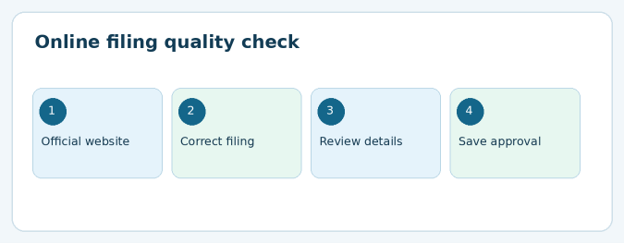
Start from an official government domain found through your state authority, not the first sponsored registration result.
Create a secure portal account and activate multifactor authentication when offered.
Select formation versus foreign qualification correctly. “Foreign” may simply mean an entity formed in another U.S. state.
Choose the correct entity type and legal name, then enter the registered agent’s information.
Enter organizer, address, and management details. Review the effective-date and public-record implications.
Read the agency’s disclosure and signature statements before electronically signing.
Check all items in the final preview; pay the official filing fee once and save the transaction reference.
Download the filed or accepted certificate and formation documents after approval.
Do not assume an online payment equals approved registration. A receipt may only acknowledge submission. Verify status in the government registry and look for approval, rejection, or requests to correct an application. Keep the filing ID separate from any tax ID.
💡 Quick Hack: Download the full completed application before submitting where the portal permits. If a form is rejected, a copy makes it easier to identify one incorrect field without reconstructing the entire record.
Obtain Tax IDs and Set Up Tax Registration
A registration certificate does not automatically complete tax registration. In the United States, the federal Employer Identification Number, or EIN identifies a business for certain tax and banking purposes. Some entities and employers need one; not every individual sole proprietor needs an EIN for every activity. Guides about how to register a small business online should always separate entity formation from tax registration.
How to apply for a U.S. EIN safely
Confirm the entity has been legally formed first when applying for an EIN for a new organization.
Visit the official IRS EIN page and determine which application method applies to the entity and responsible party.
Provide the business’s legal identity, responsible-party information, and relevant tax classification.
Complete the application following IRS eligibility and session instructions; some applicants must use another submission channel.
How to register a small business online
The IRS issues EINs free. Paid intermediaries can charge for assistance, but purchasing an EIN itself is unnecessary. The online application has eligibility restrictions for businesses whose principal place of business is outside the United States; international applicants should follow the IRS alternative instructions.
State revenue accounts may be separate. Depending on the business, the owner might need sales or use tax registration, withholding accounts, unemployment-insurance accounts, or special excise registrations. Sales-tax collection rules can be complicated for ecommerce sellers operating across jurisdictions.
Pro-Tip: Build a tax registration map with columns for government agency, account number, login, tax type, return frequency, due dates, and responsible person. This small spreadsheet often prevents expensive missed returns after launch.
Official IRS guide: apply for an EIN at no charge
Apply for Licenses, Permits, and Banking
Forming a legal entity is not permission to perform every business activity. A café may need food-service and health approvals; a contractor may need trade credentials; a home-based business may face zoning or occupancy restrictions. Check the rules for the actual product, customers, premises, and geographic reach. That distinction is essential when explaining how to register a small business online to new founders.
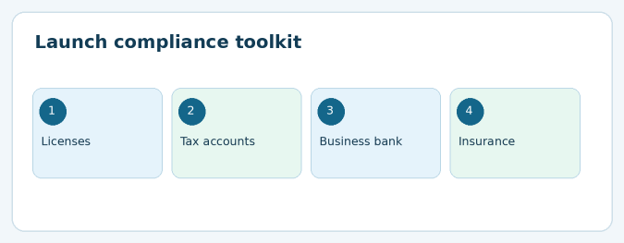
License research checklist
City or county general business licenses and zoning restrictions.
Industry permits: food, building, transportation, childcare, or professional services where applicable.
Sales tax or other state-level tax registrations.
Employer registration, labor notices, and workers’ compensation rules when hiring.
Signage, occupancy, fire, health, waste, or environmental permits for physical locations.
Online trade obligations such as privacy disclosures, refund policies, and consumer protection.
An ecommerce store should not assume it is exempt from local rules merely because it has no storefront. Its home office, warehouse, employees, and sales activities may still create obligations. For cross-border ecommerce, additional consumer, import, and tax rules can arise.
Open a dedicated business bank account
A separate account clarifies accounting and can help demonstrate proper separation between company and owner finances. A bank may ask for approved formation documents, EIN or other identification, ownership details, beneficial-owner information, and a valid business address. Exact requirements depend on the financial institution.
Set up payment processing only after understanding identity verification, prohibited-business rules, chargebacks, transaction fees, and payout holds. Record every fee in your pricing model so transaction costs do not quietly consume profits.
💡 Quick Hack: Before paying for a permit, call or email the responsible government department with a concise description of the exact work you plan to do. A written response or reference to the relevant rule can prevent buying the wrong license.
Confirm Approval and Maintain Compliance
The final step of how to register a small business online is turning one-time paperwork into a dependable system. Some owners complete formation and forget that business entities can owe periodic reports, fees, registered-agent maintenance, license renewals, and tax filings even during months with no income.
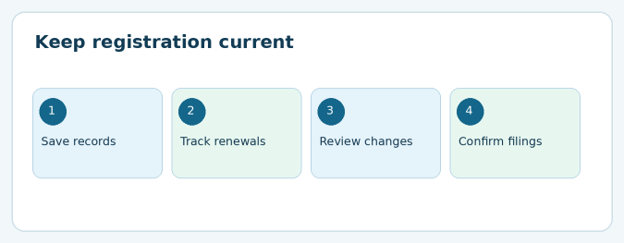
Set up a registration control center
Save a PDF of the certificate, submitted form, confirmation receipt, and governing agreement.
Record each registration number and the exact agency that issued it.
Note annual or biennial report deadlines and separate tax-filing dates.
Record registered-agent contact details and renewal arrangements.
Track local permit expiration dates and employee-license changes.
Document material changes in address, business activities, managers, or owners that trigger updates.
Keep backups with role-based access and a recovery email.
Use a calendar with reminders well ahead of deadlines, and assign one named person to verify completion. An automated reminder helps, but it is not evidence that the government accepted a report. Always save the official confirmation of submission.
Pro-Tip: Create a quarterly 20-minute compliance review. Compare your actual business address, services, ownership, employees, and sales territories against the records on file. Small updates are often easier to handle promptly than after a penalty notice.
How Much Does Online Business Registration Cost?
Registration cost consists of several independent components: filing, name or DBA registration, registered agent, tax registration, licenses, professional advice, and recurring fees. The SBA says most U.S. state business-formation filings cost under $300, but the exact amount varies substantially by state and structure; ongoing expenses can change the total. The true price of how to register a small business online therefore depends on the full compliance picture.
Example A: Individual freelancer. A sole proprietor using a legal name may avoid an entity-formation charge but could still need a city business license, an assumed-name filing if branding under another name, or relevant tax permits. Do not assume zero costs without checking local rules.
Example B: Single-owner LLC. Budget the state filing fee, possible registered-agent expense, any required operating documents, local licenses, and annual reports. EIN issuance is free through the IRS when available to you, although professional advice costs extra.
Example C: Regulated business or employer. Add professional licenses, inspections, employer accounts, insurance, staffing compliance, and location permits. These categories can exceed the entity-formation fee. A short written budget beats a bundled-service quote that hides renewals.
Five Common Mistakes Beginners Make
- Filing in the wrong state or country
A fashionable out-of-state formation location does not automatically eliminate obligations where you actually operate. You might need foreign qualification, multiple reports, extra fees, or tax accounts. Start with the locations of employees, premises, and substantive business activity, not internet anecdotes.
- Treating a DBA as liability protection
A trade name helps identify a business but ordinarily is not a standalone legal entity. If liability separation matters, investigate the appropriate entity, insurance, contracts, and governance instead of relying on a name certificate.
- Buying unnecessary tax ID services
The IRS provides EINs without an issuance fee. Check eligibility and use official instructions. Third parties may sell filing assistance, but their fee is not a government charge for the EIN.
- Ignoring licensing and zoning
Entity approval does not authorize restricted trades or premises. Verify local, state, and federal requirements relevant to what you sell, where you work, and whom you employ before opening to customers.
- Forgetting ongoing obligations
An entity can fall out of good standing after missed reports or unpaid fees. Set reminders, maintain a registered agent as required, and retain filing confirmations. A compliance calendar is part of the business infrastructure, not optional admin tidying.
Advanced Strategies and Next-Level Shortcuts
Standardize the operating agreement or bylaws review. Even a small company should document control, decision rights, capital contributions, distributions, record access, and ownership exits. For a two-owner venture, ambiguous authority can become far more expensive than the original filing fee.
Separate formation planning from tax optimization. Forming an entity does not automatically create a particular tax saving. The best tax treatment depends on profits, payroll, owner residence, eligibility, and law. Ask a qualified adviser before making a tax election that introduces new returns or payroll requirements.
Use a filing evidence convention. Rename saved documents consistently: YYYY-MM-DD_Agency_Document_EntityName.pdf. Keep both the signed/submitted version and the agency-approved version. Store proof of payments in the same folder.
Control access. Government portals may hold private addresses, tax IDs, and owner information. Enable multifactor authentication, avoid sharing credentials in email, and use a password manager for delegated access. Remove access when a contractor no longer works with the business.
Model multi-state activity early. A company formed in one state but expanding employees, warehouses, or physical operations elsewhere may face foreign-qualification and tax obligations. Ask before expansion rather than assuming the original filing covers every location.
💡 Quick Hack: Request free counseling or publicly available small-business resources before paying for a generic formation consultation. In the U.S., the SBA provides launch guidance and connections to counseling services, although individual legal advice still requires an appropriate professional.
Troubleshooting: Fix Registration Problems Without Starting Over
Name rejected by the registry
Read the stated reason. Common issues include an unavailable or misleading name, a missing legal suffix, or restricted terminology. Adjust the name consistently across the form; do not change only one field. If the name is legally important, explore the agency’s appeal or consent process rather than repeatedly guessing.
Payment charged but no confirmation arrived
Check your account dashboard, spam folder, and card statement. Record the payment timestamp and reference, then contact the official support channel. Avoid immediately submitting and paying again until you confirm whether the first application was received.
Application pending beyond expected timing
Check the public entity search or portal status and any request for corrections. Timelines vary, and a portal’s estimated processing period may not guarantee acceptance. If a contract or bank opening depends on approval, avoid representing a pending entity as fully formed.
Business address, owner, or agent changed
Review whether an amendment, updated report, registered-agent change, or tax-agency notification is required. Different agencies maintain separate records, so updating one website may not update others. Keep the old and new confirmation documents in your record archive.
EIN application cannot be completed online
Verify that the entity and responsible party meet IRS online eligibility rules. Some foreign-principal-place-of-business applicants must apply by phone, fax, or mail instead. Do not use fabricated addresses or identification details to bypass a restriction.
Business registered but permits are missing
Pause regulated activity until the required approvals are in place. Contact the licensing authority, explain your proposed operations, and obtain the correct instructions. Formation documents and tax IDs cannot substitute for professional or location-based permits.
Maintenance: Your 30-, 90-, and 365-Day Checklist
Within 30 days: confirm entity acceptance, save evidence, complete tax and permit research, prepare owner agreements, and set up bookkeeping and a separate bank account where appropriate. Some agencies require post-formation actions within a specific short window; follow the actual notice rather than this editorial checklist.
Within 90 days: audit customer invoices for the correct legal name, verify tax settings, review contractor and employee arrangements, and reconcile initial registration costs. Confirm that insurance and privacy policies match the activities underway.
Every year: check the state registry, registered-agent status, license renewals, tax accounts, annual reports, changing ownership, and records retention. Verify current rules directly because reporting obligations and federal disclosure requirements can change.
Frequently Asked Questions
- Can I register a small business online for free?
Sometimes there may be no formal entity-formation filing for a sole proprietor operating under a personal legal name, but licenses or assumed-name registrations may still cost money. U.S. LLC and corporate state filings commonly have government charges. The IRS does not charge for issuing an EIN.
- How long does online business registration take?
Form completion can be quick once information is ready, but agency processing may take longer and varies by jurisdiction, entity type, backlog, and expedited service. Check the actual portal for its current turnaround and do not treat a payment receipt as approval.
- Can I register a business from home?
Many businesses begin at home, but zoning, lease terms, homeowners’ association rules, customer visits, storage, signage, and licensing may limit activities. A home-based online shop can still trigger local registration or tax requirements.
- Do I need an LLC to sell products online?
Not necessarily. An LLC is one potential structure, not a universal ecommerce requirement. Evaluate liability risk, number of owners, jurisdiction, business contracts, taxes, and costs. Retailers may still need sales-tax registration or other permits regardless of structure.
- Do I need a tax ID if I have no employees?
It depends on entity type and tax purpose. Certain entities generally need an EIN even without employees, while some sole proprietors may use a personal taxpayer identification number for specified purposes. Banking and state requirements can also affect the decision.
- Can someone outside the United States register a U.S. business?
There are circumstances in which non-U.S. owners can form U.S. entities, but formation, foreign ownership disclosures, tax obligations, banking, and EIN application methods require careful attention. The standard online EIN eligibility rules do not fit every international applicant. Consult the relevant agencies and advisers for the specific facts.
Final Registration Checklist and Takeaway
How to register a small business online is ultimately a sequence of verifiable decisions: pick the right structure, clear the name, prepare accurate details, submit official filings, obtain tax IDs, secure licenses, and maintain records. Resist unnecessary paid shortcuts, verify approval at each agency, and create a calendar that turns launch paperwork into predictable ongoing compliance.
For MyFlexBots readers, the fastest responsible route is preparation—not rushing through checkout. Which part of the registration process has been hardest for you: choosing the structure, finding the official portal, or understanding tax and license requirements? Share your experience in the comments.
editor's pick
latest video
news via inbox
Nulla turp dis cursus. Integer liberos euismod pretium faucibua