How to Run Facebook Ads: Step-by-Step Guide
Facebook advertising can drain a budget quickly when the campaign goal, tracking, audience, and landing page do not match. This guide explains how to run facebook ads with a controlled system: prepare the offer, install measurement, build the campaign in the right order, launch cleanly, and improve results without reacting to every small fluctuation.
You will learn what each Ads Manager level controls, which objective to choose, how to set a sensible test budget, what creative to produce, and how to diagnose expensive clicks or weak conversions. The process applies to lead generation, e-commerce, local services, content promotion, app growth, and message-based campaigns.
Direct Answer: The Fastest Safe Way to Start
| Featured Snippet: To learn how to run facebook ads, create a Meta ad account, connect your Page and payment method, install the Meta Pixel and Conversions API, choose the objective that matches your business result, define an audience, set a test budget, publish multiple creatives, verify tracking, and optimize from conversion data rather than clicks alone. |
Essential Tools, Access and Budget Breakdown
This is a digital project, but it still needs a materials list. Assemble access, tracking, creative files, a destination page, and a measurement sheet before you click Create. Missing one item often causes more waste than a small targeting mistake.
| Tool / Asset | Purpose | Estimated Cost | Skill | Budget-Saving Alternative |
| Meta business portfolio | Owns Pages, ad accounts, pixels and permissions | Free | Beginner | Use a company-owned login and add staff with limited access. |
| Facebook Page and Instagram account | Provides the ad identity | Free | Beginner | A Facebook Page is essential; Instagram is strongly recommended. |
| Ad account and payment method | Holds billing, currency and time zone | Free + media spend | Beginner | Choose currency and time zone carefully because changing them may require a new account. |
| Meta Pixel | Tracks browser events on a website | Free | Intermediate | Use a supported CMS integration where possible. |
| Conversions API | Sends server-side events to improve measurement | Free to variable | Intermediate | Use a partner integration, CRM connector or developer setup. |
| Landing page or instant form | Collects the lead, sale or next action | Free to $50+/month | Intermediate | Use a focused page with one offer and one primary CTA. |
| Creative production tool | Builds images, video and variations | Free to $30+/month | Beginner | Canva, CapCut or native editing tools are enough for testing. |
| Analytics and UTM tracker | Separates campaign traffic and outcomes | Free | Intermediate | Use GA4 and a spreadsheet before buying attribution software. |
| Test budget | Buys enough delivery to evaluate the offer | Varies | Intermediate | Base the budget on target CPA and conversion volume, not a random daily number. |
| 💡 Quick Hack: Create a one-page launch folder containing the offer, audience notes, final URLs, tracking events, ad copy, images, videos and naming rules. A tidy launch folder prevents broken links, duplicate versions and last-minute creative mistakes. |
Define the Result, Offer and Economics
Before you learn how to run facebook ads inside the interface, define what a successful result is worth. “More traffic” is not a business target. A useful target is a qualified lead below $25, a purchase at a 2.5 return on ad spend, or a booked call with a profitable close rate.
Write a one-sentence campaign brief
Use this formula: “We will show [offer] to [audience] so they complete [action], and we can afford up to [target cost] for that action.” This sentence forces the offer, audience, conversion and budget to agree.
Offer: the product, service, lead magnet, consultation, trial or message prompt.
Audience: the clearest customer group you can serve profitably.
Action: purchase, lead, call, message, registration, app event or page visit.
Target cost: the maximum cost per result that protects margin.
Calculate a break-even acquisition cost
For e-commerce, start with gross profit per order, not revenue. If a $100 order leaves $40 after product cost, fulfilment, discounts and payment fees, the break-even first-order CPA is below $40 unless repeat purchases add proven lifetime value.
For lead generation, multiply gross profit per customer by the lead-to-customer close rate. If one customer is worth $600 in gross profit and 10% of qualified leads become customers, the rough break-even lead value is $60. Set the target below that number to leave room for overhead and weak periods.
| Pro-Tip: Do not build the first campaign around the full product catalogue. Pick one strong offer with clear proof. A narrow offer produces cleaner data because the audience, creative and landing page are solving the same problem. |
Set Up the Meta Business Assets Correctly
Anyone learning how to run facebook ads should use business-owned assets rather than relying on one employee’s personal control. The person can use a personal Facebook profile to access the tools, but the Page, ad account, dataset and billing should sit inside the company’s business portfolio.
Create or open the Meta business portfolio and confirm the legal business details.
Add the Facebook Page and connect the correct Instagram account.
Create or add the ad account. Confirm currency, time zone and billing country before spending.
Add the payment method and, when available, a backup method.
Assign people or partners only the permissions they need. Remove former staff promptly.
Turn on two-factor authentication for everyone with access.
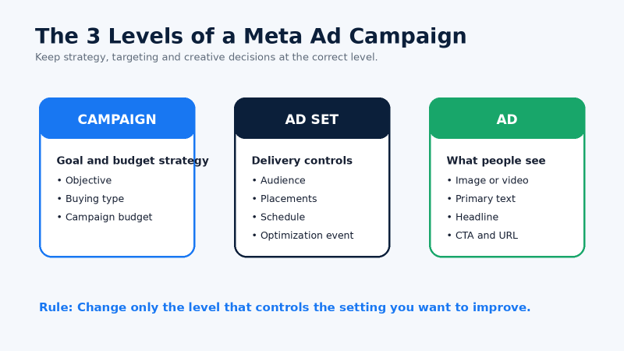
Meta Ads Manager uses three levels: campaign, ad set and ad. The campaign stores the objective and certain budget settings. The ad set controls audience, placements, schedule and optimization. The ad holds the identity, media, copy, link and call to action.
| 💡 Quick Hack: Create a second administrator who is a trusted owner or senior manager. One-person access becomes a serious risk when a phone is lost, an employee leaves or a profile is temporarily restricted. |
Install Tracking Before Spending
Tracking is not a task to postpone until the campaign is live. If the event is missing or duplicated, the system learns from bad information and your reports cannot separate a creative problem from a website problem.
Use the Meta Pixel and Conversions API together
The Meta Pixel records browser events, while the Conversions API can send events from a server, commerce platform or CRM. Meta recommends considering both for website events because the two sources can improve measurement across the customer journey. Use event IDs or a supported partner integration to deduplicate events so one purchase is not counted twice.
Official reference: About Conversions API
Choose the event that represents value
E-commerce: ViewContent, AddToCart, InitiateCheckout and Purchase.
Lead generation: ViewContent, Lead, Schedule, Contact or a qualified CRM stage.
Subscriptions: CompleteRegistration, StartTrial and Subscribe when available in the implementation.
Local services: Lead, Contact, Schedule and offline closed-sale events.
Open Events Manager and use the Test Events tool. Complete the action yourself on desktop and mobile, confirm the event name and parameters, then check whether browser and server events are deduplicated. Review Event Match Quality as a diagnostic, not as a vanity score.
| 💡 Quick Hack: Record a 30-second screen video of a successful test event and save it in the launch folder. When tracking changes later, your team has a clear example of what “working” looked like. |
Choose the Correct Campaign Objective
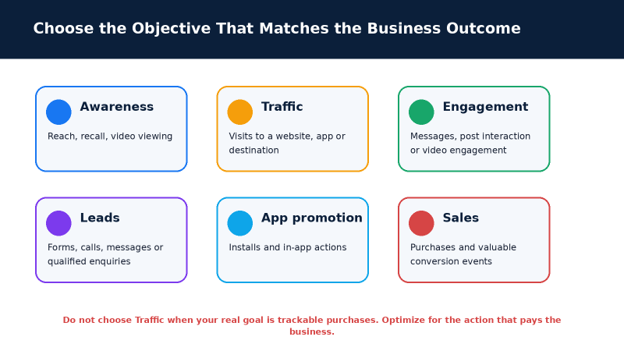
The biggest decision in how to run facebook ads is not the audience interest. It is the objective, because the delivery system looks for people likely to complete the action linked to that objective. Meta currently groups campaigns into six objectives: Awareness, Traffic, Engagement, Leads, App promotion and Sales.
| Objective | Optimizes Toward | Best Use | Common Misuse |
| Awareness | Reach, recall, video viewing | Brand launch, local reach, upper-funnel video | Expecting it to find buyers as efficiently as Sales. |
| Traffic | Landing-page views or destination visits | Articles, third-party destinations, early page tests | Using it for trackable purchases just because clicks are cheap. |
| Engagement | Messages, video engagement, post interaction | Messenger/WhatsApp conversations, social proof, video engagement | Optimizing for likes when the real goal is leads. |
| Leads | Instant forms, calls, messages or website leads | Service businesses, B2B, consultations, enquiries | Collecting low-intent leads without qualifying questions or follow-up. |
| App promotion | Installs and in-app actions | Mobile app acquisition and re-engagement | Launching without app event measurement. |
| Sales | Purchases and valuable conversion events | E-commerce, subscriptions, trackable revenue actions | Choosing Purchase when the account has no reliable purchase event. |
Use Meta’s official guide to choose the right Meta ad objective when the conversion location or performance goal is unclear.
Build a Clean Campaign Structure
Click Create in Ads Manager, select the objective, and give the campaign a name that another person can understand six months later. A useful naming format is: country–offer–funnel stage–objective–date. Example: UK–BoilerQuote–Cold–Leads–Aug26.
Campaign budget or ad-set budget?
Advantage+ campaign budget distributes one campaign budget across ad sets. It is useful when the ad sets pursue the same result and Meta is allowed to move spend toward the strongest opportunity. Ad-set budgets give tighter control during a structured audience test or when regions have separate financial limits.
Do not split a small budget across many ad sets. Each extra ad set creates another delivery pool that needs data. A beginner campaign is often stronger with one or two ad sets and several creative variations than with ten narrow audiences.
Declare a Special Ad Category when required for credit, employment, housing, social issues, elections or politics.
Use an A/B test when you need a controlled answer to one meaningful question.
Keep prospecting and retargeting separate when their audiences, messages or targets differ.
| Pro-Tip: Test one major variable at a time. When the audience, offer, video, copy, landing page and optimization event all change together, the result cannot teach you what caused the improvement. |
Build Audiences Around Buyer Readiness
When people ask how to run facebook ads, they often expect a secret list of interests. Modern delivery works better when the audience is large enough for the system to learn and the conversion signal is reliable. Start with business constraints, then add suggestions rather than choking delivery with dozens of filters.
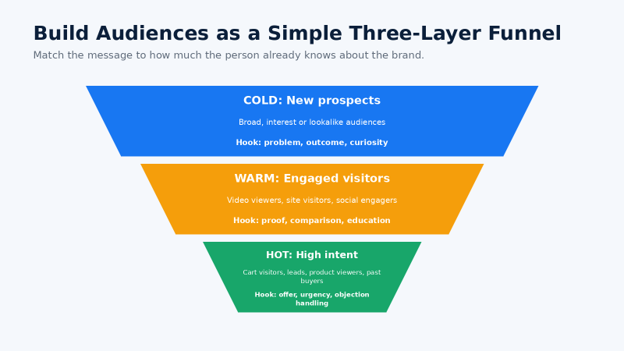
Cold audiences
Cold audiences have not interacted with the business recently. Test a broad audience limited by location, age or language when those restrictions are genuine. An interest audience can still be useful when the product is niche, the budget is small, or you need an initial hypothesis, but avoid stacking so many interests that reach becomes fragile.
Warm and hot audiences
Warm audiences may include video viewers, Facebook or Instagram engagers, website visitors and email subscribers. Hot audiences include product viewers, cart visitors, leads, trial users and past customers. Exclude recent purchasers from acquisition ads unless the campaign promotes a suitable repeat purchase.
Advantage+ audience
Advantage+ audience can use your inputs as suggestions and expand beyond them to find lower-cost results, while strict controls such as location, minimum age, language and exclusions remain available for business constraints. It is often a sensible starting point when tracking and creative are strong.
| 💡 Quick Hack: Build exclusions before launch. Exclude employees, test leads, recent customers and overlapping retargeting groups where appropriate. Clean exclusions reduce awkward messaging and prevent campaigns from competing for the same people. |
Set a Budget and Schedule That Can Produce Data
A practical answer to how to run facebook ads on a small budget is to narrow the test, not starve it. Use one offer, one conversion action, one or two ad sets, and three to six useful creatives. A tiny budget divided across too many cells produces noise instead of learning.
Use target CPA to estimate the test budget
A planning heuristic is to budget for several target-cost conversions per week, not one lucky result. If your target lead cost is $20, a $5 daily budget is unlikely to reveal much quickly. A $20 to $40 daily test concentrated in one ad set may be more informative, but the correct number depends on market CPM, conversion rate, geography and risk tolerance.
For an expensive B2B sale, the campaign may optimize first for a qualified lead rather than closed revenue. For a low-cost store, Purchase may be realistic from the start. The event must occur often enough to guide delivery and still represent real value.
Know the four basic equations
CPM = spend ÷ impressions × 1,000.
Link CTR = link clicks ÷ impressions × 100.
Landing-page conversion rate = conversions ÷ landing-page views × 100.
CPA = spend ÷ conversions. ROAS = tracked revenue ÷ ad spend.
Use a start and end date for a fixed promotion. For an evergreen campaign, launch at a time when someone can monitor comments, forms, messages and the website. Avoid making major launches immediately before a weekend if no one can respond to leads.
Choose Placements Without Throwing Away Inventory
Advantage+ placements allow delivery across eligible Meta surfaces, including Facebook, Instagram, Messenger and other supported placements. This is the best default for most campaigns because the system can pursue the result where an impression is most valuable.
Use manual placements only for a clear reason: the creative cannot be adapted, a regulated message cannot appear in a surface, a destination does not work in a placement, or a controlled test requires it. Do not remove Reels or Stories simply because the first design is square; create a vertical version instead.
Feed: use 1:1 or 4:5 creative with readable mobile text.
Stories and Reels: use 9:16 creative, quick movement and safe space around interface elements.
Right column and smaller placements: rely on a simple visual and short headline.
Video placements: communicate the offer without requiring sound.
| 💡 Quick Hack: Export one master concept in square and vertical formats. Keep the hook and brand elements consistent, but reposition text rather than stretching or letterboxing the same file. |
Create Ads That Make the Offer Easy to Understand
Knowing how to run facebook ads technically is not enough when the creative is vague. The ad must earn attention, explain the value, reduce doubt and make the next step feel safe. A polished brand film can lose to a simple demonstration if the demonstration answers the buyer’s real question faster.
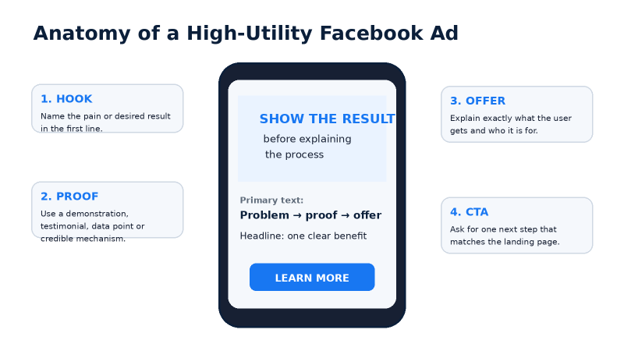
Use a four-part creative formula
Hook: name the painful problem, desired result, surprising fact or relevant situation.
Proof: demonstrate the product, show the process, use a credible testimonial or explain the mechanism.
Offer: state what the user receives, who it is for and why it matters now.
CTA: ask for one action that matches the next page or conversation.
Build a practical test matrix
Create three angles, two formats and two copy styles. For example, test a pain angle, a result angle and a proof angle; produce each as a short video and a static image; then pair concise and detailed copy. You do not need every possible combination on day one. Start with the strongest six.
Pain angle: “Still losing enquiries because nobody answers after 6 p.m.?”
Result angle: “Book qualified consultations without adding another admin shift.”
Proof angle: “See how the follow-up workflow replies, qualifies and schedules in minutes.”
Claims must be truthful, supportable and clear. Review the FTC’s truth-in-advertising standards and place material limitations close to the claim rather than hiding them on a distant page.
| Pro-Tip: Mine sales calls, support tickets, reviews and comments for copy. The words customers use to describe fear, delay, confusion and desired outcomes are usually stronger than invented marketing language. |
Assemble the Ad and Destination
At the ad level, select the correct Facebook Page and Instagram identity. Choose the format, upload the media, crop each placement, and preview every major surface. Confirm that automated creative enhancements do not alter regulated text, pricing or brand-critical details in an unwanted way.
Primary text: lead with the most relevant line before the truncation point.
Headline: state one benefit, offer or decision-driving fact.
Description: use it for useful support, not essential information that may not display everywhere.
CTA button: match the action—Learn More, Shop Now, Sign Up, Book Now, Send Message or another available option.
Destination: link to the exact page promised in the ad, not a generic homepage.
Add UTM parameters
Use consistent parameters such as utm_source=facebook, utm_medium=paid_social, utm_campaign=offer_country_date and utm_content=creative_angle. Google recommends using the relevant UTM fields consistently so Analytics can identify campaign traffic.
Build and document URLs with the Google Analytics campaign URL builder. Keep names lowercase and avoid changing the naming pattern halfway through a campaign.
| 💡 Quick Hack: Paste the final URL into a private browser window on a phone. Complete the full journey, including form submission, checkout, thank-you page and confirmation email. This catches login dependence, mobile spacing problems and broken redirects. |
Run a Pre-Publish Quality Check
Do not treat the green Publish button as the quality check. Review the campaign level, ad set level and ad level separately. A strong ad can still fail because the schedule is wrong, the country is missing, the event points to the wrong dataset, or the landing page loads slowly.
☐ The objective and performance goal match the real business action.
☐ The correct Page, Instagram account, ad account and dataset are selected.
☐ The audience location, age, language, exclusions and customer lists are accurate.
☐ Budget, start date, end date and account time zone are understood.
☐ Every creative fits its placement and text remains readable on mobile.
☐ Price, discount, deadline, guarantee and disclaimer match the landing page.
☐ The destination URL and UTM parameters work.
☐ The primary event fires once and is visible in Test Events.
☐ Forms send notifications and leads reach the CRM or responsible person.
☐ The privacy policy and required consent language are present.
Launch, Read the Data and Optimize
The difference between knowing how to run facebook ads and managing them profitably is disciplined diagnosis. Do not pause a new ad after a few expensive clicks, and do not celebrate a low CPC if the traffic never converts. Compare performance with the target CPA, conversion quality and downstream sales.
First 24 to 72 hours
Confirm that the campaign is delivering, spending near the intended pace, receiving comments normally, sending users to the correct page and recording events. Fix broken tracking, rejected creative or a dead landing page immediately. Avoid constant audience and budget edits simply because results move during early delivery.
After enough meaningful data
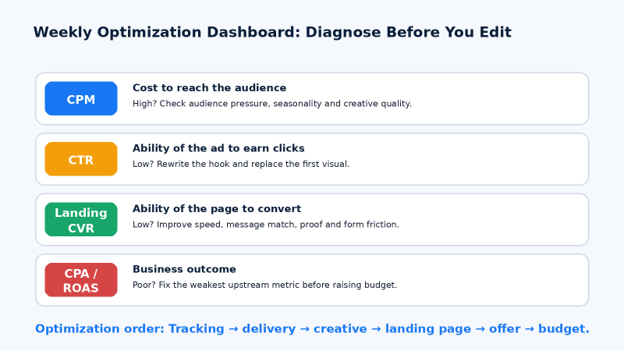
Use a funnel diagnosis. High CPM but acceptable CTR may point to an expensive audience or season. Low CTR usually points to weak relevance or creative. Good CTR with low landing-page conversion points to page speed, message mismatch, form friction, price or offer weakness.
| Symptom | Likely Cause | First Fix |
| High CPM | Audience pressure, seasonality, narrow reach, quality signals | Broaden eligible reach, refresh creative, review exclusions and placements. |
| Low link CTR | Weak hook, unclear visual, wrong audience-message match | Replace the opening visual and first line; test a different angle. |
| Good CTR, high CPC | CPM is high or click volume is still limited | Check placement mix, audience size and creative relevance. |
| Clicks, no landing views | Slow page, redirect error, accidental clicks | Test mobile speed, destination, redirects and page-load event. |
| Landing views, no leads | Offer, proof, form or message mismatch | Reduce fields, strengthen proof and align the headline with the ad. |
| Leads, poor sales quality | Weak qualification or optimization signal | Add qualifying questions, feed qualified stages back through CRM/CAPI. |
| Frequency rising, CPA worsening | Creative fatigue or small retargeting pool | Rotate concepts, shorten retargeting window or cap spend through structure. |
Common Mistakes to Avoid
Mistake 1: Choosing cheap clicks instead of valuable outcomes
Traffic campaigns can produce low-cost visits, but cheap traffic is not automatically qualified. When a purchase or lead event is reliable, optimize toward that event rather than using clicks as a substitute for business value.
Mistake 2: Launching without verified tracking
A missing event can make a good campaign look bad. A duplicated event can make a bad campaign look profitable. Test browser and server events before launch and compare Meta, website and CRM records regularly.
Mistake 3: Splitting a small budget into too many ad sets
Over-segmentation slows learning and makes each result look more random. Consolidate audiences that share the same offer and target, then test meaningful creative differences inside a cleaner structure.
Mistake 4: Sending every ad to the homepage
A homepage asks the visitor to choose the next step. A campaign page continues the exact promise from the ad, shows proof, answers objections and presents one primary action. Message match usually matters more than decorative design.
Mistake 5: Editing based on emotion
One bad morning does not prove an ad is broken, and one cheap sale does not prove it will scale. Set review intervals, define stop rules, and make changes after comparing enough data with your target economics.
Advanced Tips and Next-Level Hacks
Separate creative testing from scaling
Use a controlled test environment to identify strong concepts, then move or duplicate proven ads into the scaling structure. Keep the original post ID when preserving social proof is useful, but confirm that comments remain accurate and appropriate for the offer.
Scale in two directions
Vertical scaling increases budget on a proven structure. Make measured increases, then watch CPA and delivery rather than doubling spend repeatedly. Horizontal scaling adds new creative, offers, countries, customer segments or funnel stages so growth does not depend on one ad.
Feed back lead quality, not just lead volume
For lead businesses, connect the CRM and send later-stage outcomes through the Conversions API where the implementation and privacy basis allow it. A campaign that learns which leads become qualified appointments is more valuable than one that only learns who submits the easiest form.
Create a paid-and-organic content loop
Turn winning ads into organic posts and use organic comments to create the next ad angle. MyFlexBots readers can also learn how to grow your organic Instagram audience and build a repeatable content calendar so creative testing does not begin from zero every week.
Build a lead-nurture bridge
A lead ad is only the first step. Send a fast confirmation, explain what happens next, and follow up through email, phone, messaging or a sales workflow. Review options to choose an email marketing platform when leads need education before they are ready to buy.
| 💡 Quick Hack: Create a “winner log” with the hook, angle, format, audience, spend, CTR, conversion rate, CPA, comments and reason it worked. After three months, this becomes a custom creative playbook based on your market rather than generic best practices. |
Troubleshooting and Long-Term Maintenance
Campaign is active but spending very little
Check start time, account balance, billing holds, audience size, bid controls, event availability and review status. Very narrow audiences, low budgets relative to auction costs, or restrictive cost controls can limit delivery. Remove unnecessary restrictions one at a time.
Ads are rejected
Read the stated policy reason, compare the ad, destination and business model with the relevant policy, and correct the actual issue. Avoid repeatedly resubmitting the same creative. When the decision appears wrong, use the available review process and document the claim, proof and landing-page context.
Meta reports more conversions than the CRM
Compare date ranges, time zones, attribution settings, event definitions, deduplication and lead status. Meta may attribute conversions that occurred after an ad interaction, while the CRM may count only unique submitted or qualified records. Build a reconciliation sheet rather than assuming one platform is lying.
CPA suddenly rises
Check whether CPM, CTR or landing-page conversion changed first. Also review stock, price, promotion expiry, site speed, competitor activity, seasonality, comments and audience frequency. Diagnose the broken stage before changing the whole campaign.
The campaign gets leads but the team cannot close them
Listen to sales calls and classify the failure: wrong geography, wrong budget, unclear need, slow response, poor qualification or a weak offer. Update form questions and ad copy to filter obvious mismatches, but do not make the form so demanding that good prospects abandon it.
Weekly maintenance routine
Reconcile spend, leads, purchases and revenue across Meta, analytics and CRM.
Review top and bottom creatives by business outcome, not only CTR.
Read comments and messages for objections, confusion and new copy ideas.
Check event health, deduplication and Event Match Quality after site changes.
Inspect landing-page speed, form delivery and checkout on mobile.
Refresh at least one creative concept before fatigue becomes severe.
Record every meaningful edit with date, reason and expected effect.
Monthly maintenance routine
Audit access, partners, payment methods and two-factor authentication.
Compare customer quality and refund rate by campaign or offer.
Update exclusions and customer audiences.
Review the break-even CPA using current margins and close rates.
Archive dead tests and keep a clean naming structure.
Plan the next creative batch from winner logs and customer language.
Frequently Asked Questions
How should a small business start with Facebook ads?
Start with one profitable offer, one conversion action and one local or clearly defined audience. Install tracking, use the objective that matches the action, create three to six ads with different angles, and concentrate the budget instead of spreading it across many ad sets. Follow up with leads quickly.
How much should a beginner spend on Facebook ads?
There is no universal minimum. Work backward from the target CPA and buy enough delivery to observe several meaningful outcomes. A low-cost local lead may support a smaller daily test than an expensive B2B opportunity, but a budget that cannot realistically produce a conversion will not answer much.
Should I use broad targeting or interests?
Broad or Advantage+ audience is a strong default when the account has reliable conversion signals and good creative. Interests can help form an initial hypothesis in a niche market or restricted budget. Test them fairly, avoid excessive stacking, and compare customer quality as well as cost.
Are Facebook lead forms better than website forms?
Instant forms usually reduce friction and may produce more leads, while website forms can provide a richer brand experience and stronger intent. Use qualifying questions, a clear next step and CRM follow-up. Test both when lead quality and volume matter.
How long should I let an ad run before changing it?
Fix technical failures immediately, but avoid judging normal performance from a handful of impressions or clicks. Use the target CPA, spend, conversion volume and funnel metrics to decide. High-cost purchases need a longer window than inexpensive leads or add-to-cart events.
Why are my Facebook ads getting clicks but no sales?
The most common causes are low-intent optimization, a slow or confusing landing page, weak message match, missing proof, an uncompetitive offer, checkout friction or broken tracking. Compare landing-page views, conversion rate, device performance and event tests before changing the audience.
Conclusion: Launch With a System, Not a Guess
Now you know how to run facebook ads from foundation to optimization: define the economics, secure the account, verify events, choose the right objective, simplify the structure, match creative to buyer readiness, test with enough budget, and diagnose the funnel before editing.
The best first campaign is not the one with the most settings. It is the one that produces a clear lesson without risking more than the business can afford. Which part of your current setup needs the biggest fix—tracking, targeting, creative, landing page or follow-up? Share it in the comments.
editor's pick
latest video
news via inbox
Nulla turp dis cursus. Integer liberos euismod pretium faucibua