How to Scale a Small Business: Step-by-Step Guide
Growth sounds exciting until orders pile up, customer service slows down, cash becomes tight, and the owner works longer hours for thinner margins. Learning how to scale a small business means building the capacity to serve more customers without allowing costs, errors, or complexity to rise at the same speed.
This guide gives you a controlled path from founder-dependent operations to a repeatable growth engine. You will learn how to test readiness, protect cash flow, document work, hire in the right order, expand marketing, and measure whether growth is actually improving the business.
How Do You Scale a Small Business?
Featured snippet answer: To scale a small business, confirm profitable demand, document repeatable processes, remove operational bottlenecks, protect cash flow, automate routine work, hire for clear constraints, and expand sales through measured tests. Scale only when added revenue can grow faster than the cost and complexity required to deliver it.
Scaling vs. Growing: Know the Difference
When owners search for how to scale a small business, the most important distinction is whether additional revenue can be delivered without matching increases in cost and founder effort.
A business grows when revenue rises. It scales when revenue rises faster than the resources required to produce that revenue. A consultant who doubles sales but also doubles personal working hours has grown, but has not created a scalable operation.
A scalable company improves output through systems, technology, specialization, stronger margins, or reusable assets. The goal is not simply “more.” The goal is more revenue with controlled cost, consistent quality, and less dependence on the founder.
| 💡 Quick Hack: Before approving any growth project, write one sentence: “This initiative will increase revenue without requiring an equal increase in ______.” Fill the blank with owner hours, payroll, inventory, support tickets, or another constraint. If you cannot complete the sentence honestly, the plan may be ordinary growth rather than scaling. |
Essential Tools and Resources Breakdown
| Tool or Resource | Typical Cost | Skill Level | Primary Use |
| Spreadsheet or accounting dashboard | $0-$50/month | Beginner | Cash flow, margin, and forecast tracking |
| CRM platform | $0-$100+/month | Beginner-Intermediate | Lead tracking, follow-up, and sales visibility |
| Project management system | $0-$30/user/month | Beginner | Workflow ownership, deadlines, and capacity |
| Automation platform | $0-$100+/month | Intermediate | Connect apps and remove manual data entry |
| SOP knowledge base | $0-$20/user/month | Beginner | Document repeatable processes and training |
| Payroll/HR platform | $40-$150+/month | Intermediate | Hiring, payroll, compliance, and records |
| Customer support software | $0-$100+/month | Intermediate | Ticket tracking, response standards, and self-service |
| Business advisor or accountant | $100-$500+/hour | Advanced support | Financial structure, tax, funding, and risk review |
Costs vary by provider, team size, and region. Begin with the simplest tool that produces reliable data. A complicated stack that nobody uses is less valuable than a basic system used every day.
Confirm That the Business Is Ready to Scale
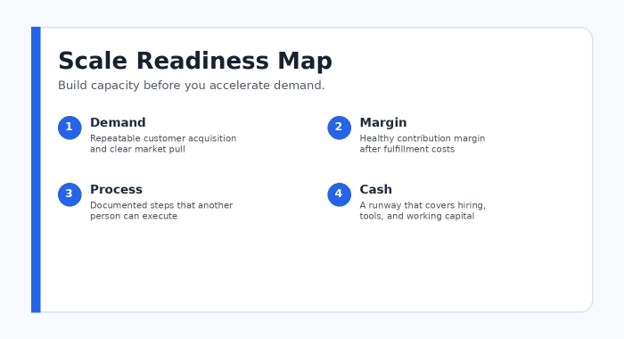
The first step in how to scale a small business is proving that the current model works. Scaling magnifies strengths, but it also magnifies bad pricing, weak fulfillment, poor retention, and unclear responsibilities.
Check for repeatable demand
Look for demand that appears repeatedly rather than revenue created by a single large contract, seasonal spike, viral post, or personal relationship. A stable pipeline should show where leads come from, how often they convert, and how long the sales process takes.
At least one customer segment buys consistently.
Your best offer solves a clear, urgent problem.
Customers can explain why they chose you.
Sales are not entirely dependent on the owner.
Lead volume and conversion can be measured.
Test your unit economics
Calculate the profit left after the direct cost of serving one additional customer. Include materials, transaction fees, shipping, commissions, contractor time, onboarding, support, returns, and discounts. Revenue that looks attractive at the top line can become unprofitable after fulfillment.
A useful decision metric is contribution margin: selling price minus variable costs. That margin must be large enough to cover fixed costs, fund acquisition, absorb mistakes, and still produce profit.
| Pro-Tip: Recalculate margin for your fastest-growing product or service separately. Many owners scale the offer with the highest sales volume, even though a quieter offer produces more cash and fewer support problems. |
Set a Specific Scaling Target
“Grow revenue” is not an operating plan. Choose a target that defines the amount, timing, source, and guardrails. For example: increase monthly recurring revenue from $40,000 to $60,000 within nine months while maintaining a gross margin above 55% and customer churn below 3%.
A strong target includes four parts:
Outcome: the revenue, customer, location, or capacity goal.
Deadline: a realistic date for reaching it.
Driver: the channel, offer, market, or team that will create it.
Guardrails: minimum margin, quality, cash, and customer-service standards.
This prevents a common trap: hitting the sales target while damaging profit, delivery time, employee morale, or customer trust.
Map Capacity and Find the Constraint
A capacity map makes how to scale a small business practical because it shows exactly where added volume will create delays, overtime, or defects.
Every business has a limiting factor. It may be production time, founder approvals, sales appointments, installation crews, inventory, customer onboarding, or working capital. Scaling works fastest when you identify the current constraint and improve it before adding more demand.
Create a simple capacity map
List the major stages from lead to payment and repeat purchase.
Write the maximum weekly output for each stage.
Record current volume and average cycle time.
Mark where work waits, returns, or requires rework.
Estimate the volume that would cause each stage to fail.
For a service company, the sales team may close 30 clients per month while onboarding can handle only 18. For an e-commerce company, marketing may generate orders easily, but inventory replenishment may take 60 days. The bottleneck determines what to fix next.
| 💡 Quick Hack: Ask each employee, “What work sits in a queue the longest?” Their answers often reveal the constraint faster than a complex process audit. |
Document the Work Before Delegating It
You cannot delegate work that exists only in the founder’s memory. Standard operating procedures turn individual knowledge into an asset the company can reuse for training, quality control, automation, and improvement.
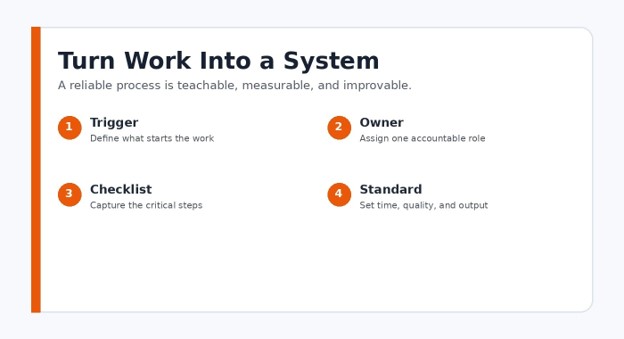
Build a minimum viable SOP
Do not begin with a 40-page manual. Start with a one-page procedure containing:
Purpose: what outcome the process should create.
Trigger: what event starts the process.
Owner: the role accountable for completion.
Inputs: information, tools, or materials required.
Steps: the critical sequence, including decision points.
Standard: expected time, quality, and final output.
Escalation: when and where to request help.
Record a screen-share video while completing digital tasks, then convert the recording into a checklist. For physical work, use photos at the points where quality errors commonly occur.
Simplify and Automate Repetitive Work
For many owners, how to scale a small business becomes easier once routine administration is removed from skilled employees and handled by reliable systems.
Automation should follow simplification. Automating a confusing process makes errors happen faster. Remove unnecessary approvals, duplicated data entry, unused reports, and low-value steps before connecting tools.
Prioritize automation by return
Score each repetitive task using frequency, minutes per occurrence, error risk, and employee frustration. Begin with tasks that happen often, follow predictable rules, and do not require sensitive judgment.
Lead capture and routing
Appointment reminders
Proposal and invoice generation
Payment-failure notifications
Customer onboarding emails
Inventory reorder alerts
Weekly KPI reporting
Support-ticket categorization
Maintain a human review step for high-value pricing decisions, legal commitments, refunds, hiring, safety, and sensitive customer issues.
| 💡 Quick Hack: Use a “two-tool rule” for the first automation. Connect only the app where information begins and the app where it must end. Multi-step automations are powerful, but they are harder to debug and maintain. |
Protect Cash Flow and Fund the Gap
One of the hardest parts of how to scale a small business is paying for growth before customers pay you. Hiring, stock, advertising, software, equipment, and larger premises can create a cash gap even when the income statement shows profit.
Build a rolling 13-week cash forecast
Forecast opening cash, expected collections, payroll, inventory, tax, rent, loan payments, marketing, and major one-time purchases for each of the next 13 weeks. Update the forecast every week using actual results.
Run three scenarios: expected, conservative, and stress. The stress case should assume slower sales, delayed collections, higher acquisition costs, or a major customer leaving.
Improve cash before borrowing
Request deposits or milestone payments.
Invoice immediately and shorten payment terms.
Offer annual prepayment where appropriate.
Negotiate supplier terms that match your cash cycle.
Reduce slow-moving inventory and unused subscriptions.
Raise prices where demand and value support it.
For U.S. businesses, review the IRS Small Business and Self-Employed Tax Center and work with a qualified accountant before hiring, changing entity structure, or entering a new state.
Hire in the Right Sequence
Hiring too early burns cash. Hiring too late damages quality and exhausts the owner. The right time arrives when a recurring constraint has enough volume to support a defined role and the value of solving it exceeds the fully loaded employment cost.
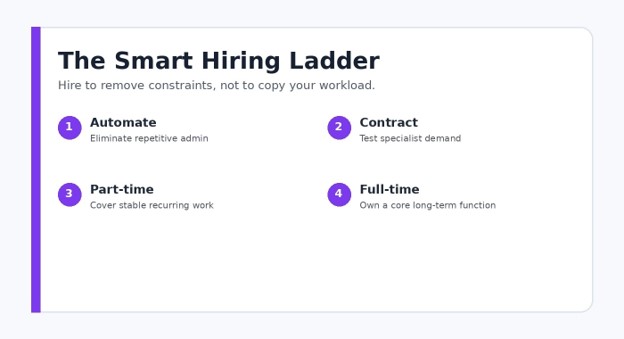
Use the hiring ladder
Automate or eliminate the task.
Use a specialist contractor for variable demand.
Add part-time capacity when work becomes predictable.
Hire full-time when the function is core, recurring, and measurable.
Write the scorecard before the job description. Define the outcomes the person must own in the first 30, 60, and 90 days. Include performance measures such as response time, orders shipped, qualified meetings, error rate, retention, or gross profit.
| Pro-Tip: Your first operations hire should remove a cluster of repeatable tasks, not become a vague “helper.” A clear role produces leverage; an undefined role produces more management work. |
Create a Management Rhythm
A repeatable meeting and reporting rhythm is central to how to scale a small business without turning every decision into an emergency.
As the team grows, casual communication stops being reliable. A management rhythm creates predictable places for decisions, accountability, and problem-solving without filling every day with meetings.
Daily: 10-minute operational check for urgent blockers.
Weekly: KPI review, priorities, capacity, and customer issues.
Monthly: profit, cash, channel performance, and hiring review.
Quarterly: strategy, offer mix, market changes, and major investments.
Each recurring meeting should have a fixed agenda, owner, required metrics, and decision log. Cancel status meetings that merely repeat information available in the project system.
Step 9: Expand Marketing in Controlled Experiments
Do not pour money into marketing until fulfillment and retention can absorb the demand. Once the operation is ready, scale one channel at a time using a defined test budget and success threshold.
Build a channel test card
Audience: who the campaign targets.
Offer: what action and value proposition you are testing.
Budget: the maximum amount at risk.
Window: how long the test will run.
Primary metric: qualified leads, purchases, or gross profit.
Stop rule: the point at which the test is paused.
Scale rule: the performance required to increase budget.
Measure customer acquisition cost against contribution margin and expected customer value. Cheap leads are not useful when they rarely buy, require heavy support, or quickly cancel.
A supporting resource is the SBA guide to growing your business, which covers expansion planning, new locations, acquisitions, and compliance considerations.
| 💡 Quick Hack: Increase a winning marketing budget in steps of roughly 15% to 30%, then watch conversion rate, lead quality, fulfillment time, and acquisition cost. Sudden budget jumps can change audience quality and expose operational weaknesses. |
Improve Retention Before Chasing More Leads
Retention is one of the strongest scaling levers because repeat customers reduce the pressure to replace every sale. Analyze why customers stay, expand, downgrade, complain, or leave.
Create a retention system
Set a clear onboarding milestone that predicts success.
Contact customers before common failure points.
Track support themes and product complaints.
Schedule renewal or reorder reminders.
Offer logical upgrades based on customer outcomes.
Interview lost customers without becoming defensive.
Track a Weekly Scaling Scorecard
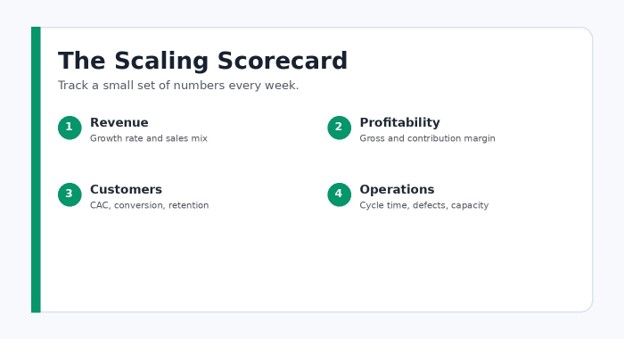
The owner needs a small group of metrics that reveal whether the business is becoming healthier or merely busier. Choose leading indicators that teams can influence and lagging indicators that confirm the financial result.
Revenue growth rate
Gross margin and contribution margin
Cash balance and 13-week low point
Qualified leads and conversion rate
Customer acquisition cost
Retention, churn, or repeat purchase rate
Order or project cycle time
On-time delivery percentage
Error, return, or rework rate
Capacity utilization by bottleneck
Review trends rather than isolated numbers. A single weak week may be noise; a four-week decline in conversion, margin, or on-time delivery requires investigation.
For broader U.S. labor-market and establishment trends, consult Business Employment Dynamics data from the U.S. Bureau of Labor Statistics.
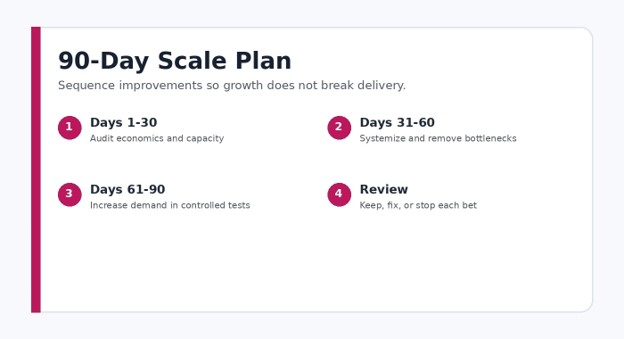
Run a 90-Day Scaling Cycle
The most practical answer to how to scale a small business is to work in controlled 90-day cycles. Each cycle should improve one major constraint, protect the current operation, and test one growth driver.
Days 1-30: Diagnose and prepare
Verify margins and cash runway.
Map capacity and identify the constraint.
Choose the scaling target and guardrails.
Document the most important process.
Select the metrics for the weekly scorecard.
Days 31-60: Build capacity
Simplify or automate repetitive work.
Train a backup owner for critical processes.
Add contractor or employee capacity where justified.
Fix quality issues and customer handoffs.
Test the cash forecast under stress.
Days 61-90: Increase demand carefully
Launch one channel or offer experiment.
Increase volume in measured steps.
Monitor delivery, support, margin, and retention.
Stop weak experiments quickly.
Document lessons and choose the next constraint.
Common Mistakes to Avoid
- Scaling an unprofitable offer
More sales will not repair negative unit economics. Reprice, redesign, bundle, or discontinue the offer before expanding it.
- Hiring without defined outcomes
A vague role absorbs payroll and management attention. Create a scorecard with measurable outcomes and decision authority.
- Adding demand before capacity
Marketing can expose weak onboarding, inventory, scheduling, and support within days. Build a capacity buffer before increasing spend.
- Using too many tools
A crowded software stack creates duplicate data, training costs, and fragile automations. Give each system a clear purpose and owner.
- Ignoring cash timing
Profit does not pay this week’s payroll when customers pay in 60 days. Forecast cash weekly and arrange funding before the gap becomes urgent.
Advanced Tips and Next-Level Scaling Hacks
At the advanced stage, how to scale a small business depends on improving leverage through better offers, clearer decisions, and reduced key-person risk.
Create a productized service
Service businesses become easier to scale when scope, process, timeline, deliverables, and price are standardized. Keep a premium custom option, but design a core offer that the team can deliver repeatedly.
Segment customers by profitability
Rank customer groups by gross profit, support demand, payment speed, retention, and referral value. Focus acquisition on the segment that produces the healthiest total relationship, not simply the largest invoice.
Build redundancy into critical roles
Every essential process should have a primary owner, backup owner, documented access, and recovery instructions. This protects the company from absence, turnover, and emergencies.
Use decision thresholds
Predefine when the team can approve a refund, discount, rush order, replacement, or campaign adjustment without the owner. Decision thresholds reduce delays while keeping risk controlled.
| 💡 Quick Hack: Track “founder touches” for one week. Every approval, answer, rescue, and manual handoff is evidence of a missing rule, skill, system, or role. Remove the most frequent founder touch first. |
Troubleshooting and Long-Term Maintenance
Revenue rises, but cash keeps falling
Check receivables, deposits, inventory, payment terms, ad spend, returns, and hiring timing. Tighten collections, reduce slow stock, pause weak campaigns, and update the 13-week forecast immediately.
Quality drops as volume increases
Inspect the bottleneck, staffing ratio, training, supplier quality, and work-in-progress limits. Add quality checks at the point where defects originate rather than relying only on final inspection.
The owner remains the bottleneck
List decisions only the owner can make, decisions the team can make within limits, and decisions that should be automated. Transfer one decision category at a time and review the results weekly.
Customer acquisition cost suddenly increases
Separate channel changes from sales changes. Review audience saturation, creative fatigue, landing-page conversion, lead response time, sales close rate, and customer quality before changing the entire strategy.
Employees feel overwhelmed
Reduce work in progress, clarify priorities, remove low-value tasks, and rebalance capacity. A team cannot execute ten “top priorities” simultaneously.
Maintenance schedule
Weekly: update cash forecast, scorecard, priorities, and blockers.
Monthly: review profitability by offer, customer segment, and channel.
Quarterly: audit SOPs, software, roles, pricing, and capacity.
Twice yearly: test backup procedures, permissions, and key-person risk.
Annually: revisit strategy, market position, funding needs, and legal structure.
Frequently Asked Questions
When is a small business ready to scale?
A business is usually ready when demand is repeatable, unit economics are profitable, cash flow is forecasted, core processes are documented, quality is stable, and the owner can identify the next operational constraint. Readiness is proven by data, not enthusiasm.
How much money do you need to scale a small business?
The amount depends on the cash conversion cycle, hiring plan, inventory needs, marketing tests, equipment, and time to customer payment. Build a 13-week cash forecast and a 12-month scenario model, then include a contingency reserve rather than using a generic percentage.
Can you scale a business without hiring employees?
Yes. Many businesses scale first through process simplification, automation, contractors, productized services, licensing, digital products, better pricing, and channel partnerships. Full-time hiring becomes appropriate when a core recurring function needs stable ownership.
What is the best way to scale a service business?
Standardize the offer, narrow the ideal customer, document delivery, separate sales from fulfillment, train specialists, automate administration, and price around value and capacity. Avoid unlimited custom work that depends on the founder.
What metrics matter most when scaling?
Track revenue growth, contribution margin, cash runway, acquisition cost, conversion, retention, cycle time, on-time delivery, error rate, and bottleneck utilization. The exact scorecard should reflect the business model and current constraint.
How fast should a small business scale?
Scale only as fast as cash, quality, people, and systems can support. Use staged increases and 90-day cycles. If margin, retention, delivery time, or employee workload moves outside the guardrails, pause demand growth and repair capacity.
Conclusion: Build a Business That Gets Stronger as It Grows
Understanding how to scale a small business is less about chasing rapid sales and more about building a company that can absorb success. Profitable demand, disciplined cash management, documented processes, smart automation, clear roles, and a weekly scorecard create the foundation.
Choose one constraint, improve it during the next 90 days, and then increase demand in measured steps. Which part of your business would break first if sales doubled next month? Share your answer in the comments and use it as the starting point for your scaling plan.
editor's pick
latest video
news via inbox
Nulla turp dis cursus. Integer liberos euismod pretium faucibua