How to Use AI for Marketing Step-by-Step Guide for 2026
The fastest way to waste money while learning how to use ai for marketing is to begin with a tool subscription and hunt for a problem afterward. Start with a repeated task that is slow, inconsistent, expensive, or difficult to scale. Good first projects include turning customer calls into objection themes, producing ad variants from an approved offer, repurposing one expert interview into multiple formats, or summarizing weekly campaign performance.
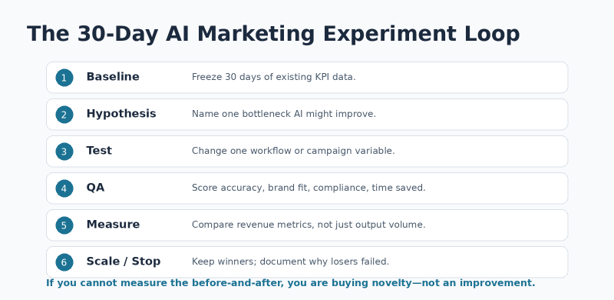
Write down the current workflow before you change it. Capture how long it takes, who touches it, what quality checks exist, and which KPI the work should influence. This baseline gives you something AI hype usually lacks: a before-and-after comparison.
Score possible AI use cases on four factors: frequency, business value, reviewability, and data readiness. A task done every day with clear inputs and an obvious human reviewer is usually safer to automate than a high-stakes strategic decision made twice a year.
| 💡 Quick Hack: Use the “30-minute rule.” Pick a task that regularly consumes at least 30 minutes and can be reviewed in five minutes or less. Those workflows often show value quickly without creating a complicated automation project. |
Create a one-sentence experiment brief
Use this formula: “We will use AI to improve [specific workflow] for [audience/channel], while a human checks [risk], and we will judge success by [metric] over [time period].”
Example: “We will use AI to create five paid-search headline angles from approved product claims; the PPC manager will check accuracy and policy compliance; success means a higher qualified-conversion rate without raising CPA over 30 days.”
- Build a Clean Marketing Knowledge Base
AI output quality depends heavily on the context you provide. Before asking for campaigns, collect the information your best marketer already knows: products, differentiators, price constraints, target customer, objections, proof points, tone, legal restrictions, geographies, offers, seasonal rules, and examples of strong existing content.
For teams learning how to use ai for marketing, this knowledge base is more valuable than a folder full of “magic prompts.” A strong prompt cannot compensate for contradictory product information or an outdated offer.
Separate facts from opinions. Product specifications, eligibility rules, refund terms, locations, and pricing should live in a controlled source. Customer-language research, competitor observations, and creative hypotheses can live in a second working file. This separation makes review faster because the reviewer knows which claims must match exactly.
Do not dump sensitive customer records into consumer AI tools by default. Follow your company policy, vendor terms, privacy obligations, and data-processing agreements. Where possible, remove names, emails, phone numbers, account identifiers, payment data, and unnecessary free-text fields before analysis.
| Pro-Tip: Maintain a one-page “AI-safe brand brief.” Include approved brand description, audience, differentiators, claims AI may use, claims AI may not make, words to avoid, CTA patterns, and a link to the current source-of-truth document. |
- Use a Repeatable Prompt Brief Instead of One-Line Prompts
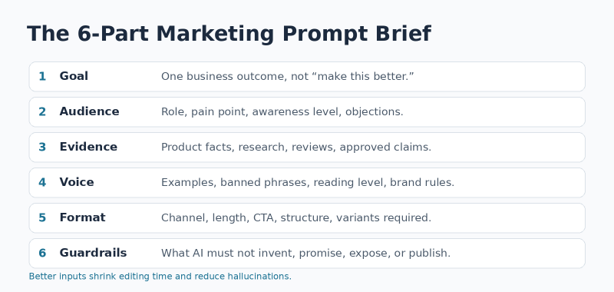
A useful marketing prompt looks more like a creative brief than a command. Give the model a business goal, audience context, evidence, constraints, output format, and a review standard. Ask for alternatives and reasoning you can inspect, rather than asking for a single “perfect” answer.
Once your team understands how to use ai for marketing, prompts become templates for consistent thinking. A landing-page prompt, for example, can require one primary promise, three proof points, objection handling, CTA variants, prohibited claims, and a final self-check against the source material.
Tell the model what to do when information is missing: mark the gap, ask a question, or write “[VERIFY]” instead of inventing a fact. This tiny instruction can prevent polished-looking errors from moving downstream.
| 💡 Quick Hack: Ask AI to grade its draft against a five-point rubric—accuracy, specificity, brand fit, reader usefulness, and CTA clarity—then revise only the weak dimensions. This produces more focused edits than “make it better.” |
- Apply AI to Content and SEO Without Publishing Generic Pages
AI is excellent at accelerating the mechanical parts of content work: clustering questions, extracting recurring themes from reviews, building interview questions, turning expert notes into outlines, producing alternative introductions, creating metadata options, and checking whether a draft answers the intended query.
The risky version of how to use ai for marketing for SEO is mass-producing thin pages with almost no original information. Google’s current guidance says generative AI can help with research and structure, but creating many pages without added value can violate scaled-content-abuse policies. Your advantage should come from experience, evidence, examples, testing, screenshots, original data, and editorial judgment—not volume alone.
Use AI before and after the human expert, not instead of the expert. Before the interview, let AI map the topic and identify unanswered questions. After the interview, let it organize notes, identify missing explanations, create multiple headline angles, and turn approved sections into social snippets. The expert remains responsible for the insight.
For SEO briefs, feed the model first-party evidence such as Search Console queries, existing rankings, top landing pages, conversion data, support questions, and internal-link opportunities. Ask it to distinguish “must answer” questions from optional semantic coverage. This keeps the page focused instead of stuffing every related phrase into one article.
For the search-quality guardrails behind this approach, review Google guidance on generative AI content and its emphasis on accuracy, quality, relevance, and useful original value.
| Pro-Tip: Give AI your top three converting pages and ask it to identify structural patterns—proof placement, CTA timing, specificity, objection handling—not sentences to copy. Patterns are reusable; imitation is fragile. |
- Use AI for Paid Media as a Testing Engine
Paid media is one of the best places for controlled AI use because feedback arrives quickly. Use AI to expand a verified offer into multiple angles, map messages to awareness levels, generate negative-keyword hypotheses, summarize search-term themes, and explain performance changes for human review.
When deciding how to use ai for marketing in Google Ads, keep platform automation and your own generative workflow separate in your mind. Google already uses AI across bidding, targeting, and creative systems such as Performance Max and AI Max for Search. Your job is still to provide strong conversion tracking, accurate business goals, useful creative inputs, exclusions, geographic controls, and enough budget for the system to learn.
Do not let a language model make budget changes from a narrative prompt with no guardrails. A safer automation can flag campaigns whose CPA exceeds a threshold, prepare a diagnosis using recent data, and ask an operator to approve a change.
Use an “angle matrix” for creative testing. Put customer pain points down the rows and proof types across the columns: speed, cost, convenience, social proof, guarantee, expertise, or outcome. Ask AI for two compliant variants in each useful cell. The matrix creates deliberate variety instead of 30 headlines that say the same thing.
Google documents its current AI-assisted Search capabilities in Google Ads AI Max for Search campaigns; use the official controls and documentation when deciding what to enable.
| 💡 Quick Hack: Before launching AI-generated ad variants, deduplicate them by “idea,” not wording. If five headlines all communicate the same benefit, you are not testing five concepts. |
- Use AI for Email, CRM, and Lifecycle Marketing

Lifecycle marketing gives AI rich structure: event triggers, customer stages, product categories, and past engagement. Use it to draft welcome sequences, summarize account history for a salesperson, classify support reasons, create win-back angles, and adapt a core message for different lifecycle stages.
A practical approach to how to use ai for marketing in email is to automate preparation more aggressively than sending. AI can propose subject lines, summarize customer context, select an approved content block, and draft a personalized first sentence; your ESP or CRM should still enforce consent, suppression, frequency caps, and approved sending logic.
Do not personalize with creepy details simply because the data exists. Personalization should reduce friction or increase relevance. “Here is the guide related to the product you viewed” is understandable. Mentioning inferred personal circumstances or sensitive attributes is usually unnecessary and risky.
For segmentation, start with observable behavior: viewed pricing, downloaded a guide, requested a demo, purchased once, purchased repeatedly, became inactive, or opened support tickets. Then test whether AI-generated messaging improves conversion inside those segments.
| Pro-Tip: Build a “message library” of approved value propositions, proof points, disclaimers, CTAs, and objection responses. Let AI assemble from this controlled library before allowing completely free-form copy. |
- Use AI for Social Media Without Sounding Like Every Other Brand
The easiest way to spot weak AI social content is the absence of a point of view. Generic motivation, overused hooks, and empty “game-changing” claims create volume but not distinction. Use AI to reshape real material: founder opinions, customer questions, product demonstrations, event notes, case-study lessons, and staff expertise.
A strong repurposing workflow begins with one high-information source—a webinar, interview, article, demo, or customer Q&A. Ask AI to extract five standalone insights, then assign each insight to the format it fits best: short video, carousel, LinkedIn post, X thread, Pinterest pin, email, or FAQ.
Create a platform rulesheet. Define maximum length, first-line hook style, emoji policy, hashtag policy, CTA style, banned clichés, and whether links belong in the post or comments. A channel-specific template dramatically reduces cleanup time.
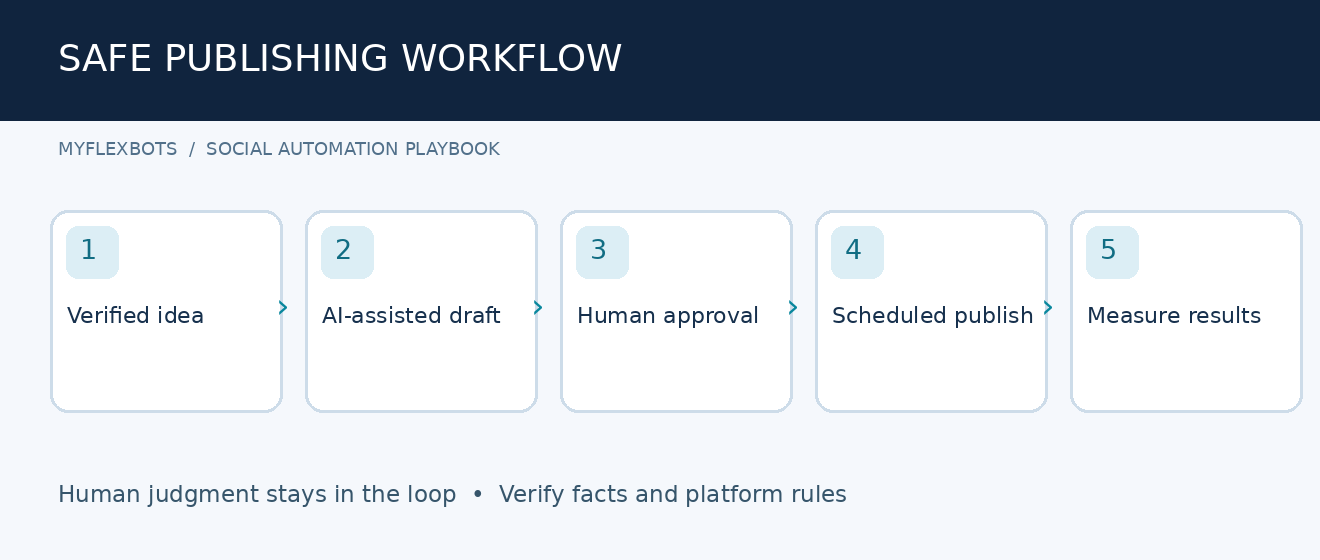
Schedule only approved content. If you connect AI to social-publishing tools, require an approval state between generation and publication. This protects you from accidental claims, outdated offers, formatting problems, and off-brand responses.
- Automate the Handoffs, Not the Judgment
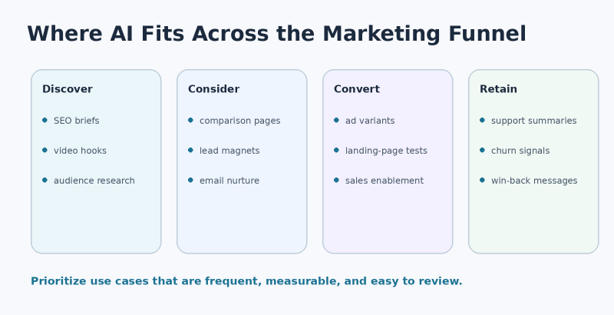
Automation creates the biggest gains when it removes copying, routing, formatting, and status-checking. A lead form can create a CRM record, enrich a non-sensitive company field, classify the inquiry, draft a reply for review, assign an owner, and update a dashboard without anyone retyping the same information.
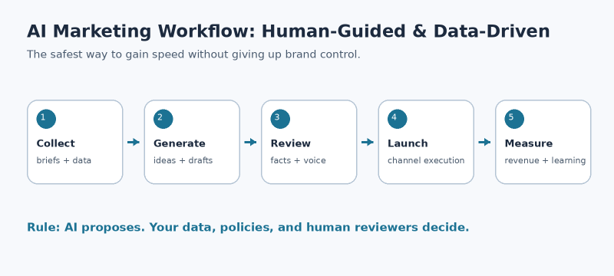
The safest architecture for how to use ai for marketing is usually “trigger → fetch approved context → AI task → validation → human approval → action → logging.” Each step should have a clear owner and a failure path.
Add deterministic checks around probabilistic AI. For example, code can verify that an email contains the correct price, that the destination URL is on an approved domain, that required disclaimers exist, that a character limit is met, or that an output contains no placeholders before it reaches a customer.
Keep logs for important automations: input source, model/tool used, output, reviewer, approval time, final action, and error state. Logs make troubleshooting possible and create evidence when a process needs to be audited.
| 💡 Quick Hack: Automate the boring “wrapper” around AI first—file naming, task creation, routing, status updates, and reporting. These steps are predictable and often deliver ROI with less risk than autonomous publishing. |
- Measure AI by Business Outcomes and Quality, Not Output Volume
Producing 100 posts is not a success metric. Measure whether the AI workflow improves a real constraint: time to launch, cost per qualified lead, conversion rate, revenue per recipient, creative testing velocity, retention, support deflection, or analyst hours saved.
For teams serious about how to use ai for marketing, pair one business KPI with one efficiency KPI and one quality KPI. An example for content might be organic conversions, editing hours per article, and factual-error rate. For paid ads it could be qualified CPA, time to produce a test batch, and policy-rejection rate.
Use a holdout when possible. Keep part of the process unchanged or compare similar campaigns so you can distinguish AI impact from seasonality, budget shifts, promotions, or channel changes. Even a simple before/after baseline is better than celebrating activity.
GA4 can also support more advanced audience work when a property is eligible for predictive metrics. Predictive audiences can help identify groups such as likely purchasers or likely churners, but they still require sufficient data and should be evaluated against your own economics.
For measurement ideas, see Google Analytics documentation on predictive audiences and treat modeled segments as testable inputs rather than guaranteed outcomes.
Common Mistakes to Avoid
Mistake 1: Automating a broken process
If the underlying brief, CRM fields, attribution, or approval process is messy, AI usually makes the mess move faster. Fix the workflow first, then automate the stable parts.
Mistake 2: Treating confident language as evidence
Language models can produce fluent but incorrect details. Require source-based drafting for claims, numbers, policies, product specs, legal statements, and anything that could materially influence a buying decision.
Mistake 3: Giving AI unrestricted access to sensitive data
Minimize the data shared, choose business-appropriate tools, configure permissions, and follow your legal and security requirements. The marketing benefit of extra personal data is rarely worth careless exposure.
Mistake 4: Publishing unreviewed brand content
One reason beginners struggle with how to use ai for marketing is that they remove humans from the wrong step. Automate drafts, categorization, and routing; keep people responsible for strategy, sensitive decisions, claims, and customer-facing edge cases.
Mistake 5: Optimizing for cheap content instead of useful marketing
Lower production cost can be valuable, but only if the work still differentiates your brand and moves customers. If AI reduces cost by 70% and conversion falls by 50%, the “efficiency” is fictional.
Advanced Tips and Next-Level Hacks
Create role-based AI workflows
Instead of one universal prompt, create small workflows for strategist, researcher, copy editor, analyst, and QA reviewer roles. Each role gets different evidence and different permissions. This makes failures easier to diagnose and improves accountability.
Use retrieval instead of repeated copy-paste
When your approved knowledge base grows, use an enterprise knowledge or retrieval setup that can pull relevant source material into the task. This reduces stale context and helps teams update facts once instead of editing dozens of prompt templates.
Build an evaluation set
Save 20-50 representative tasks and the characteristics of a good answer. Whenever you change a model, prompt, data source, or automation, rerun the set and compare error rates, editing time, and brand scores. This is a practical way to stop “it feels better” from becoming your QA methodology.
Separate creative exploration from factual production
Give AI more freedom when brainstorming campaign concepts, metaphors, visual directions, and test hypotheses. Tighten constraints when generating product claims, customer communications, regulated content, or anything tied to contractual terms.
Create a lightweight governance policy
As you scale how to use ai for marketing, document approved tools, prohibited data, review requirements, disclosure rules, logging, incident handling, and owners. NIST’s generative AI risk profile is a useful external framework for thinking about trustworthiness and risk management without turning marketing into a compliance maze.
Use the NIST Generative AI Risk Management Profile as a reference when formalizing governance, testing, and human oversight.
| 💡 Quick Hack: Give every AI workflow an owner and a kill switch. If nobody can explain who disables it when inputs change or errors spike, the automation is not production-ready. |
Troubleshooting and Maintenance Guide
The output sounds generic
Feed real examples, customer language, constraints, and a narrower audience. Ask for specific evidence, concrete nouns, and one distinctive point of view. Delete clichés from your brand rules.
The AI invents facts
Require source citations or exact supplied evidence, tell it to mark unknowns, reduce the scope of the task, and add a human fact-check checkpoint. Never let the model invent prices, policies, guarantees, or statistics.
Automation sends the wrong message
Pause the workflow, inspect trigger conditions and mapping, review the prompt version, check stale CRM fields, add deterministic validation, and test with sandbox records before re-enabling.
Campaign performance drops after adding AI
Compare targeting, creative, tracking, budget, landing-page changes, and seasonality. Roll back one variable at a time. AI may have increased output while weakening offer clarity or audience fit.
Editors spend as long fixing AI as writing manually
Shorten the task. Use AI for outline, options, or first-pass analysis rather than full drafts. Improve the source brief and rubric. Measure editing minutes, not generation seconds.
Brand voice drifts over time
Refresh examples quarterly, version-control prompts, audit top-performing output, and remove stale phrases. Models and teams change; your brand rules need maintenance too.
Monthly maintenance checklist
Review permissions, connected apps, and data sources.
Check prompt and workflow versions against current offers and policies.
Sample outputs for factual errors, bias, tone drift, and missing disclosures.
Compare AI-assisted work against a baseline for efficiency and business KPI impact.
Remove automations that save little time or create repeated review problems.
Update the knowledge base with new products, FAQs, objections, and campaign learnings.
Frequently Asked Questions
What are the best first AI use cases for a small marketing team?
Start with high-frequency, low-risk tasks: research summaries, content repurposing, ad or subject-line variants, meeting-note extraction, lead classification, reporting summaries, and QA checklists. Choose one workflow with a clear reviewer and measurable before/after time.
Can AI replace a marketing team?
AI can compress production and analysis time, but it does not remove the need for positioning, customer understanding, judgment, accountability, creative direction, relationship-building, and budget decisions. Teams usually gain more by redesigning roles around AI than by trying to remove the human layer.
Is AI-generated content bad for SEO?
Not automatically. Search engines care about usefulness, accuracy, originality, and policy compliance. AI-assisted content becomes risky when it is produced at scale with little added value, weak fact-checking, or the primary purpose of manipulating rankings.
How much should I spend on AI marketing tools?
Begin with the smallest stack that can prove value. Many teams can test an AI workspace plus existing analytics and design tools for tens of dollars per user per month. Add automation and specialist software only after a use case has a measurable return.
How do I keep AI marketing on-brand?
Use approved examples, a brand brief, a message library, banned phrases, channel rules, and a human approval step. Score outputs against a rubric and update the examples when the brand evolves.
What marketing data should I avoid sharing with AI tools?
Unless your organization has explicitly approved the tool and data flow, avoid unnecessary personally identifiable information, payment data, credentials, private customer communications, confidential contracts, unreleased strategy, and sensitive attributes. Minimize and anonymize whenever possible.
Conclusion: Build Leverage, Then Scale It
The durable lesson in how to use ai for marketing is simple: use AI to create leverage around a sound marketing system, not to substitute for one. Give it clean context, constrain high-risk tasks, measure outcomes, preserve human accountability, and scale only what proves useful.
editor's pick
latest video
news via inbox
Nulla turp dis cursus. Integer liberos euismod pretium faucibua