Profitable Home Business Ideas: 17 Low-Cost Models That Can Scale
Starting from home sounds inexpensive until you buy software you do not need, build a website nobody visits, or stock products before a customer has proven they want them. The best profitable home business ideas begin with a narrow customer problem, a simple offer, and a fast path to the first paid transaction—not a perfect logo or a spare room full of inventory.
This guide shows you how to compare business models by startup cost, speed to revenue, margin, skill requirement, and scalability. You will also get a 30-day execution plan, realistic launch tools, mistake-proofing, troubleshooting, and next-level systems for turning a side project into a dependable small business.
What Is the Best Home Business to Start?
Among profitable home business ideas, the best home business is one that solves a specific, paid problem using skills or assets you already have. Start with a service for fast cash flow, validate demand before spending heavily, keep fixed costs low, then systemize delivery and add recurring or scalable revenue once customers repeatedly buy.
Essential Tools & Materials Breakdown
To compare profitable home business ideas fairly, you do not need every item below on day one. Treat this as a menu: buy the minimum that helps you make a sale, deliver the work, collect payment, and keep records. Costs are broad USD estimates; local pricing, regulations, and software plans vary.
| Tool / Material | Typical Cost | Skill Level | Who Needs It | Buy-Now Test |
| Laptop or capable smartphone | $0-$1,200 | Beginner | Almost every model | Use what you own until it blocks paid work. |
| Reliable internet + backup hotspot | $20-$100/mo | Beginner | Remote/service businesses | Essential when missed calls or uploads cost money. |
| Domain + professional email | $15-$120/yr | Beginner | Client-facing businesses | Buy after choosing a defensible name and offer. |
| Invoice/payment system | $0-$40/mo + fees | Beginner | Anyone taking payments | Set up before the first client says yes. |
| Scheduling / CRM | $0-$50/mo | Beginner | Consulting, coaching, local services | Add when manual follow-up starts dropping leads. |
| Bookkeeping system | $0-$70/mo | Beginner-Intermediate | Every business | Track money from the first transaction. |
| Lighting / microphone / camera | $0-$600 | Intermediate | Tutors, creators, consultants | Upgrade only when quality limits conversion or delivery. |
| Packaging + shipping supplies | $30-$500+ | Beginner | Physical-product sellers | Buy in small batches until repeat demand is proven. |
| Business registration / permits | $0-$500+ | Beginner | Varies by location/model | Check requirements before operating or advertising. |
| Insurance / specialist advice | Varies widely | Intermediate | Higher-liability models | Prioritize when clients, property, food, children, or regulated work are involved. |
💡 Quick Hack: Delay subscriptions until they replace a recurring problem. If a free spreadsheet, calendar, payment link, and folder system can serve your first five customers, use them. Software is cheap individually but expensive when ten “small” monthly bills arrive before revenue does.
How to Choose Among Profitable Home Business Ideas
A business idea is attractive only when the economics and the customer behavior work together. A $50 service that takes five hours to deliver is not automatically better than a $300 service that takes three hours; likewise, a high-margin digital product can still fail if customer acquisition is costly or demand is weak.
Score Your Starting Position
Write down the assets you can use immediately: marketable skills, certifications, software access, equipment, professional contacts, audience, portfolio examples, storage space, transportation, and available weekly hours. Do not rate a skill by how advanced it feels to you; rate it by whether someone else would pay to avoid learning or doing it themselves.
Skills: writing, bookkeeping, design, coding, tutoring, sales, repair, organization, photography, cooking, language ability.
Assets: laptop, camera, spare room, garage, tools, printer, vehicle, existing website, social following, vendor relationships.
Constraints: family schedule, noise, zoning, storage, delivery radius, licensing, cash available, physical workload.
Pick a Customer Before Picking a Brand
“Social media management” is broad. “Short-form content repurposing for independent real-estate agents who already film weekly videos” is easier to explain, price, and sell. Narrowing the first customer type gives you clearer outreach lists, sharper proof, and faster referrals.
Use a one-sentence offer formula: “I help [specific customer] get [measurable result] without [common pain] by providing [specific service/product].” If you cannot fill that sentence cleanly, the idea is still too fuzzy.
Validate Demand Before You Build
For profitable home business ideas, validation means asking the market for a real commitment, not asking friends whether an idea “sounds good.” The strongest signals are deposits, pre-orders, booked calls, paid trials, or customers agreeing to a defined next step.
Identify 25 potential buyers you can contact directly.
Ask five problem-focused questions before pitching anything.
Offer a small paid pilot with a concrete scope and deadline.
Track objections word-for-word; those phrases become your pricing, FAQ, and sales-copy research.
Do not expand the offer until at least three customers buy for roughly the same reason.

17 Home Business Models Worth Testing
The list below is ranked by practicality rather than hype. The most attractive profitable home business ideas generally combine low fixed costs, an identifiable buyer, strong gross margins, and a sales process you can repeat without depending on a single platform.
| Business Model | Startup Cost | Speed to First Sale | Margin Potential | Scalability | Best First Customer |
| Freelance writing/editing | $0-$100 | Fast | High | Medium | Agency or niche business |
| Virtual assistant / ops support | $0-$150 | Fast | High | Medium | Busy owner or consultant |
| Bookkeeping | $50-$500 | Medium | High | High | Local service business |
| Online tutoring | $0-$300 | Fast | High | Medium | Parent, student, professional |
| Graphic / presentation design | $0-$300 | Fast | High | Medium | B2B team or creator |
| Web design / no-code builds | $50-$500 | Medium | High | High | Local business |
| SEO / local marketing services | $50-$500 | Medium | High | High | Business with weak visibility |
| Short-form video editing | $0-$500 | Fast | High | High | Creator or sales team |
| UGC / product photography | $0-$800 | Medium | High | Medium | E-commerce brand |
| Digital templates / printables | $0-$200 | Medium | Very high | High | Niche online buyer |
| Online course / cohort | $0-$500 | Slow | Very high | High | Audience with proven problem |
| Print-on-demand | $0-$300 | Medium | Medium | High | Niche community |
| Handmade / personalized goods | $50-$1,000+ | Medium | Medium | Medium | Gift buyer / hobby niche |
| Home bakery / specialty food | $100-$2,000+ | Medium | Medium | Medium | Local repeat customer |
| Pet sitting / boarding coordination | $50-$500+ | Fast | High | Medium | Local pet owner |
| Home organization consulting | $50-$400 | Fast | High | Medium | Busy household |
| Affiliate content / niche media | $50-$500 | Slow | High | High | Search/social audience |
1-4. Service Businesses: Fastest Route to Cash Flow
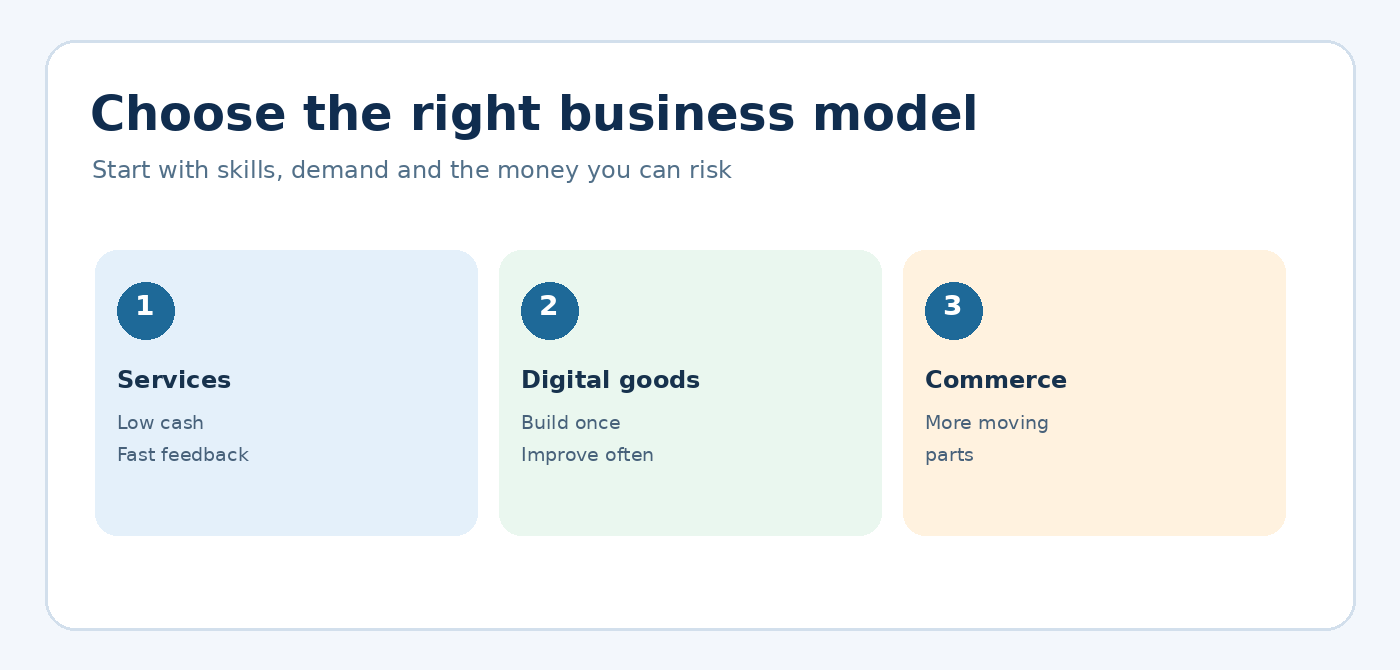
Among profitable home business ideas, freelance writing, virtual assistance, bookkeeping, and tutoring are strong beginner models because there is almost no inventory and the buyer can understand the result quickly. The tradeoff is capacity: if every dollar requires another hour, your first scaling job is to standardize the offer rather than simply working longer.
Package a defined outcome. Example: “four polished newsletters per month” beats “freelance writing by the hour.”
Set a minimum engagement. Small one-off jobs create admin work without building predictable revenue.
Build proof from before/after samples, turnaround time, error reduction, grades improved, or time saved—only using claims you can substantiate.
Pro-Tip: Sell the first version manually. A simple PDF scope, calendar invite, and payment request can close a client faster than a six-page website. Build the polished sales system after you learn the objections real buyers actually raise.
5-9. Creative and Technical Services: Higher Ticket, Skill Driven
Graphic design, web builds, SEO/local marketing, video editing, and product photography can command higher project fees because the output affects a client’s sales, visibility, or brand. These businesses work best when you specialize by outcome instead of offering every creative service to everyone.
For example, a “website designer” competes with thousands of providers. A “one-week lead-generation website sprint for home-service companies” is a productized offer with a buyer, timeline, and business purpose.
10-12. Digital Products, Courses, and Print-on-Demand
Digital products are attractive because each additional sale can have little delivery cost, but the hard part is distribution. A template with no audience can earn less than a service with a ten-person prospect list. Build from repeated client questions, recurring workflows, or a niche audience with obvious purchasing behavior.
Templates: spreadsheets, checklists, proposal packs, lesson plans, design files, calculators, prompt systems, planners.
Courses: teach a specific transformation with a defined starting point and outcome; do not turn every fact you know into a 40-module library.
Print-on-demand: test designs without holding inventory, but calculate marketplace fees, shipping, returns, ad costs, and design time before calling the margin attractive.
13-16. Physical and Local Home-Based Businesses
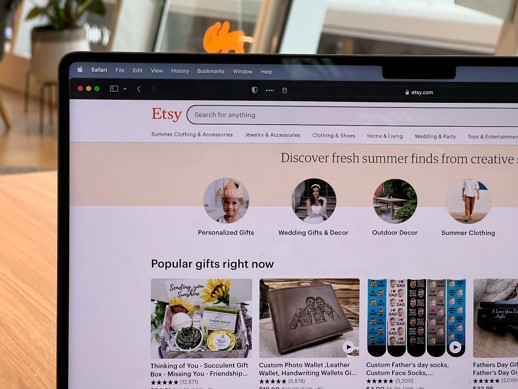
Handmade goods, specialty food, pet services, and home-organization consulting can create strong local word of mouth. They also bring more operational constraints: storage, insurance, food-safety rules, zoning, noise, customer visits, transportation, and fulfillment. Check local requirements before you take money or advertise services that may be regulated.
For U.S. readers, the provides a practical checklist covering location, business structure, registration, tax IDs, permits, banking, and insurance. Outside the U.S., use the equivalent national and local authorities for your jurisdiction.
- Affiliate Content and Niche Media
Affiliate publishing, comparison content, newsletters, and niche video channels can scale well because a useful piece of content may keep attracting buyers after it is published. The weakness is slow ramp-up: search rankings, audience trust, and platform distribution take time. Treat it as a media business with editorial standards, disclosure, and diversified traffic—not instant passive income.
💡 Quick Hack: Pair a slow-build media model with a fast service model. A niche newsletter may take months to monetize, while consulting, editing, or implementation can produce cash sooner and expose the exact questions your future content should answer.
Comprehensive Step-by-Step Execution Guide
Create a One-Page Business Thesis
Before naming the business, write a one-page thesis. This prevents you from solving three unrelated problems for five unrelated customer types.
Customer: one specific group with a reachable list or community.
Pain: an expensive, urgent, frequent, or emotionally important problem.
Offer: one deliverable or result with a clear boundary.
Proof: sample, case study, credential, demonstration, guarantee structure, or transparent process.
Price: enough to cover labor, overhead, taxes, acquisition cost, rework, and profit.
Channel: one primary way to reach buyers during the first 30 days.
Run a Seven-Day Demand Test
Choose one outreach route: direct email, direct messages, local networking, community groups that allow promotion, an existing professional network, marketplace listings, or a simple landing page paired with targeted outreach. The goal is not broad awareness; it is learning whether a clearly defined buyer will act.
- Day 1: Build a list of 25 prospects and record why each is a plausible fit.
- Day 2: Write two outreach messages, each under 120 words, focused on a visible problem.
- Days 3-5: Send targeted messages and log response, objection, and next step.
- Days 6-7: Offer a paid pilot to qualified prospects and ask non-buyers what prevented a yes.
A rough benchmark is not the goal because channels differ wildly. What matters is diagnostic movement: are people replying, agreeing the problem matters, booking a call, and accepting the price? If nobody recognizes the problem, change the offer or customer before changing your logo.
Price for Profit, Not Just for a Yes
Beginners often price from fear: “What number will not scare anyone away?” A better method is to price from unit economics. Estimate direct delivery time, tools, materials, payment fees, shipping, revision risk, taxes, and a share of monthly overhead. Then add the profit needed to make the business worth operating. This is where profitable home business ideas separate from expensive hobbies: the price must survive the real cost of delivery.
For services, use value-based packaging where possible: a defined outcome, a fixed scope, a revision limit, and a timeline. For products, calculate landed cost per item, marketplace fees, packaging, returns allowance, shipping subsidies, payment processing, and acquisition cost before deciding whether a sale is truly profitable.
💡 Quick Hack: Create three packages around scope—not fake features. A starter package solves one urgent problem, a core package handles the common full job, and a premium package adds speed, access, volume, or implementation. The middle option should be the easiest to understand and deliver consistently.
Phase 4:professional infrastructure. Requirements differ by country, state, city, business type, and whether customers visit your home, so use local official guidance rather than generic social-media advice.
Choose an appropriate business structure and register where required.
Check zoning, licenses, food/childcare/professional rules, signage, and customer-visit restrictions.
Create a separate business email and a simple recordkeeping system.
Use written scopes, policies, invoices, and receipts from the start.
Open separate business banking when appropriate for your structure and jurisdiction.
For a practical comparison, see MyFlexBots’ guide to the best business bank accounts. Keeping business money separate makes bookkeeping, tax preparation, and performance review dramatically cleaner.
Build a Minimum Viable Sales System
You need fewer marketing assets than most beginners expect: one clear offer page or profile, one proof asset, one booking/contact method, one follow-up process, and one way to measure where leads came from. A visually impressive site cannot rescue a weak offer, while a plain page with a strong promise and proof can sell.
Headline: name the customer and outcome.
Proof: show relevant work, numbers, testimonials, demonstrations, or credentials.
Process: explain what happens after someone says yes.
Risk reducers: transparent scope, timelines, policies, FAQs, and realistic expectations.
CTA: one clear next step—book, request a quote, order, or reply.
As you expand beyond direct outreach, use a documented channel plan. MyFlexBots’ best digital marketing strategies for 2026 can help you combine SEO, social, paid traffic, email, and measurement without spreading a tiny budget across every platform.
Deliver the First Five Orders Like a Research Project
Your first customers are not only revenue; they are product research. Track where each project slows down, what customers repeatedly ask, what creates revisions, what causes delight, and what can be templated. After every order, update the checklist so the next one requires less memory.
Create an intake form that captures everything needed before work starts.
Use templates for proposals, confirmations, briefs, delivery emails, and follow-up.
Define “done” in writing to prevent endless scope expansion.
Ask for a testimonial only after a measurable win or clearly positive experience.
Record time and material cost even if you charged a fixed fee.
Use a 30-Day Launch Plan
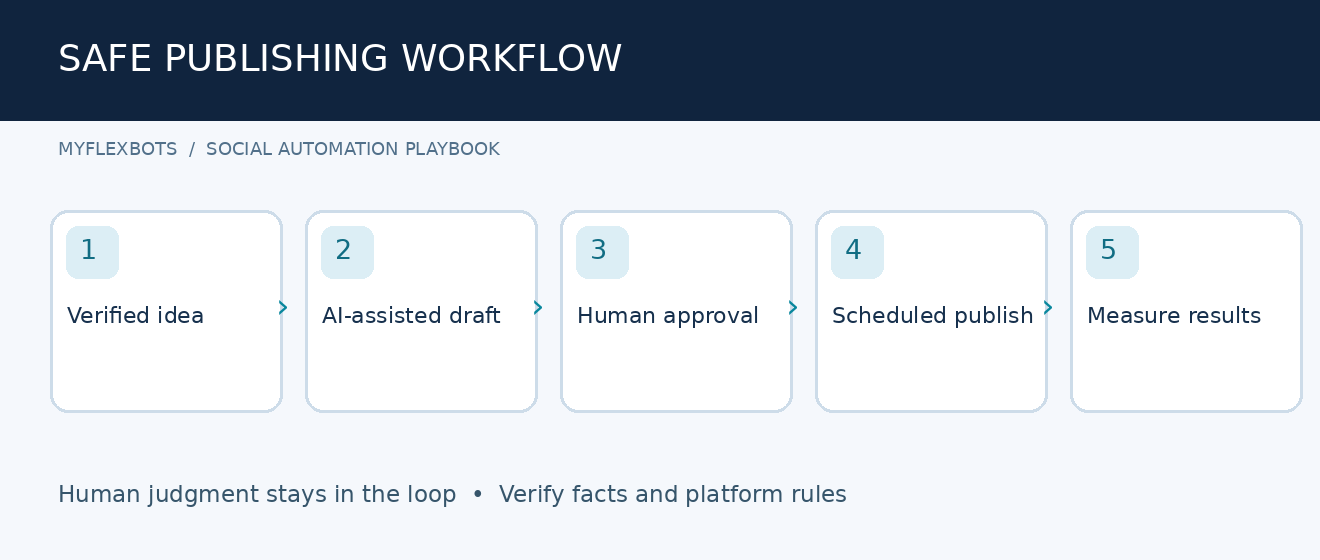
If you are comparing several profitable home business ideas, give one model a focused 30-day test instead of jumping to a new idea every three days. The goal is not to become “fully established” in a month; it is to prove the customer, offer, price, and channel enough to make an informed decision.
Week 1 — Research: choose customer, interview prospects, define one offer, identify legal constraints.
Week 2 — Sell: contact prospects, publish a simple offer page/profile, pitch a paid pilot, refine objections.
Week 3 — Deliver: complete early orders, track time/cost, improve checklist, collect proof.
Week 4 — Repeat: follow up, ask for referrals, raise clarity, remove waste, choose the best acquisition channel for month two.
Common Mistakes to Avoid
Even promising profitable home business ideas can become expensive distractions when beginners skip validation, underestimate operating costs, or copy income claims that do not match their market.
Mistake 1: Buying an Opportunity Instead of Building an Offer
Be skeptical of programs that promise easy income, guaranteed earnings, or a turnkey “business in a box” that mainly requires paying the promoter. Evaluate the actual customer demand, economics, refund policies, required purchases, and evidence behind income claims.
For U.S. readers evaluating paid business opportunities, review the FTC Business Opportunity Rule and related FTC consumer guidance before sending money or personal information.
Mistake 2: Confusing Revenue With Profit
A $5,000 month can be mediocre if $3,500 disappeared into ads, materials, software, shipping, refunds, contractors, and rework. Track gross revenue, direct costs, operating expenses, owner time, and cash collected. Profitability improves when you know which customer type and offer produce the best contribution margin—not simply the biggest invoice.
Mistake 3: Starting With Too Many Offers
A long menu feels flexible to the seller and confusing to the buyer. Start with one flagship offer and one obvious add-on. When customers repeatedly ask for an adjacent service, add it deliberately and document the delivery process.
Mistake 4: Ignoring Home-Based Rules and Risk
Customer traffic, food production, childcare, inventory storage, signage, employees, noise, chemicals, and certain professional services can trigger extra requirements. Verify zoning, licenses, insurance, tax, and safety obligations with the authorities and professionals relevant to your location and activity.
Mistake 5: Depending on One Platform
A marketplace, social network, or search engine can be an excellent acquisition channel, but algorithms and policies can change. Build assets you control: customer email permissions, repeat-order reminders, referrals, a simple website, documented reviews, and a database of past buyers. That turns platform traffic into a business relationship.
💡 Quick Hack: Ask every satisfied customer for one of three assets: a referral, a review/testimonial, or permission to send future offers. Do not ask for all three in the same breath. Choose the asset that strengthens the weakest part of your current funnel.
Advanced Tips and Next-Level Hacks
Productize Before You Hire
Hiring someone into a chaotic process multiplies the chaos. First document the intake, inputs, quality standard, delivery steps, communication cadence, and exception handling. Then delegate a well-defined stage and measure quality before expanding the role.
Build Recurring Revenue Around a Recurring Problem
The best profitable home business ideas often become more durable when recurring revenue is built around a problem that genuinely repeats. Retainers and subscriptions work when the customer’s problem repeats: monthly bookkeeping, weekly content editing, tutoring, maintenance, replenishable products, recurring reporting, ongoing optimization, or scheduled organization sessions. Do not force a subscription onto a problem customers naturally solve once.
Track the Four Numbers That Actually Guide Decisions
Qualified leads per month: people with the need, authority, timing, and ability to buy.
Close rate: how many qualified leads become paying customers.
Gross profit per order/client: revenue minus direct fulfillment cost.
Repeat/referral rate: how much future revenue comes from trust you already earned.
These numbers reveal whether the bottleneck is visibility, sales, pricing, delivery economics, or retention. They are more useful than vanity metrics such as followers if those followers never become prospects. Tracking them monthly keeps profitable home business ideas grounded in cash flow, customer behavior, and repeatable economics rather than online hype.
Create a “No-Founder” Delivery Test
Once a process is stable, pretend you are unavailable for one week. Could a contractor, assistant, or future employee understand the next step from your checklist, templates, naming conventions, and quality examples? Anything that still lives only in your head is a scaling risk.
Pro-Tip: Batch work by energy type. Put sales calls together, editing together, bookkeeping together, packing together, and admin together. Context switching can quietly consume the limited hours that make a home business attractive in the first place.
Troubleshooting & Long-Term Maintenance Guide
Problem: People Like the Idea but Nobody Buys
This usually means the problem is not painful enough, the buyer is wrong, the offer is vague, the proof is weak, or the price feels disconnected from the outcome. Stop adding features. Interview non-buyers and ask what they do instead, what the current problem costs them, and what would have made the decision easier.
Problem: You Are Busy but Not Making Enough
Measure delivery time by task for two weeks. Then eliminate low-value custom work, set revision limits, standardize inputs, raise minimum order size, bundle common requests, or increase price. If a business cannot pay for the owner’s time after direct costs, volume alone can make the problem worse.
Problem: Leads Arrive in Bursts
Create a weekly prospecting floor even when you are busy. For example: five referral requests, ten targeted outreach messages, one proof-based post, and one follow-up block every week. Consistent pipeline activity prevents the feast-or-famine pattern caused by stopping sales whenever delivery gets hectic.
Problem: Customers Keep Asking for Changes
Fix the system before blaming the customer. Add better examples, a structured intake form, explicit exclusions, a revision count, acceptance checkpoints, and a definition of completion. Repeated revisions are often a scope-clarity problem that should be corrected upstream.
Problem: Cash Flow Is Confusing
Separate business and personal transactions, invoice promptly, define due dates, collect deposits when appropriate, set aside money for tax obligations, and review cash weekly. Do not treat your bank balance as profit; it may include money needed for future fulfillment, taxes, refunds, or upcoming bills.
U.S. taxpayers who use part of a home for business should review the IRS rules for business use of your home and consult a qualified tax professional when needed. Rules can differ by activity, entity, year, and jurisdiction, so tax treatment should never be assumed from a blog example.
Problem: The Business Is Taking Over the House
Set physical and time boundaries before growth makes them harder. Designate storage zones, cutoff times, customer-contact hours, packing days, and a maximum inventory level. If the business creates regular visitors, noise, odors, safety risk, or significant storage needs, confirm that the home is still the right operating base.
Monthly Maintenance Checklist
Review revenue, gross profit, operating expenses, cash collected, and unpaid invoices.
Identify the top lead source and the weakest conversion step.
Update one template or checklist based on a recent mistake or delay.
Remove or downgrade one tool that is not saving time or producing revenue.
Contact past customers with a genuinely useful follow-up, reorder reminder, or referral request.
Check whether pricing still covers labor, materials, fees, and increased complexity.
Back up customer records, financial files, contracts, and creative assets securely.
Recheck any permit, insurance, tax, platform, or supplier change that affects operations.
💡 Quick Hack: Keep a “friction log” next to your task list. Every time you repeat a confusing step, search for a file, answer the same question, or fix the same error, add one line. At month-end, automate, template, delegate, or eliminate the top three recurring friction points.
Frequently Asked Questions
What home business is most profitable for beginners?
For most beginners, a specialized service can reach profit fastest because startup costs are low and you can sell before building inventory. Writing, virtual assistance, bookkeeping, tutoring, design, editing, and local professional services are strong candidates when the founder already has a useful skill and a reachable customer group.
How much money do I need to start a home business?
Some service businesses can start with equipment and software you already own, while food, inventory, licensed, insured, or equipment-heavy businesses may require hundreds or thousands of dollars. Build a startup-cost list, separate must-haves from upgrades, and validate demand before making irreversible purchases.
Can I run a business from home legally?
Often yes, but requirements depend on your location and activity. Zoning, licensing, professional rules, food preparation, customer visits, employees, signage, storage, insurance, and taxes can all matter. Check official national, state/provincial, and local sources before operating a regulated or higher-risk business.
Which profitable home business ideas can become passive income?
No business is truly passive at the start. Digital products, affiliate content, licensing, print-on-demand, and courses can reduce delivery work per additional sale, but they still require research, creation, marketing, customer support, platform management, updates, and quality control. Focus on scalable systems rather than “effort-free” income promises.
How do I get my first customer without paying for ads?
Start with targeted outreach, referrals, local networking, professional communities, marketplace listings, partnerships, and useful proof-based content. A short list of well-matched prospects and a clear offer usually teaches you more than broad paid traffic before your sales message has been validated.
When should I quit my job for a home business?
Avoid making the decision from one unusually good month. Look for repeatable demand, stable margins, a realistic pipeline, emergency savings, predictable household obligations, and evidence that the business can survive slower periods. Consider professional financial and tax advice before changing employment if the decision materially affects your household.
Conclusion: Choose One Model and Prove It
The strongest profitable home business ideas are not necessarily the trendiest. They are the ones you can explain in one sentence, validate with a real buyer, deliver at a healthy margin, and improve through a repeatable process. Start narrow, spend late, document everything that works, and let customer behavior—not excitement—decide what deserves more investment.
If you were going to test one home business for the next 30 days, which model would you choose—and what specific customer problem would you solve first? Share your answer in the comments so other MyFlexBots readers can compare approaches and learn from the reasoning behind your choice.
editor's pick
latest video
news via inbox
Nulla turp dis cursus. Integer liberos euismod pretium faucibua